







Question: PART C: ELECTRON IN A WIRE (E > I) Consider an electron with total energy E moving to the right through a very long smooth
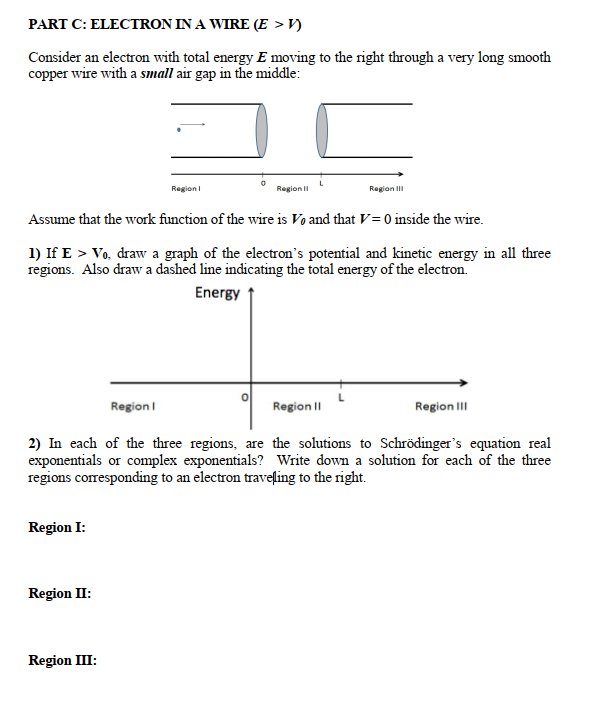
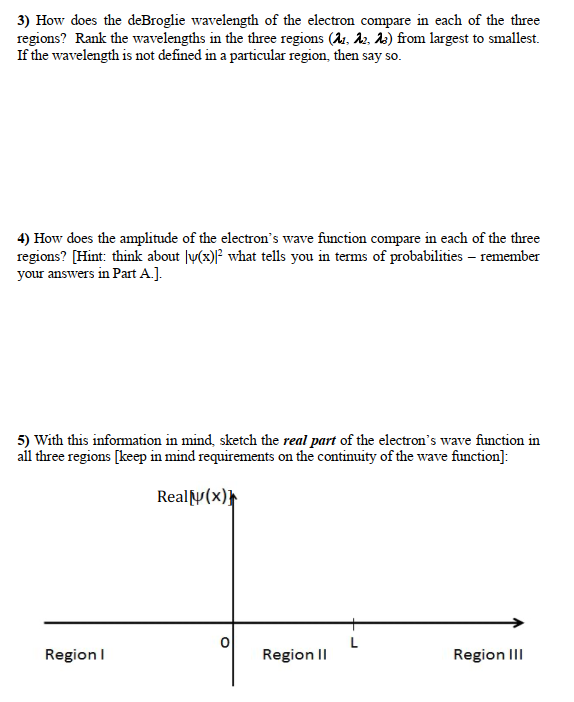
PART C: ELECTRON IN A WIRE (E > I) Consider an electron with total energy E moving to the right through a very long smooth copper wire with a small air gap in the middle: Ragion I Region II Ragion III Assume that the work function of the wire is Vo and that I'= 0 inside the wire. 1) If E > Vo, draw a graph of the electron's potential and kinetic energy in all three regions. Also draw a dashed line indicating the total energy of the electron. Energy o Region I Region II Region Ill 2) In each of the three regions, are the solutions to Schrodinger's equation real exponentials or complex exponentials? Write down a solution for each of the three regions corresponding to an electron traveling to the right. Region I: Region II: Region III:3) How does the deBroglie wavelength of the electron compare in each of the three regions? Rank the wavelengths in the three regions (11, 12, 1) from largest to smallest. If the wavelength is not defined in a particular region, then say so. 4) How does the amplitude of the electron's wave function compare in each of the three regions? [Hint: think about |y(x)| what tells you in terms of probabilities - remember your answers in Part A.]. 5) With this information in mind, sketch the real part of the electron's wave function in all three regions [keep in mind requirements on the continuity of the wave function]: Real (x) } L Region I Region II Region
Step by Step Solution
There are 3 Steps involved in it

Get step-by-step solutions from verified subject matter experts
 Study Help