







Question: Part C: Newton's Second Law (20 points total) The acceleration of an object is directly proportional to the force acting on it and inversely proportional
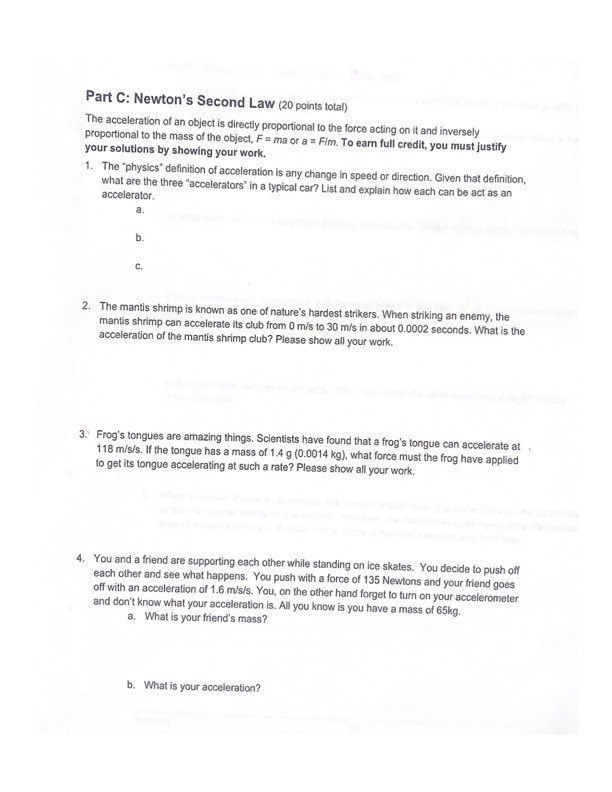
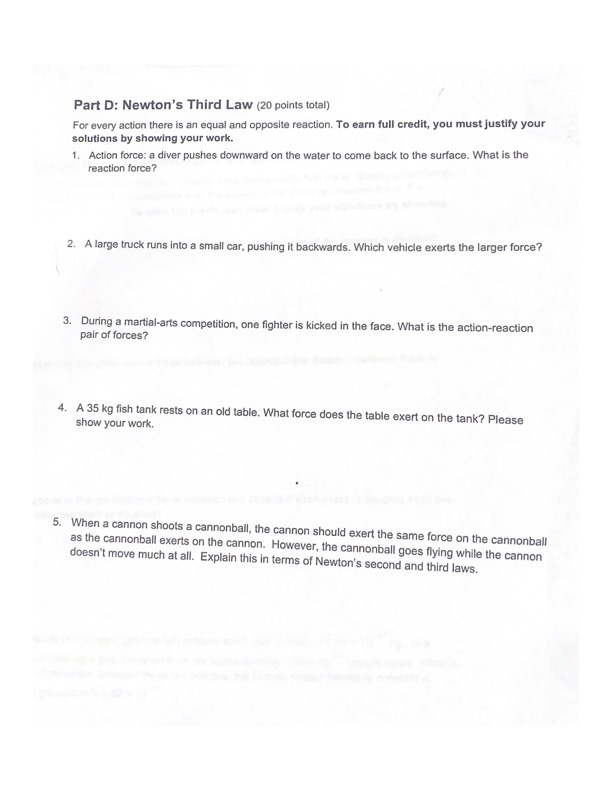
Part C: Newton's Second Law (20 points total) The acceleration of an object is directly proportional to the force acting on it and inversely proportional to the mass of the object, F = ma or a = Fim. To earn full credit, you must justify your solutions by showing your work. 1. The "physics" definition of acceleration is any change in speed or direction. Given that definition, what are the three "accelerators" in a typical car? List and explain how each can be act as an accelerator. a. b. 2. The mantis shrimp is known as one of nature's hardest strikers. When striking an enemy, the mantis shrimp can accelerate its club from 0 m/s to 30 m/'s in about 0.0002 seconds. What is the acceleration of the mantis shrimp club? Please show all your work. 3." Frog's tongues are amazing things. Scientists have found that a frog's tongue can accelerate at 118 m/s/s. If the tongue has a mass of 1.4 g (0.0014 kg), what force must the frog have applied to get its tongue accelerating at such a rate? Please show all your work. 4. You and a friend are supporting each other while standing on ice skates. You decide to push off each other and see what happens. You push with a force of 135 Newtons and your friend goes off with an acceleration of 1.6 m/s/s. You, on the other hand forget to turn on your accelerometer and don't know what your acceleration is. All you know is you have a mass of 65kg. a. What is your friend's mass? b. What is your acceleration?Part D: Newton's Third Law (20 points total) For every action there is an equal and opposite reaction. To earn full credit, you must justify your solutions by showing your work. 1. Action force: a diver pushes downward on the water to come back to the surface. What is the reaction force? 2. A large truck runs into a small car, pushing it backwards. Which vehicle exerts the larger force? 3. During a martial-arts competition, one fighter is kicked in the face. What is the action-reaction pair of forces? 4. A 35 kg fish tank rests on an old table. What force does the table exert on the tank? Please show your work. 5. When a cannon shoots a cannonball, the cannon should exert the same force on the cannonball as the cannonball exerts on the cannon. However, the cannonball goes flying while the cannon doesn't move much at all. Explain this in terms of Newton's second and third laws
Step by Step Solution
There are 3 Steps involved in it

Get step-by-step solutions from verified subject matter experts
 Study Help