







Question: Part D - Exponential and Logarithmic Inequalities (possible 20 points) Legend tells of a Roman general who was so successful in his campaigns that the
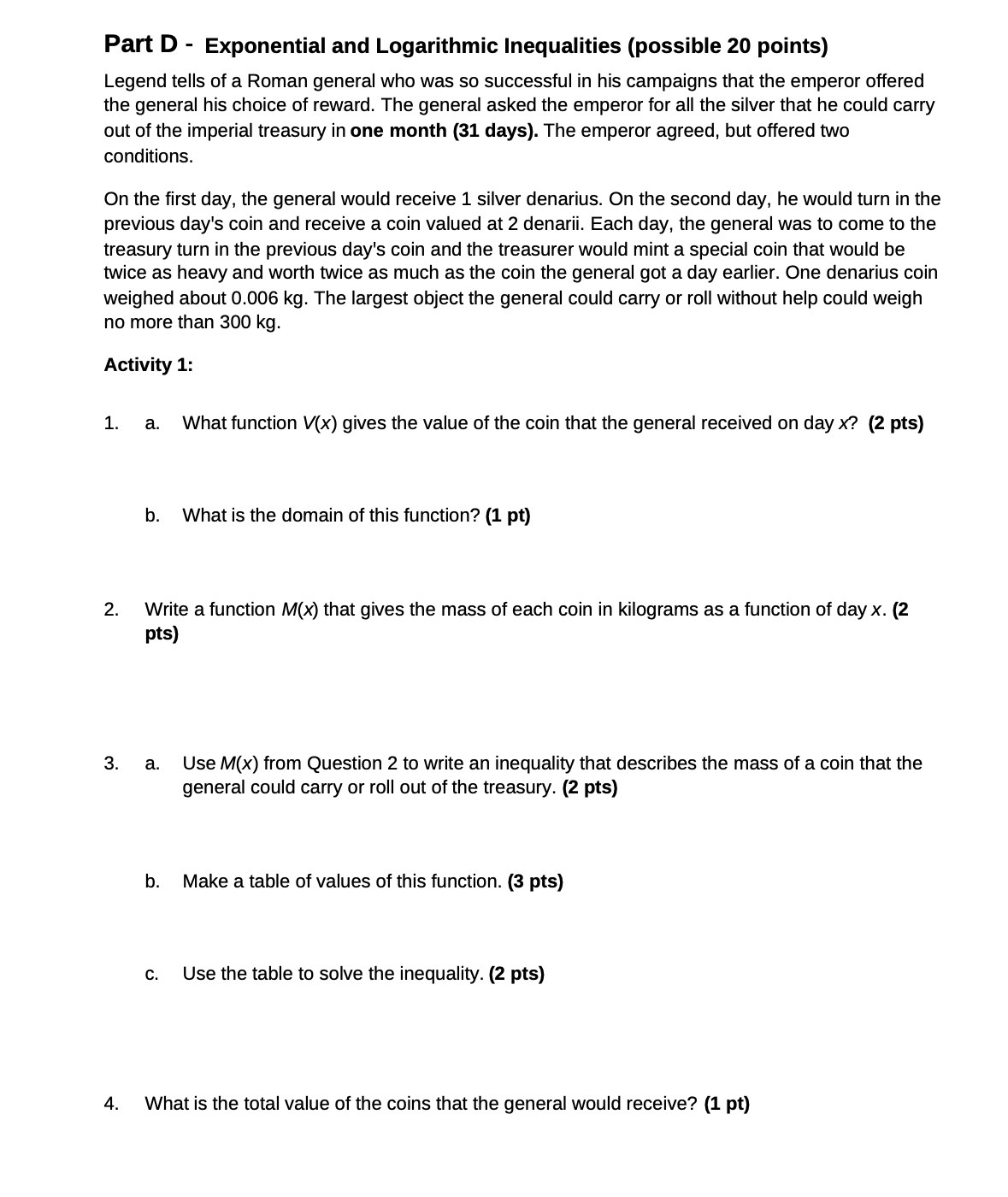
Part D - Exponential and Logarithmic Inequalities (possible 20 points) Legend tells of a Roman general who was so successful in his campaigns that the emperor offered the general his choice of reward. The general asked the emperor for all the silver that he could carry out of the imperial treasury in one month (31 days). The emperor agreed, but offered two conditions. On the first day, the general would receive 1 silver denarius. On the second day, he would turn in the previous day's coin and receive a coin valued at 2 denarii. Each day, the general was to come to the treasury turn in the previous day's coin and the treasurer would mint a special coin that would be twice as heavy and worth twice as much as the coin the general got a day earlier. One denarius coin weighed about 0.006 kg. The largest object the general could carry or roll without help could weigh no more than 300 kg. Activity 1: 1. a. Whatfunction V(x) gives the value of the coin that the general received on day x? (2 pts) b. What is the domain of this function? (1 pt) 2. Write a function M(x) that gives the mass of each coin in kilograms as a function of day x. (2 pts) 3. a. UseM(x)from Question 2 to write an inequality that describes the mass of a coin that the general could carry or roll out of the treasury. (2 pts) b. Make a table of values of this function. (3 pts) c. Use the table to solve the inequality. (2 pts) 4. What is the total value of the coins that the general would receive? (1 pt)
Step by Step Solution
There are 3 Steps involved in it

Get step-by-step solutions from verified subject matter experts
 Study Help