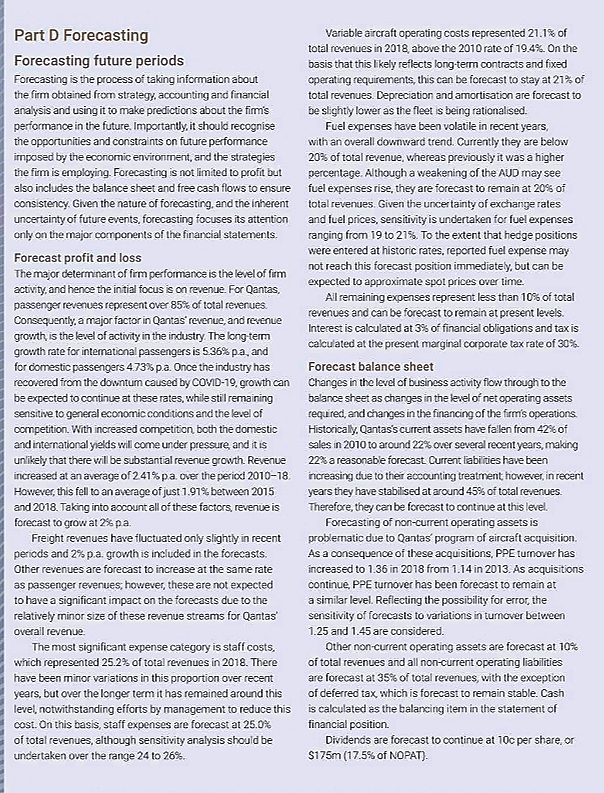
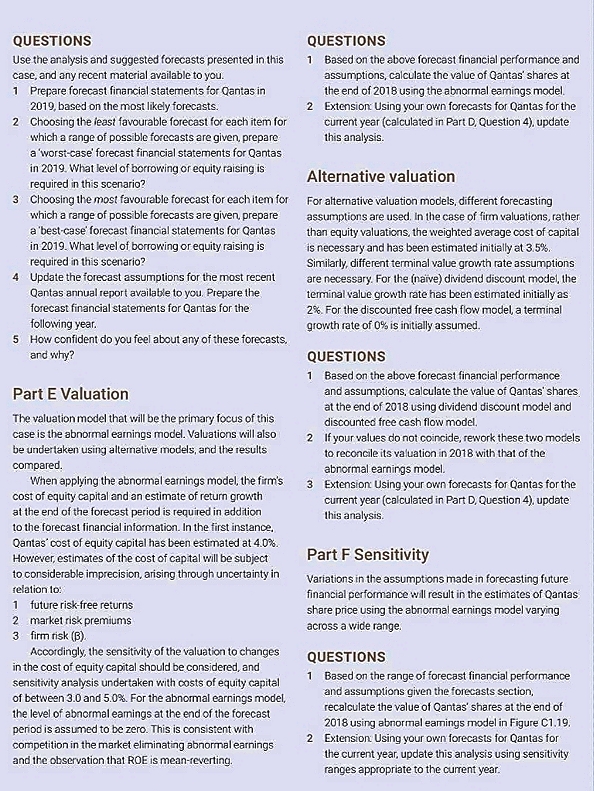
Question: Part D Forecasting Variable aircraft operating costs represented 21.1% of total revenues in 2018, above the 2010 rate of 19.4% On the Forecasting future periods
Part D Forecasting Variable aircraft operating costs represented 21.1% of total revenues in 2018, above the 2010 rate of 19.4% On the Forecasting future periods basis that this likely reflects long-term contracts and fixed Forecasting is the process of taking information about operating requirements, this can be forecast to stay at 21% of the firm obtained from strategy, accounting and financial total revenues. Depreciation and amortisation are forecast to analysis and using it to make predictions about the firm's be slightly lower as the fleet is being rationalised. performance in the future. Importantly, it should recognise Fuel expenses have been volatile in recent years, the opportunities and constraints on future performance with an overall downward trend. Currently they are below imposed by the economic environment, and the strategies 20% of total revenue, whereas previously it was a higher the firm is employing. Forecasting is not limited to profit but percentage. Although a weakening of the AUD may see also includes the balance sheet and free cash flows to ensure fuel expenses rise, they are forecast to remain at 20% of consistency. Given the nature of forecasting, and the inherent total revenues. Given the uncertainty of exchange rates uncertainty of future events, forecasting focuses its attention and fuel prices, sensitivity is undertaken for fuel expenses only on the major components of the financial statements. ranging from 19 to 21%. To the extent that hedge positions Forecast profit and loss were entered at historic rates. reported fuel expense may The major determinant of firm performance is the level of firm not reach this forecast position immediately, but can be activity, and hence the initial focus is on revenue. For Qantas, expected to approximate spot prices over time. passenger revenues represent over 85% of total revenues. All remaining expenses represent less than 10% of total Consequently. a major factor in Qantas' revenue, and revenue revenues and can be forecast to remain at present levels. growth is the level of activity in the industry. The long-term Interest is calculated at 3% of financial obligations and tax is growth rate for international passengers is 5.36% p.a, and calculated at the present marginal corporate tax rate of 30%. for domestic passengers 4.739 p.a. Once the industry has Forecast balance sheet recovered from the downtum caused by COVID-19, growth can Changes in the level of business activity flow through to the be expected to continue at these rates, while still remaining balance sheet as changes in the level of net operating assets sensitive to general economic conditions and the level of required, and changes in the financing of the firm's operations. competition. With increased competition, both the domestic Historically, Qantas's current assets have fallen from 42% of and international yields will come under pressure, and it is sales in 2010 to around 22% over several recent years, making unlikely that there will be substantial revenue growth. Revenue 22% a reasonable forecast Current liabilities have been increased at an average of 2.41% pa. over the period 2010-18, increasing due to their accounting treatment, however, in recent However, this fell to an average of just 1.97% between 2015 years they have stabilised at around 45% of total revenues. and 2018. Taking into account all of these factors, revenue is Therefore, they can be forecast to continue at this level. forecast to grow at 2% pa. Forecasting of non-current operating assets is Freight revenues have fluctuated only slightly in recent problematic due to Qantas program of aircraft acquisition. periods and 2% p.a. growth is included in the forecasts. As a consequence of these acquisitions, PPE turnover has Other revenues are forecast to increase at the same rate increased to 1.36 in 2018 from 1.14 in 2013. As acquisitions as passenger revenues, however, these are not expected continue, PPE turnover has been forecast to remain at to have a significant impact on the forecasts due to the a similar level. Reflecting the possibility for error, the relatively minor size of these revenue streams for Qantas" sensitivity of forecasts to variations in turnover between overall revenue. 1.25 and 1.45 are considered. The most significant expense category is staff costs, Other non-current operating assets are forecast at 10% which represented 25.2 of total revenues in 2018. There of total revenues and all non-current operating liabilities have been minor variations in this proportion over recent are forecast at 35% of total revenues, with the exception years, but over the longer term it has remained around this of deferred tax, which is forecast to remain stable. Cash level, notwithstanding efforts by management to reduce this is calculated as the balancing item in the statement of cost. On this basis, staff expenses are forecast at 25.0% financial position. of total revenues, although sensitivity analysis should be Dividends are forecast to continue at 10c per share, or undertaken over the range 24 to 26%. $175m (17.5% of NOPAT].QUESTIONS QUESTIONS Use the analysis and suggested forecasts presented in this 1 Based on the above forecast financial performance and case, and any recent material available to you. assumptions, calculate the value of Qantas' shares at 1 Prepare forecast financial statements for Qantas in the end of 2018 using the abnormal earnings model. 2019, based on the most likely forecasts. 2 Extension Using your own forecasts for Qantas for the 2 Choosing the least favourable forecast for each item for current year (calculated in Part D, Question 4), update which a range of possible forecasts are given, prepare this analysis. a worst-case forecast financial statements for Qantas in 2019. What level of borrowing or equity raising is required in this scenario? Alternative valuation 3 Choosing the most favourable forecast for each item for For alternative valuation models, different forecasting which a range of possible forecasts are given, prepare assumptions are used. In the case of firm valuations, rather a best-case forecast financial statements for Qantas than equity valuations, the weighted average cost of capital in 2019. What level of borrowing or equity raising is is necessary and has been estimated initially at 3.5%. required in this scenario? Similarly, different terminal value growth rate assumptions 4 Update the forecast assumptions for the most recent are necessary. For the (naive) dividend discount model, the Qantas annual report available to you. Prepare the terminal value growth rate has been estimated initially as forecast financial statements for Qantas for the 2%. For the discounted free cash flow model, a terminal following year. growth rate of 0% is initially assumed. 5 How confident do you feel about any of these forecasts. and why? QUESTIONS 1 Based on the above forecast financial performance Part E Valuation and assumptions, calculate the value of Qantas shares. at the end of 2018 using dividend discount model and The valuation model that will be the primary focus of this discounted free cash flow model. case is the abnormal earnings model. Valuations will also 2 If your values do not coincide, rework these two models be undertaken using alternative models, and the results to reconcile its valuation in 2018 with that of the compared. abnormal earnings model. When applying the abnormal earnings model, the firm's 3 Extension Using your own forecasts for Qantas for the cost of equity capital and an estimate of return growth current year (calculated in Part D, Question 4), update at the end of the forecast period is required in addition this analysis. to the forecast financial information. In the first instance. Qantas cost of equity capital has been estimated at 4.0%. However, estimates of the cost of capital will be subject Part F Sensitivity to considerable imprecision, arising through uncertainty in Variations in the assumptions made in forecasting future relation to: financial performance will result in the estimates of Qantas future risk-free returns share price using the abnormal earnings model varying 2 market risk premiums across a wide range. 3 firm risk (B) Accordingly, the sensitivity of the valuation to changes QUESTIONS in the cost of equity capital should be considered, and sensitivity analysis undertaken with costs of equity capital 1 Based on the range of forecast financial performance of between 3.0 and 5.0%. For the abnormal earnings model, and assumptions given the forecasts section, the level of abnormal earnings at the end of the forecast recalculate the value of Qantas' shares at the end of period is assumed to be zero. This is consistent with 2018 using abnormal earnings model in Figure C1.19, competition in the market eliminating abnormal earnings 2 Extension Using your own forecasts for Qantas for and the observation that ROE is mean-reverting. the current year, update this analysis using sensitivity ranges appropriate to the current year
Step by Step Solution
There are 3 Steps involved in it
1 Expert Approved Answer
Step: 1 Unlock
Question Has Been Solved by an Expert!
Get step-by-step solutions from verified subject matter experts
Step: 2 Unlock
Step: 3 Unlock
Students Have Also Explored These Related Accounting Questions!