







Question: Part (d) Pick o = 0.001, s = 1, 8 = 0.2, and some To such that |ro| 2 1. Use Armijo rule and see
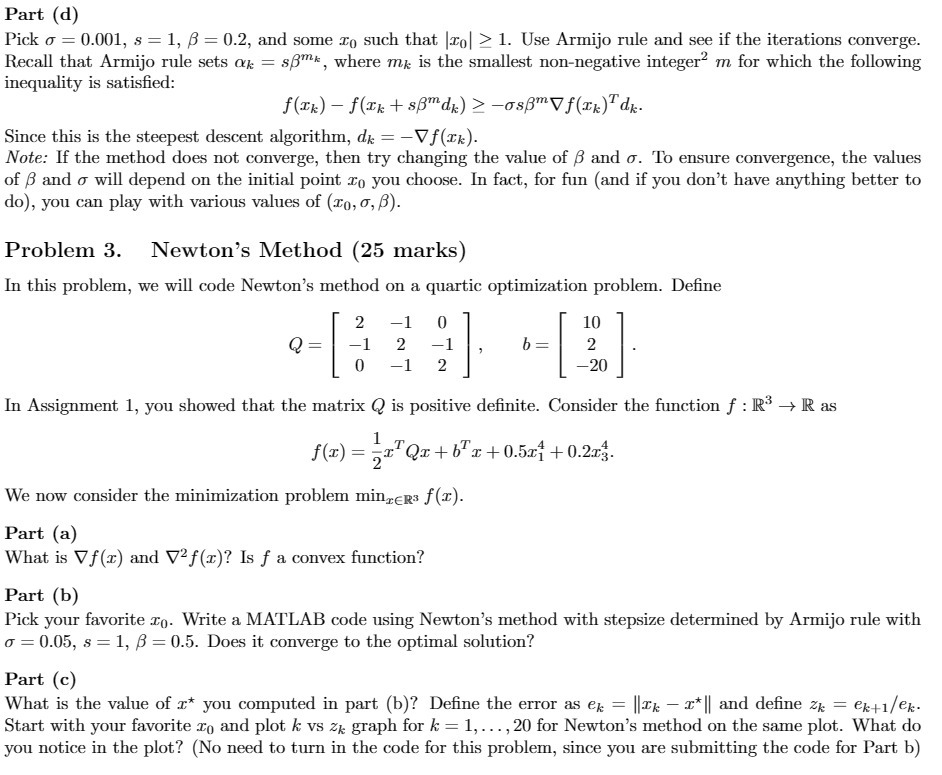
Part (d) Pick o = 0.001, s = 1, 8 = 0.2, and some To such that |ro| 2 1. Use Armijo rule and see if the iterations converge. Recall that Armijo rule sets ox = s", where me is the smallest non-negative integer m for which the following inequality is satisfied: f(Ik) - f(Ik + spmdk) > -asBMVf(Ik) ] dk- Since this is the steepest descent algorithm, di = -Vf(IE). Note: If the method does not converge, then try changing the value of B and o. To ensure convergence, the values of B and o will depend on the initial point To you choose. In fact, for fun (and if you don't have anything better to do), you can play with various values of (To, 5, B). Problem 3. Newton's Method (25 marks) In this problem, we will code Newton's method on a quartic optimization problem. Define N 10 Q = N 2 0 2 20 In Assignment 1, you showed that the matrix Q is positive definite. Consider the function f : R3 -> R as f(x) = ,xQr+bx+0.5x4 +0.213. We now consider the minimization problem minTERs f(I). Part (a) What is Vf(x) and V2 f(x)? Is f a convex function? Part (b) Pick your favorite ro. Write a MATLAB code using Newton's method with stepsize determined by Armijo rule with o =0.05, s =1, 8 =0.5. Does it converge to the optimal solution? Part (c) What is the value of * you computed in part (b)? Define the error as ex = ITx - * || and define zz = ex+1/ek. Start with your favorite To and plot k vs zx graph for k = 1, ..., 20 for Newton's method on the same plot. What do you notice in the plot? (No need to turn in the code for this problem, since you are submitting the code for Part b)
Step by Step Solution
There are 3 Steps involved in it

Get step-by-step solutions from verified subject matter experts
 Study Help