Question: Part D-Case Study (25pts) Please read the case study in its entirety and respond to instructions that follow in this section. Managing with Generation Y
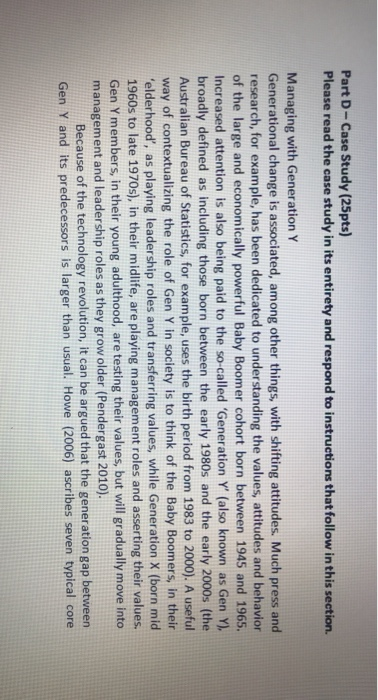
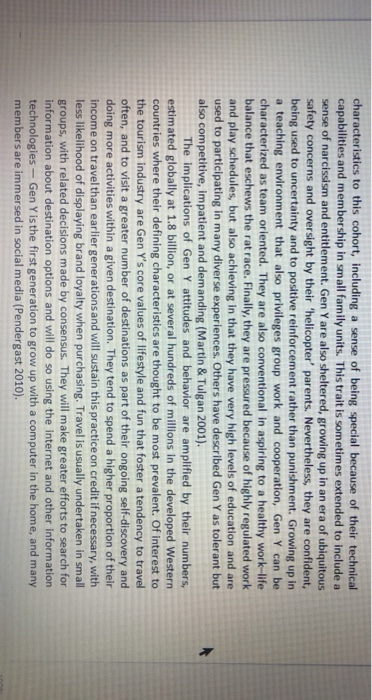
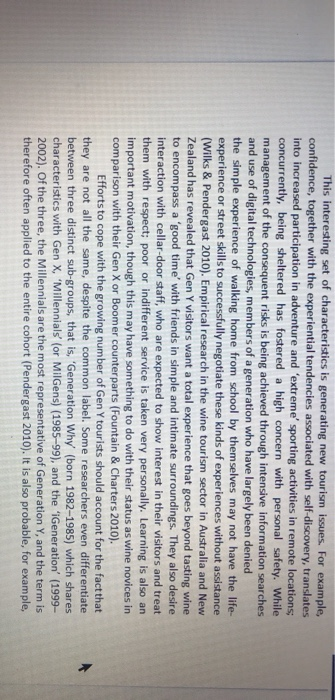
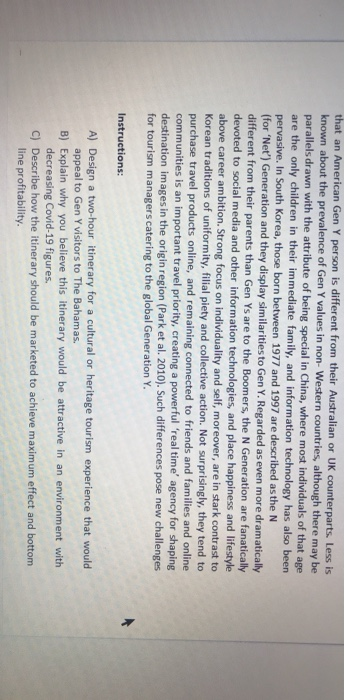
Part D-Case Study (25pts) Please read the case study in its entirety and respond to instructions that follow in this section. Managing with Generation Y Generational change is associated, among other things, with shifting attitudes. Much press and research, for example, has been dedicated to understanding the values, attitudes and behavior of the large and economically powerful Baby Boomer cohort born between 1945 and 1965. Increased attention is also being paid to the so-called 'Generation Y' (also known as Gen Y), broadly defined as including those born between the early 1980s and the early 2000s (the Australian Bureau of Statistics, for example, uses the birth period from 1983 to 2000). A useful way of contextualizing the role of Gen Y in society is to think of the Baby Boomers, in their 'elderhood', as playing leadership roles and transferring values, while Generation X (born mid 1960s to late 1970s), in their midlife, are playing management roles and asserting their values. Gen Y members, in their young adulthood, are testing their values, but will gradually move into management and leadership roles as they grow older (Pendergast 2010). Because of the technology revolution, it can be argued that the generation gap between Gen Y and its predecessors is larger than usual. Howe (2006) ascribes seven typical core characteristics to this cohort, including a sense of being special because of their technical capabilities and membership in small family units. This trait is sometimes extended to include a sense of narcissism and entitlement. Gen Y are also sheltered, growing up in an era of ubiquitous safety concerns and oversight by their 'helicopter' parents. Nevertheless, they are confident, being used to uncertainty and to positive reinforcement rather than punishment. Growing up in a teaching environment that also privileges group work and cooperation, Gen Y can be characterized as team oriented. They are also conventional in aspiring to a healthy work-life balance that eschews the rat race. Finally, they are pressured because of highly regulated work and play schedules, but also achieving in that they have very high levels of education and are used to participating in many diverse experiences. Others have described Gen Y as tolerant but also competitive, impatient and demanding (Martin & Tulgan 2001). The implications of Gen Y attitudes and behavior are amplified by their numbers, estimated globally at 1.8 billion, or at several hundreds of millions in the developed Western countries where their defining characteristics are thought to be most prevalent of interest to the tourism industry are Gen Y's core values of lifestyle and fun that foster a tendency to travel often, and to visit a greater number of destinations as part of their ongoing self-discovery and doing more activities within a given destination. They tend to spend a higher proportion of their income on travel than earlier generations and will sustain this practice on credit if necessary, with less likelihood of displaying brand loyalty when purchasing. Travel is usually undertaken in small groups, with related decisions made by consensus. They will make greater efforts to search for information about destination options and will do so using the internet and other information technologies - Gen Yis the first generation to grow up with a computer in the home, and many members are immersed in social media (Pendergast 2010). This interesting set of characteristics is generating new tourism issues. For example, confidence, together with the experiential tendencies associated with self-discovery, translates into increased participation in adventure and 'extreme' sporting activities in remote locations concurrently, being sheltered has fostered a high concern with personal safety. While management of the consequent risks is being achieved through intensive information searches and use of digital technologies, members of a generation who have largely been denied the simple experience of walking home from school by themselves may not have the life- experience or street skills to successfully negotiate these kinds of experiences without assistance (Wilks & Pendergast 2010). Empirical research in the wine tourism sector in Australia and New Zealand has revealed that Gen Y visitors want a total experience that goes beyond tasting wine to encompass a 'good time with friends in simple and intimate surroundings. They also desire interaction with cellar-door staff, who are expected to show interest in their visitors and treat them with respect; poor or indifferent service is taken very personally. Learning is also an important motivation, though this may have something to do with their status as wine novices in comparison with their Gen X or Boomer counterparts (Fountain & Charters 2010). Efforts to cope with the growing number of Gen Y tourists should account for the fact that they are not all the same, despite the common label. Some researchers even differentiate between three distinct sub-groups, that is, 'Generation Why (born 1982-1985) which shares characteristics with Gen X, 'Millennials' (or MilGens) (1985-99), and the 'Generation' (1999- 2002). Of the three, the Millennials are the most representative of Generation Y, and the term is therefore often applied to the entire cohort (Pendergast 2010). It is also probable, for example, that an American Gen y person is different from their Australian or UK counterparts. Less is known about the prevalence of Gen Y values in non- Western countries, although there may be parallels drawn with the attribute of being special in China, where most individuals of that age are the only children in their immediate family, and information technology has also been pervasive. In South Korea, those born between 1977 and 1997 are described as the N (for 'Net') Generation and they display similarities to Gen Y. Regarded as even more dramatically different from their parents than Gen Ys are to the Boomers, the N Generation are fanatically devoted to social media and other information technologies, and place happiness and lifestyle above career ambition. Strong focus on individuality and self, moreover, are in stark contrast to Korean traditions of uniformity, filial piety and collective action. Not surprisingly, they tend to purchase travel products online, and remaining connected to friends and families and online communities is an important travel priority, creating a powerful 'real time' agency for shaping destination images in the origin region (Park et al. 2010). Such differences pose new challenges for tourism managers catering to the global Generation Y. Instructions: A) Design a two-hour itinerary for a cultural or heritage tourism experience that would appeal to Gen y visitors to The Bahamas. B) Explain why you believe this itinerary would be attractive in an environment with decreasing Covid-19 figures. C) Describe how the itinerary should be marketed to achieve maximum effect and bottom line profitability









 Study Help