







Question: Part E (2 points) Earlier we said that we can evaluate whether the network has learned the grammar by looking at the predictions it makes.
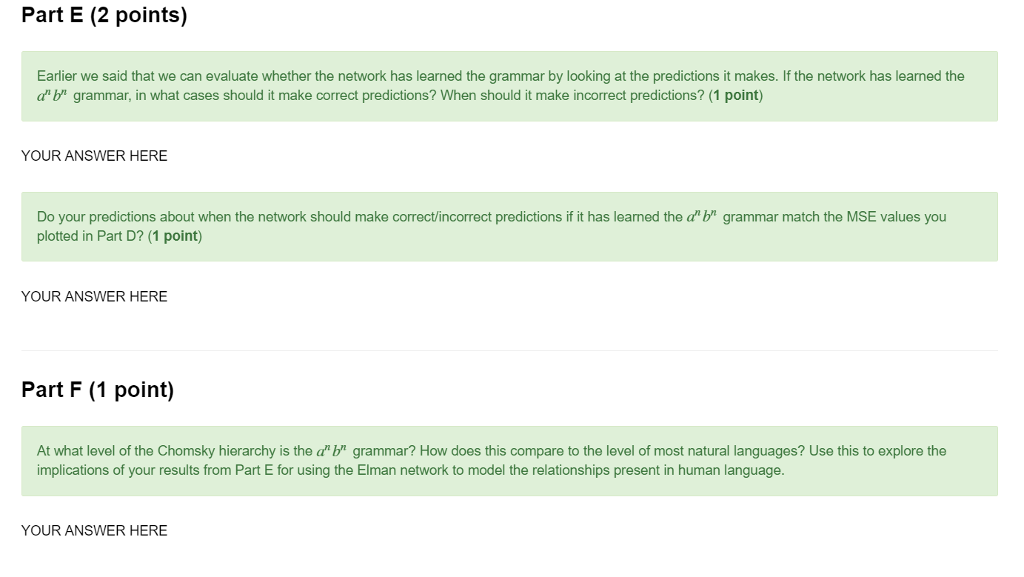
Part E (2 points) Earlier we said that we can evaluate whether the network has learned the grammar by looking at the predictions it makes. If the network has learned the "b grammar, in what cases should it make correct predictions? When should it make incorrect predictions? (1 point) YOUR ANSWER HERE Do your predictions about when the network should make correct/incorrect predictions if it has learned the ab grammar match the MSE values you plotted in Part D? (1 point) YOUR ANSWER HERE Part F (1 point) At what level of the Chomsky hierarchy is the a b" grammar? How does this compare to the level of most natural languages? Use this to explore the implications of your results from Part E for using the Elman network to model the relationships present in human language. YOUR ANSWER HERE Part E (2 points) Earlier we said that we can evaluate whether the network has learned the grammar by looking at the predictions it makes. If the network has learned the "b grammar, in what cases should it make correct predictions? When should it make incorrect predictions? (1 point) YOUR ANSWER HERE Do your predictions about when the network should make correct/incorrect predictions if it has learned the ab grammar match the MSE values you plotted in Part D? (1 point) YOUR ANSWER HERE Part F (1 point) At what level of the Chomsky hierarchy is the a b" grammar? How does this compare to the level of most natural languages? Use this to explore the implications of your results from Part E for using the Elman network to model the relationships present in human language. YOUR ANSWER HERE
Step by Step Solution
There are 3 Steps involved in it

Get step-by-step solutions from verified subject matter experts
 Study Help