







Question: Part E Use the function you build in part C to find out how many fewer daylight hours February 10 will have than March 21.
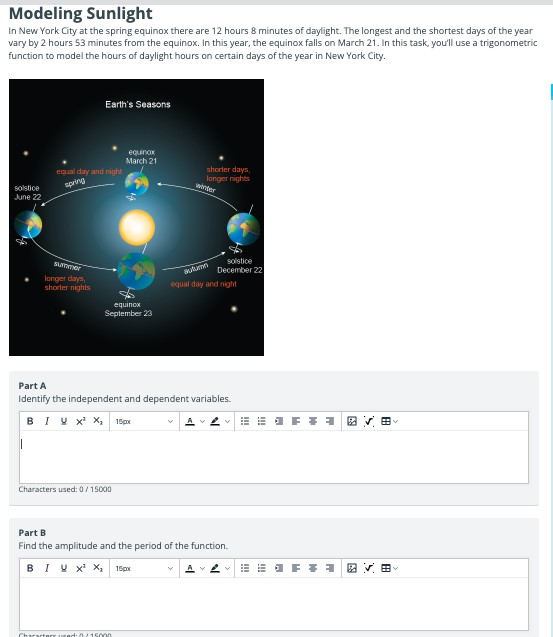
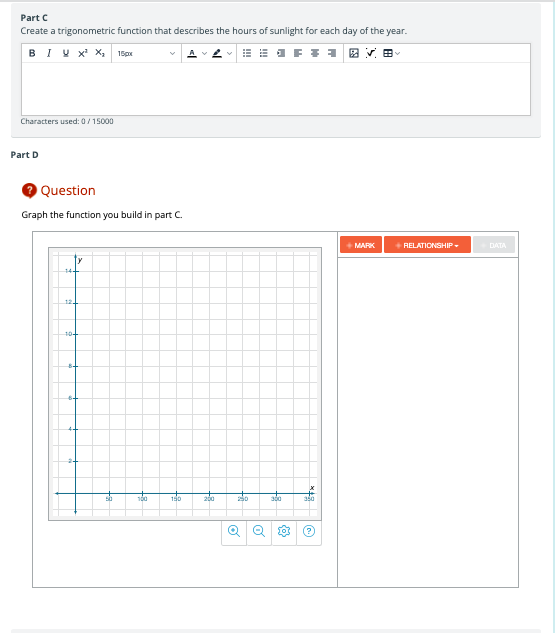
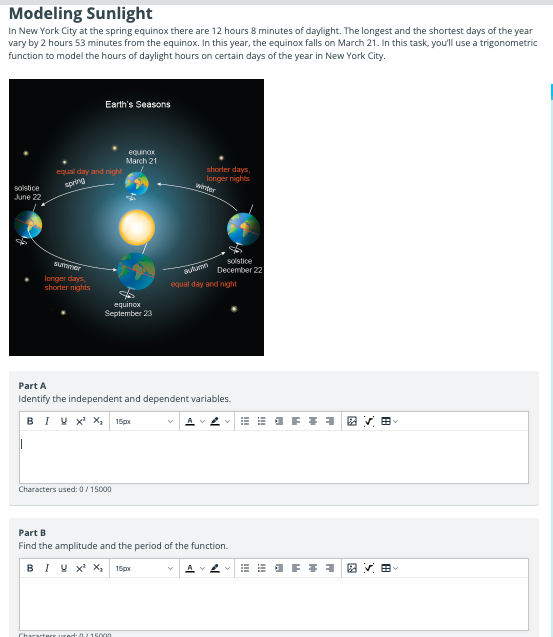
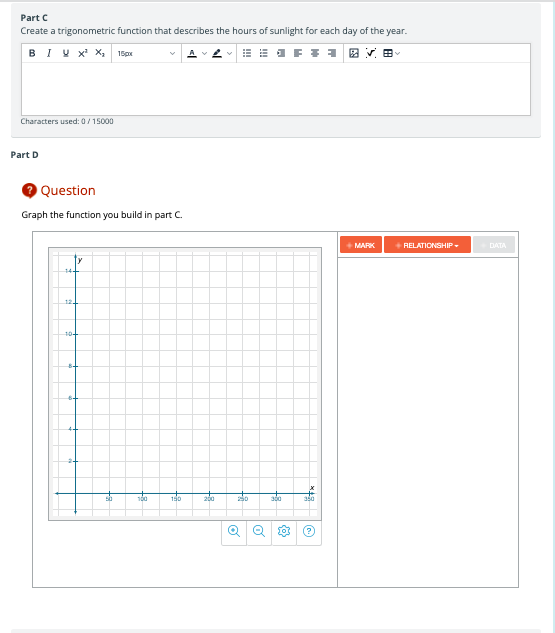
Part E Use the function you build in part C to find out how many fewer daylight hours February 10 will have than March 21. You may look at a calendar. BIUxX, 15px A Characters used: 0/15000MARK RELATIONSHIP F DATA LINEAR EXPONENTIAL QUADRATIC LOGARITHMIC CUSTOMModeling Sunlight In New York City at the spring equinox there are 12 hours 8 minutes of daylight. The longest and the shortest days of the year vary by 2 hours 53 minutes from the equinox. In this year, the equinox falls on March 21. In this task, you'll use a trigonometric function to model the hours of daylight hours on certain days of the year in New York City. Earth's Seasons equinox March 21 equal day and night shorter days, longer nights Solstice Winter June 22 solstice Summer December 22 longer days shorter nights equal day and night equinox September 23 Part A Identify the independent and dependent variables. BIUXX, 15px Characters used: 0/15000 Part B Find the amplitude and the period of the function. BIUXX, 15pxPart C Create a trigonometric function that describes the hours of sunlight for each day of the year. BIUxX, 15px Characters used: 0 /15000 Part D Question Graph the function you build in part C. MARK #RELATIONSHIP - DATA 12 of 290
Step by Step Solution
There are 3 Steps involved in it

Get step-by-step solutions from verified subject matter experts
 Study Help