







Question: Part F - Example: Finding Two Forces ( Part I ) Two dimensional dynamics often involves solving for two unknown quantities in two separate equations
Part F Example: Finding Two Forces Part I
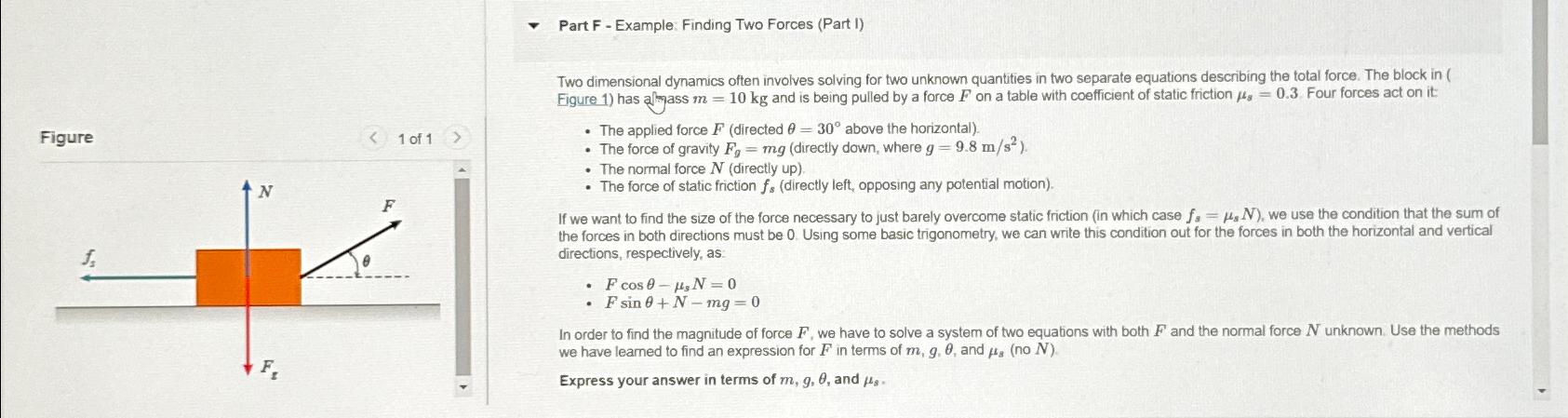
Two dimensional dynamics often involves solving for two unknown quantities in two separate equations describing the total force. The block in Figure has abrass and is being pulled by a force on a table with coefficient of static friction Four forces act on it:
The applied force directed above the horizontal
The force of gravity directly down, where
The normal force directly up
The force of static friction directly left, opposing any potential motion
If we want to find the size of the force necessary to just barely overcome static friction in which case we use the condition that the sum of the forces in both directions must be Using some basic trigonometry, we can write this condition out for the forces in both the horizontal and vertical directions, respectively, as
Fcos
Fsin
In order to find the magnitude of force we have to solve a system of two equabions with both and the normal force unknown. Use the methods we have learned to find an expression for in terms of and no
Express your answer in terms of and
Step by Step Solution
There are 3 Steps involved in it
1 Expert Approved Answer
Step: 1 Unlock

Question Has Been Solved by an Expert!
Get step-by-step solutions from verified subject matter experts
Step: 2 Unlock
Step: 3 Unlock
 Study Help