



Question: Part I 1. a) w = 20m so f = 201 = 10 Cycles minute . The cork bobs up and down once every 6
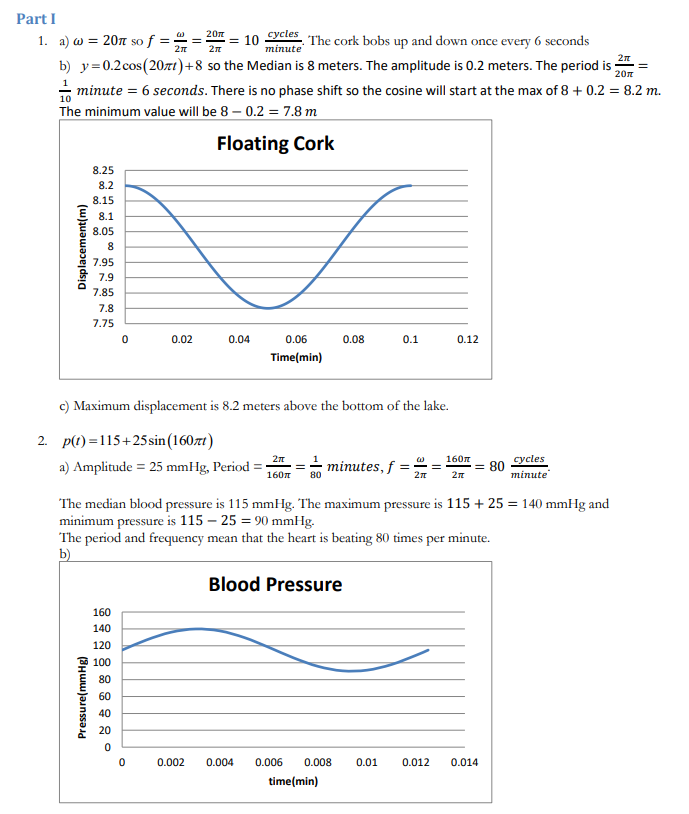
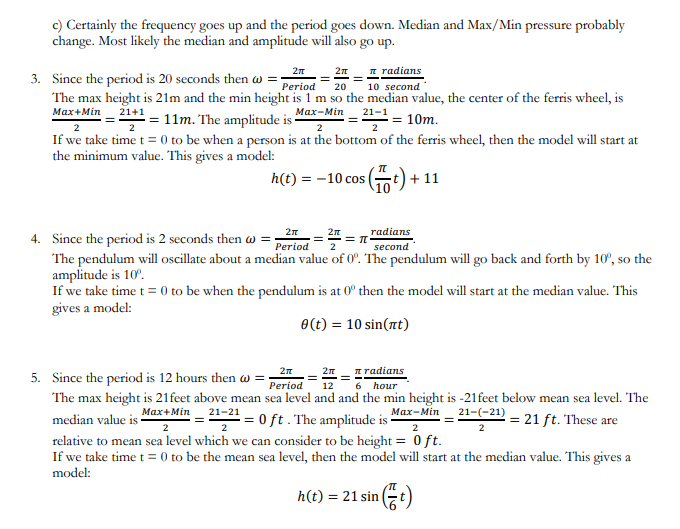
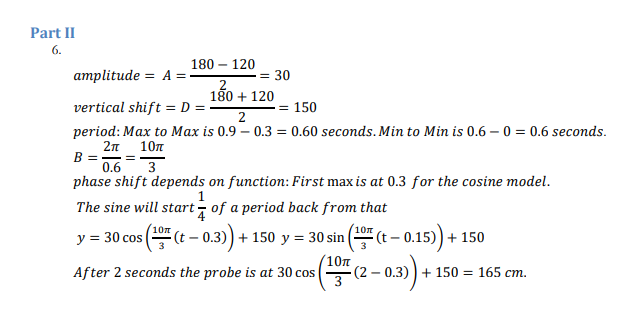
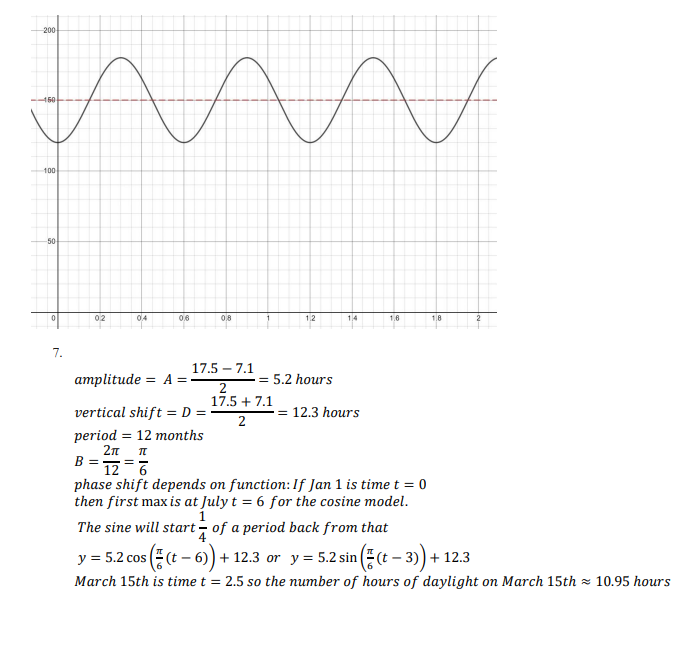
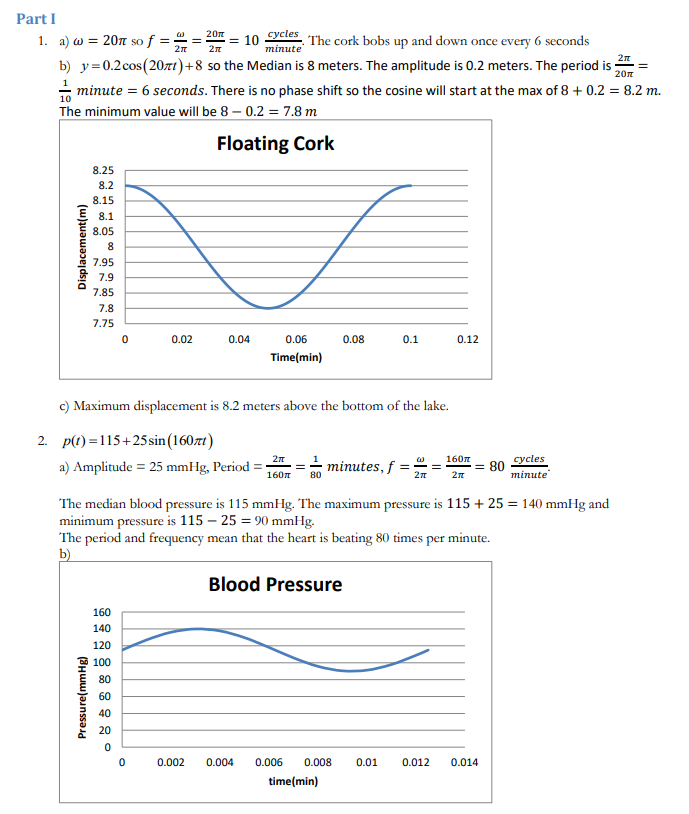
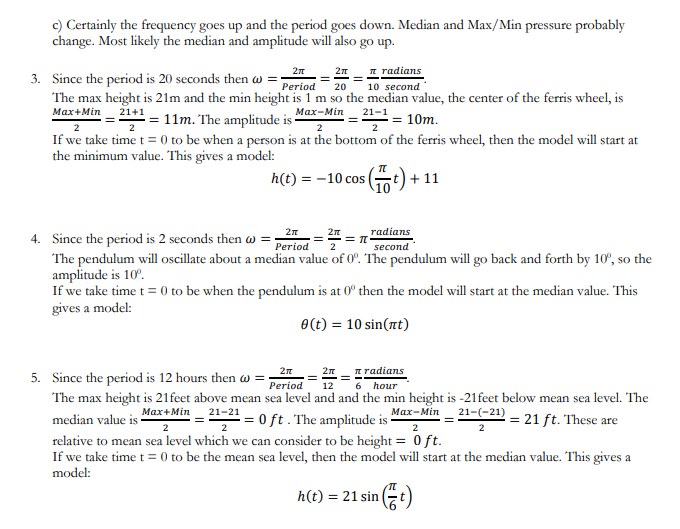
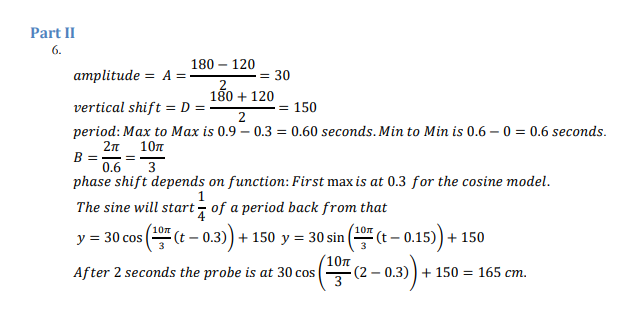
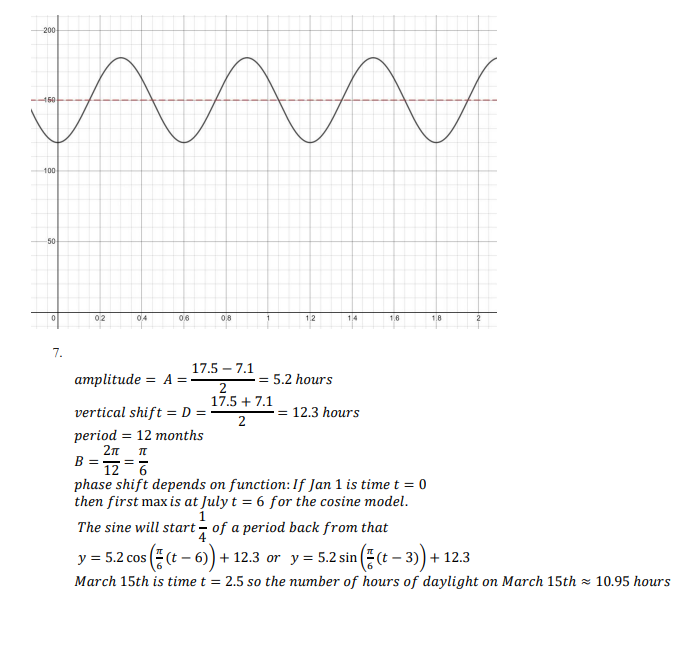
Part I 1. a) w = 20m so f = 201 = 10 Cycles minute . The cork bobs up and down once every 6 seconds b) y=0.2cos(20m1 )+8 so the Median is 8 meters. The amplitude is 0.2 meters. The period is minute = 6 seconds. There is no phase shift so the cosine will start at the max of 8 + 0.2 = 8.2 m. The minimum value will be 8 - 0.2 = 7.8 m Floating Cork 8.25 8.2 8.15 8.1 8.05 Displacement(m) 8 7.95 7.9 7.85 7.8 7.75 0 0.02 0.04 0.06 0.08 0.1 0.12 Time(min) c) Maximum displacement is 8.2 meters above the bottom of the lake. 2. p(() =115+25sin (160mt) a) Amplitude = 25 mmHg, Period = -2 160m _ = 80 - cycles 160m minutes, f = minute The median blood pressure is 115 mmHg. The maximum pressure is 115 + 25 = 140 mmHg and minimum pressure is 115 - 25 = 90 mmHg- The period and frequency mean that the heart is beating 80 times per minute. b) Blood Pressure 160 140 120 100 Pressure(mmHg) 0.002 0.004 0.006 0.008 0.01 0.012 0.014 time (min)\fPart II 6. 180 - 120 amplitude = A = - = 30 2 180 + 120 vertical shift = D = - = 150 2 period: Max to Max is 0.9 - 0.3 = 0.60 seconds. Min to Min is 0.6 - 0 = 0.6 seconds. B = 0.6 3 phase shift depends on function: First max is at 0.3 for the cosine model. 1 The sine will start - of a period back from that y = 30 cos 3" (t - 0.3) + 150 y = 30 sin 3 (t - 0.15) + 150 10n After 2 seconds the probe is at 30 cos 3 (2 - 0.3) + 150 = 165 cm.
Step by Step Solution
There are 3 Steps involved in it

Get step-by-step solutions from verified subject matter experts