







Question: Part I. (16pt) True or false. For each question, write a couple of sentence or derivation for explanation. 1. (4pt) For fixed sample size, a
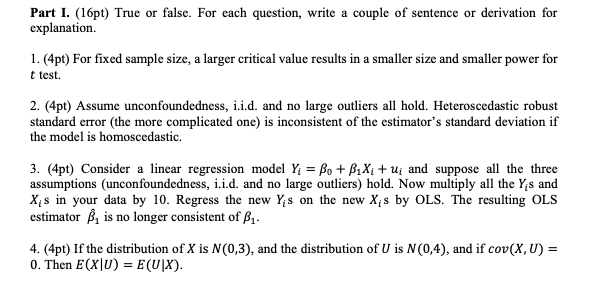
Part I. (16pt) True or false. For each question, write a couple of sentence or derivation for explanation. 1. (4pt) For fixed sample size, a larger critical value results in a smaller size and smaller power for t test. 2. (4pt) Assume unconfoundedness, i.i.d. and no large outliers all hold. Heteroscedastic robust standard error (the more complicated one) is inconsistent of the estimator's standard deviation if the model is homoscedastic. 3. (4pt) Consider a linear regression model Yi=0+1Xi+ui and suppose all the three assumptions (unconfoundedness, i.i.d. and no large outliers) hold. Now multiply all the Yi s and Xis in your data by 10 . Regress the new Yi s on the new Xi s by OLS. The resulting OLS estimator ^1 is no longer consistent of 1. 4. (4pt) If the distribution of X is N(0,3), and the distribution of U is N(0,4), and if cov(X,U)= 0 . Then E(XU)=E(UX). Part I. (16pt) True or false. For each question, write a couple of sentence or derivation for explanation. 1. (4pt) For fixed sample size, a larger critical value results in a smaller size and smaller power for t test. 2. (4pt) Assume unconfoundedness, i.i.d. and no large outliers all hold. Heteroscedastic robust standard error (the more complicated one) is inconsistent of the estimator's standard deviation if the model is homoscedastic. 3. (4pt) Consider a linear regression model Yi=0+1Xi+ui and suppose all the three assumptions (unconfoundedness, i.i.d. and no large outliers) hold. Now multiply all the Yi s and Xis in your data by 10 . Regress the new Yi s on the new Xi s by OLS. The resulting OLS estimator ^1 is no longer consistent of 1. 4. (4pt) If the distribution of X is N(0,3), and the distribution of U is N(0,4), and if cov(X,U)= 0 . Then E(XU)=E(UX)
Step by Step Solution
There are 3 Steps involved in it

Get step-by-step solutions from verified subject matter experts
 Study Help