







Question: Part I: BubbleSort Selection Sort Insertion Sort Implement the above sorting algorithms, and generate average timings (e.g. using time.time()) on random Lists of various sizes
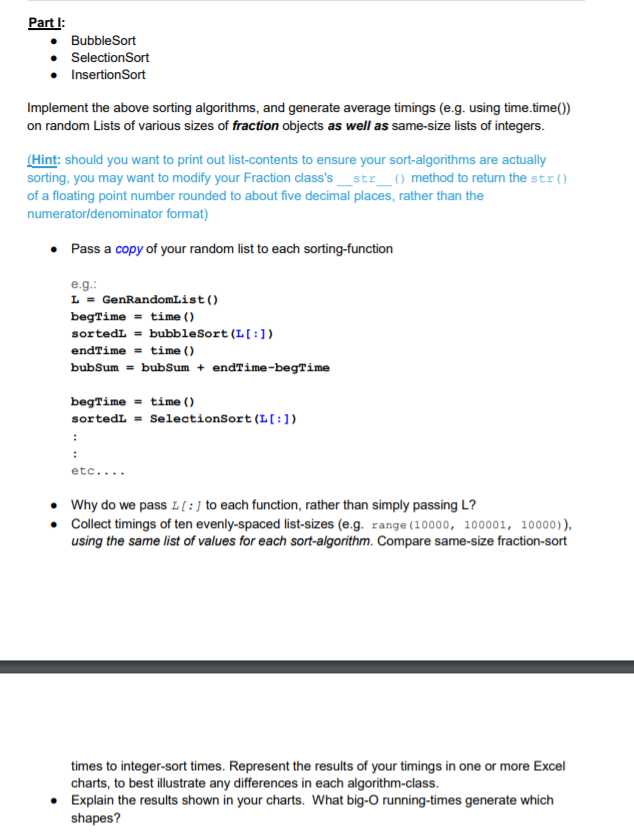
Part I: BubbleSort Selection Sort Insertion Sort Implement the above sorting algorithms, and generate average timings (e.g. using time.time()) on random Lists of various sizes of fraction objects as well as same-size lists of integers. (Hint: should you want to print out list-contents to ensure your sort-algorithms are actually sorting, you may want to modify your Fraction class's str_0 method to return the str() of a floating point number rounded to about five decimal places, rather than the numerator/denominator format) Pass a copy of your random list to each sorting-function e.g.: L = GenRandomList() begTime = time() sortedL = bubbleSort (L[:]) endTime = time() bubSum = bubSum + endTime-begTime begTime = time() sortedL = SelectionSort (L[:]) etc.... Why do we pass L[:) to each function, rather than simply passing L? Collect timings of ten evenly spaced list-sizes (e.g. range (10000, 100001, 10000)), using the same list of values for each sort-algorithm. Compare same-size fraction-sort times to integer-sort times. Represent the results of your timings in one or more Excel charts, to best illustrate any differences in each algorithm-class. Explain the results shown in your charts. What big-O running-times generate which shapes? Part I: BubbleSort Selection Sort Insertion Sort Implement the above sorting algorithms, and generate average timings (e.g. using time.time()) on random Lists of various sizes of fraction objects as well as same-size lists of integers. (Hint: should you want to print out list-contents to ensure your sort-algorithms are actually sorting, you may want to modify your Fraction class's str_0 method to return the str() of a floating point number rounded to about five decimal places, rather than the numerator/denominator format) Pass a copy of your random list to each sorting-function e.g.: L = GenRandomList() begTime = time() sortedL = bubbleSort (L[:]) endTime = time() bubSum = bubSum + endTime-begTime begTime = time() sortedL = SelectionSort (L[:]) etc.... Why do we pass L[:) to each function, rather than simply passing L? Collect timings of ten evenly spaced list-sizes (e.g. range (10000, 100001, 10000)), using the same list of values for each sort-algorithm. Compare same-size fraction-sort times to integer-sort times. Represent the results of your timings in one or more Excel charts, to best illustrate any differences in each algorithm-class. Explain the results shown in your charts. What big-O running-times generate which shapes
Step by Step Solution
There are 3 Steps involved in it

Get step-by-step solutions from verified subject matter experts
 Study Help