







Question: PART I. ON THE ANSWER SHEET TYPE THE CORRECT ANSWER AS TRUE OR FALSE NEXT TO THE NUMBER OF THE TEST ITEM. 1. In
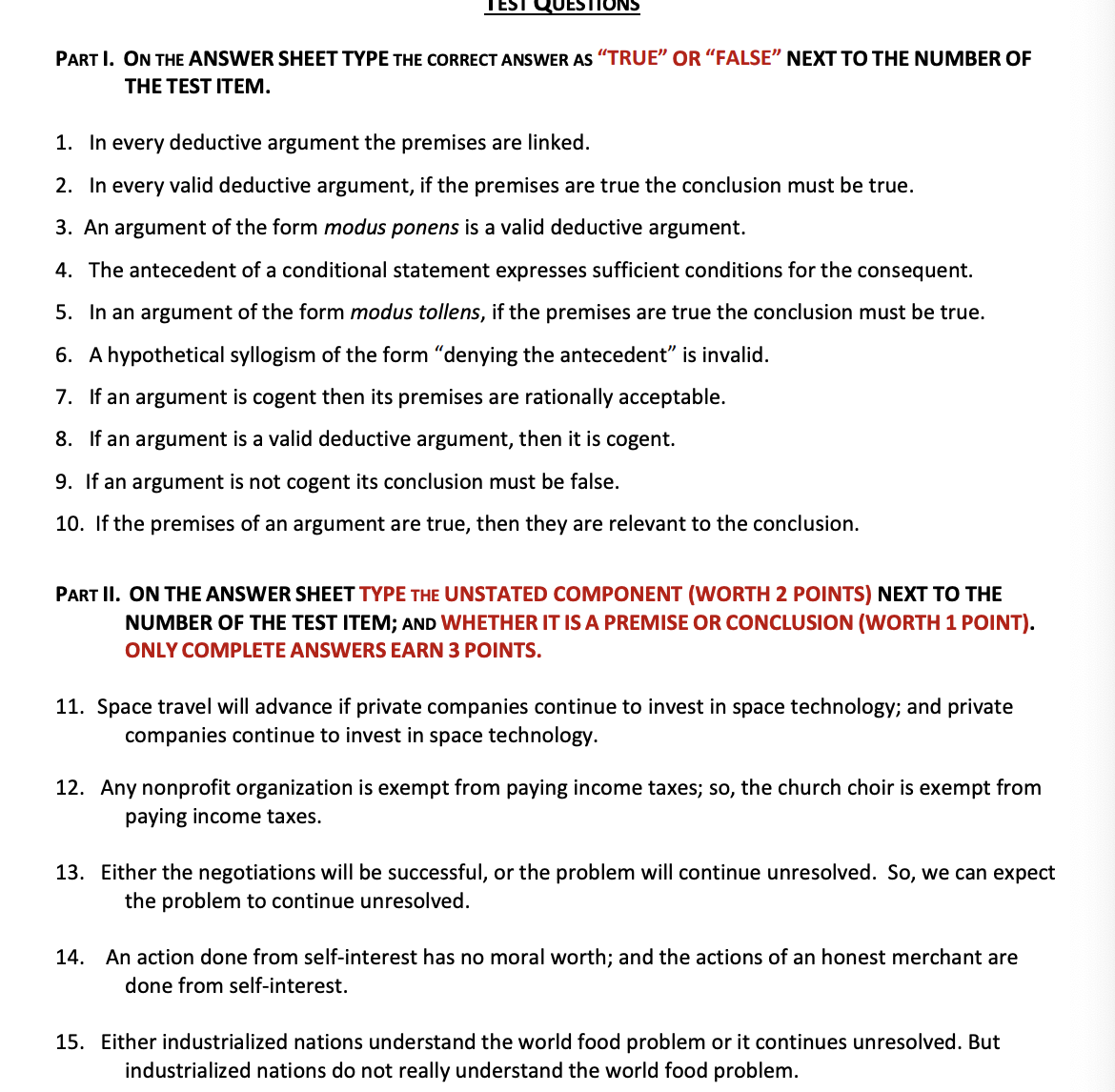
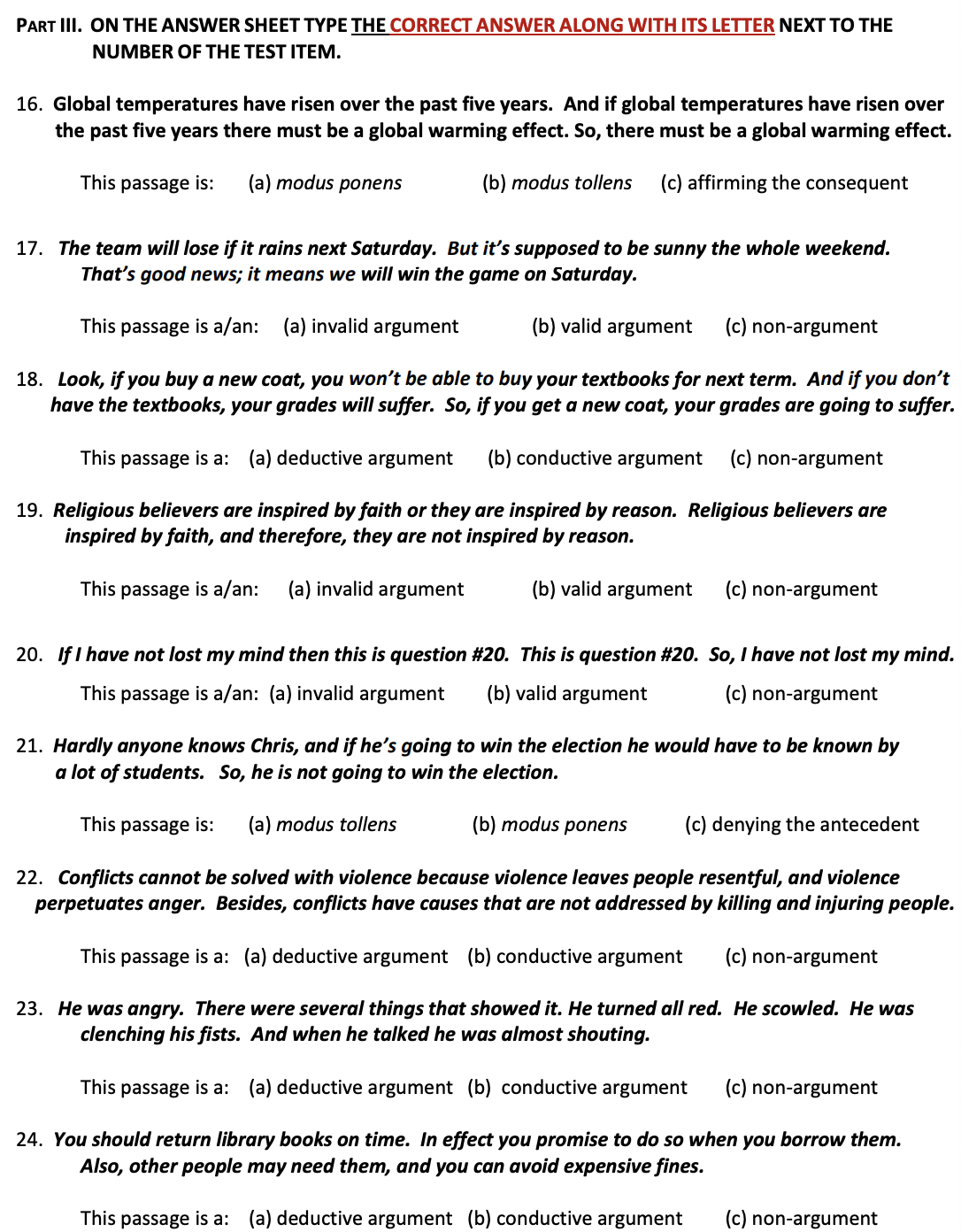
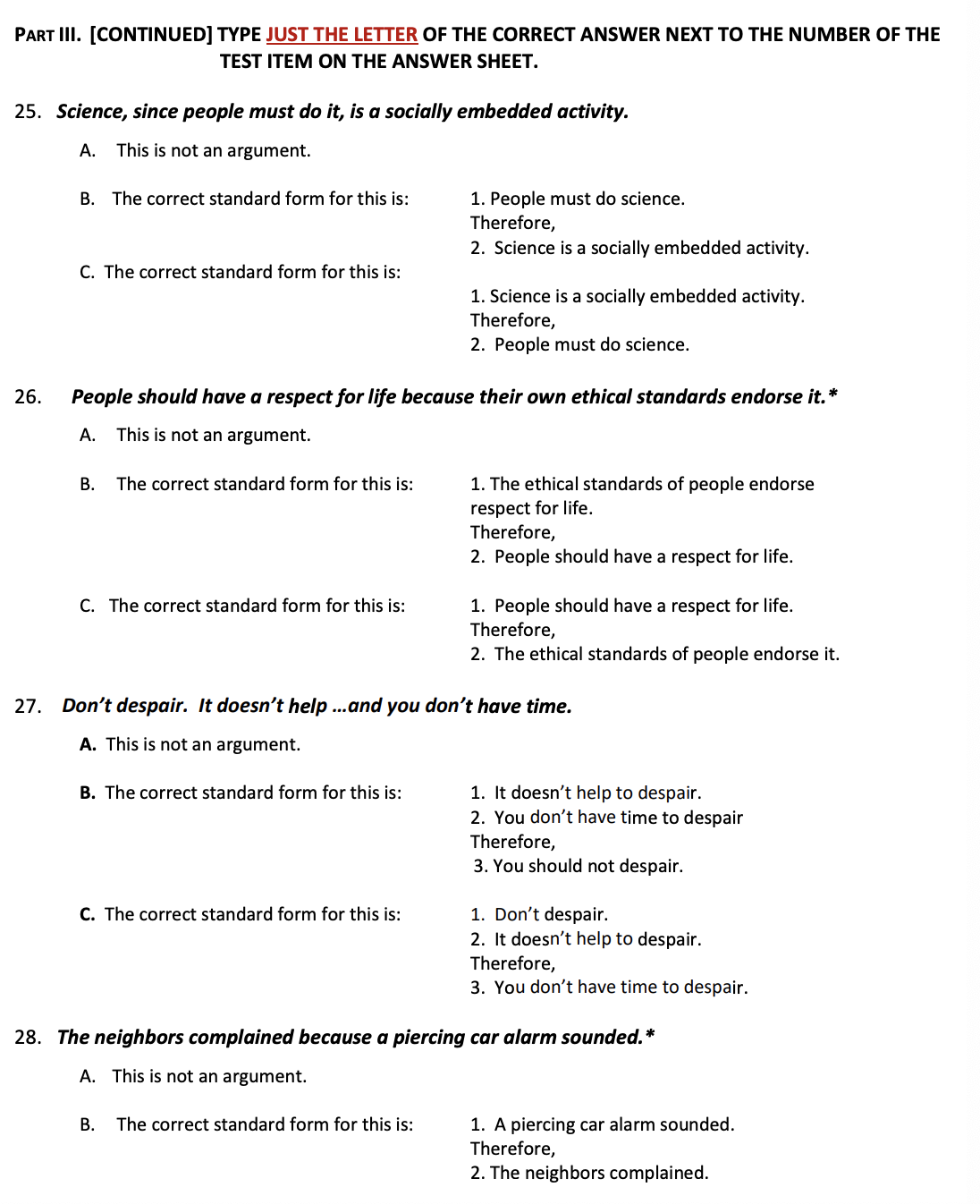
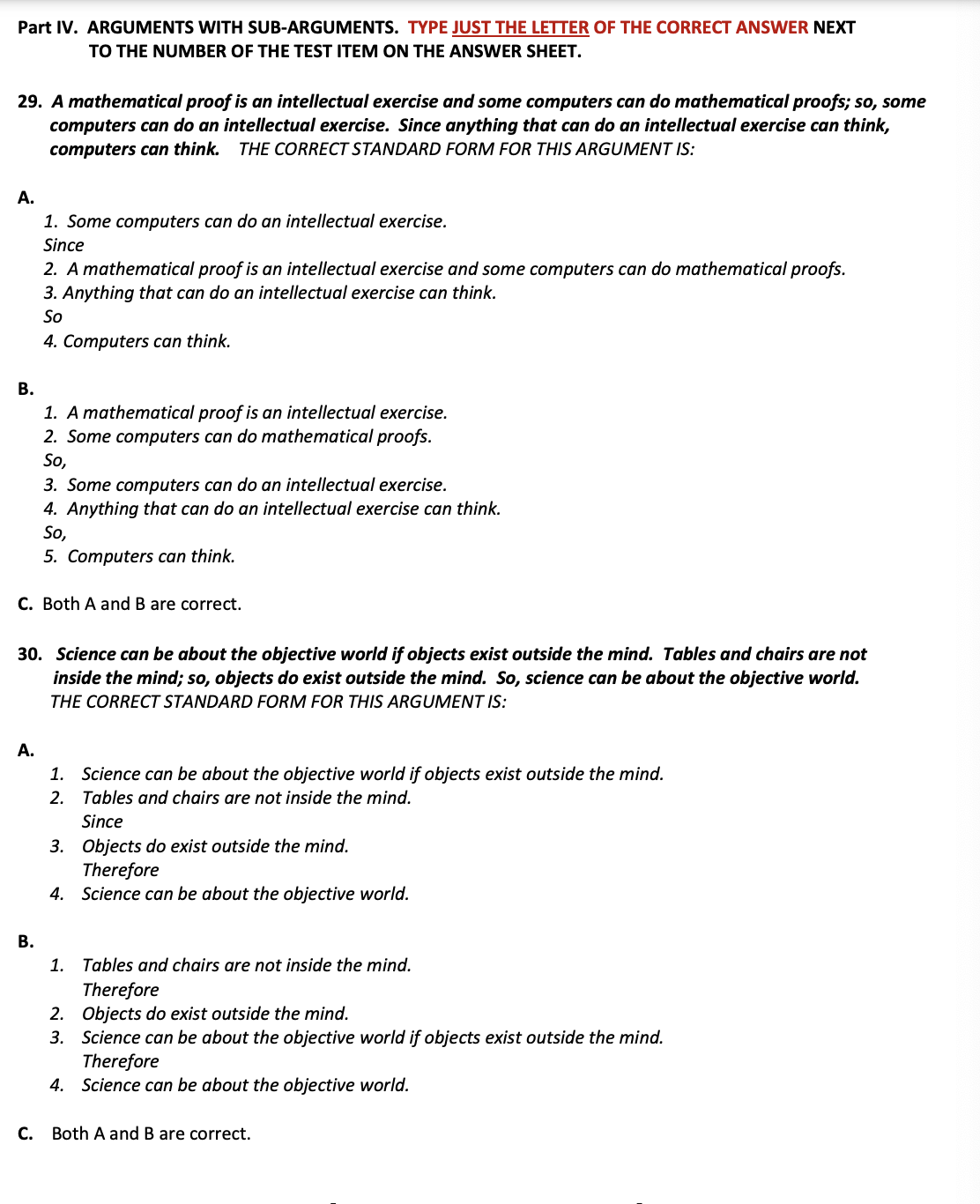
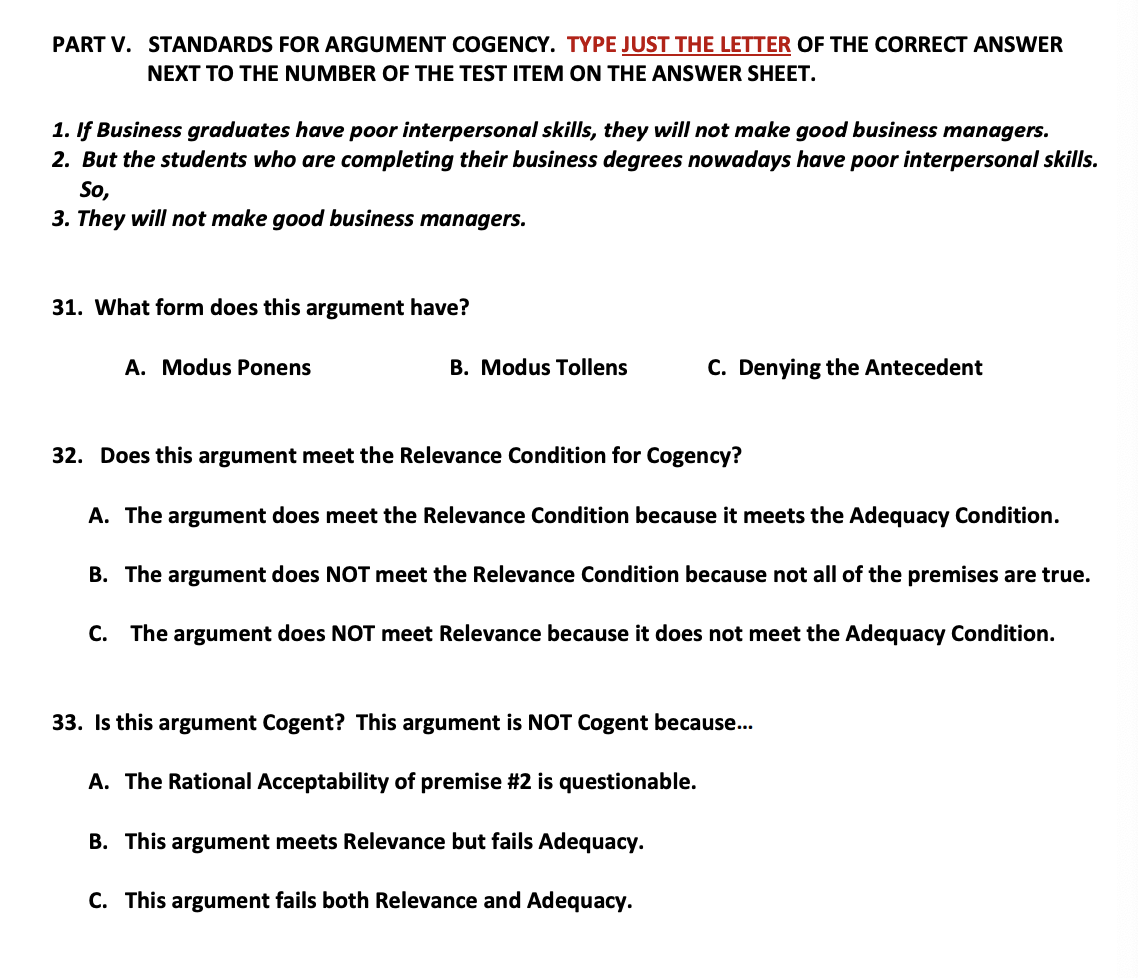
PART I. ON THE ANSWER SHEET TYPE THE CORRECT ANSWER AS "TRUE" OR "FALSE" NEXT TO THE NUMBER OF THE TEST ITEM. 1. In every deductive argument the premises are linked. 2. In every valid deductive argument, if the premises are true the conclusion must be true. 3. An argument of the form modus ponens is a valid deductive argument. 4. The antecedent of a conditional statement expresses sufficient conditions for the consequent. 5. In an argument of the form modus tollens, if the premises are true the conclusion must be true. 6. A hypothetical syllogism of the form "denying the antecedent" is invalid. 7. If an argument is cogent then its premises are rationally acceptable. 8. If an argument is a valid deductive argumen then it is cogent. 9. If an argument is not cogent its conclusion must be false. 10. If the premises of an argument are true, then they are relevant to the conclusion. PART II. ON THE ANSWER SHEET TYPE THE UNSTATED COMPONENT (WORTH 2 POINTS) NEXT TO THE NUMBER OF THE TEST ITEM; AND WHETHER IT IS A PREMISE OR CONCLUSION (WORTH 1 POINT). ONLY COMPLETE ANSWERS EARN 3 POINTS. 11. Space travel will advance if private companies continue to invest in space technology; and private companies continue to invest in space technology. 12. Any nonprofit organization is exempt from paying income taxes; so, the church choir is exempt from paying income taxes. 13. Either the negotiations will be successful, or the problem will continue unresolved. So, we can expect the problem to continue unresolved. 14. An action done from self-interest has no moral worth; and the actions of an honest merchant are done from self-interest. 15. Either industrialized nations understand the world food problem or it continues unresolved. But industrialized nations do not really understand the world food problem. PART III. ON THE ANSWER SHEET TYPE THE CORRECT ANSWER ALONG WITH ITS LETTER NEXT TO THE NUMBER OF THE TEST ITEM. 16. Global temperatures have risen over the past five years. And if global temperatures have risen over the past five years there must be a global warming effect. So, there must be a global warming effect. This passage is: (a) modus ponens (b) modus tollens (c) affirming the consequent 17. The team will lose if it rains next Saturday. But it's supposed to be sunny the whole weekend. That's good news; it means we will win the game on Saturday. This passage is a/an: (a) invalid argument (b) valid argument (c) non-argument 18. Look, if you buy a new coat, you won't be able to buy your textbooks for next term. And if you don't have the textbooks, your grades will suffer. So, if you get a new coat, your grades are going to suffer. This passage is a: (a) deductive argument (b) conductive argument (c) non-argument 19. Religious believers are inspired by faith or they are inspired by reason. Religious believers are inspired by faith, and therefore, they are not inspired by reason. This passage is a/an: (a) invalid argument (b) valid argument (c) non-argument 20. If I have not lost my mind then this is question # 20. This is question # 20. So, I have not lost my mind. This passage is a/an: (a) invalid argument (b) valid argument (c) non-argument 21. Hardly anyone knows Chris, and if he's going to win the election he would have to be known by a lot of students. So, he is not going to win the election. This passage is: (a) modus tollens (b) modus ponens (c) denying the antecedent 22. Conflicts cannot be solved with violence because violence leaves people resentful, and violence perpetuates anger. Besides, conflicts have causes that are not addressed by killing and injuring people. This passage is a: (a) deductive argument (b) conductive argument (c) non-argument 23. He was angry. There were several things that showed it. He turned all red. He scowled. He was clenching his fists. And when he talked he was almost shouting. This passage is a: (a) deductive argument (b) conductive argument (c) non-argument 24. You should return library books on time. In effect you promise to do so when you Also, other people may need them, and you can avoid expensive fines. This passage is a: (a) deductive argument (b) conductive argument (c) non-argument them. PART III. [CONTINUED] TYPE JUST THE LETTER OF THE CORRECT ANSWER NEXT TO THE NUMBER OF THE TEST ITEM ON THE ANSWER SHEET. 25. Science, since people must do it, is a socially embedded activity. A. This is not an argument. 26. B. The correct standard form for this is: C. The correct standard form for this is: B. The correct standard form for this is: People should have a respect for life because their own ethical standards endorse it.* A. This is not an argument. C. The correct standard form for this is: B. The correct standard form for this is: 1. People must do science. Therefore, 2. Science is a socially embedded activity. C. The correct standard form for this is: 1. Science is a socially embedded activity. Therefore, 2. People must do science. 27. Don't despair. It doesn't help ...and you don't have time. A. This is not an argument. B. The correct standard form for this is: 1. The ethical standards of people endorse respect for life. Therefore, 2. People should have a respect for life. 1. People should have a respect for life. Therefore, 2. The ethical standards of people endorse it. 1. It doesn't help to despair. 2. You don't have time to despair Therefore, 3. You should not despair. 1. Don't despair. 2. It doesn't help to despair. Therefore, 3. You don't have time to despair. 28. The neighbors complained because a piercing car alarm sounded.* A. This is not an argument. 1. A piercing car alarm sounded. Therefore, 2. The neighbors complained. Part IV. ARGUMENTS WITH SUB-ARGUMENTS. TYPE JUST THE LETTER OF THE CORRECT ANSWER NEXT TO THE NUMBER OF THE TEST ITEM ON THE ANSWER SHEET. 29. A mathematical proof is an intellectual exercise and some computers can do mathematical proofs; so, some computers can do an intellectual exercise. Since anything that can do an intellectual exercise can think, computers can think. THE CORRECT STANDARD FORM FOR THIS ARGUMENT IS: A. 1. Some computers can do an intellectual exercise. Since 2. A mathematical proof is an intellectual exercise and some computers can do mathematical proofs. 3. Anything that can do an intellectual exercise can think. So 4. Computers can think. B. 1. A mathematical proof is an intellectual exercise. 2. Some computers can do mathematical proofs. So, C. Both A and B are correct. 30. Science can be about the objective world if objects exist outside the mind. Tables and chairs are not inside the mind; so, objects do exist outside the mind. So, science can be about the objective world. THE CORRECT STANDARD FORM FOR THIS ARGUMENT IS: A. 3. Some computers can do an intellectual exercise. 4. Anything that can do an intellectual exercise can think. So, 5. Computers can think. B. C. 1. Science can be about the objective world if objects exist outside the mind. 2. Tables and chairs are not inside the mind. Since 3. Objects do exist outside the mind. Therefore 4. Science can be about the objective world. 1. Tables and chairs are not inside the mind. Therefore 2. Objects do exist outside the mind. 3. Science can be about the objective world if objects exist outside the mind. Therefore 4. Science can be about the objective world. Both A and B correct. PART V. STANDARDS FOR ARGUMENT COGENCY. TYPE JUST THE LETTER OF THE CORRECT ANSWER NEXT TO THE NUMBER OF THE TEST ITEM ON THE ANSWER SHEET. 1. If Business graduates have poor interpersonal skills, they will not make good business managers. 2. But the students who are completing their business degrees nowadays have poor interpersonal skills. So, 3. They will not make good business managers. 31. What form does this argument have? A. Modus Ponens B. Modus Tollens C. Denying the Antecedent 32. Does this argument meet the Relevance Condition for Cogency? A. The argument does meet the Relevance Condition because it meets the Adequacy Condition. B. The argument does NOT meet the Relevance Condition because not all of the premises are true. C. The argument does NOT meet Relevance because it does not meet the Adequacy Condition. 33. Is this argument Cogent? This argument is NOT Cogent because... A. The Rational Acceptability of premise #2 is questionable. B. This argument meets Relevance but fails Adequacy. C. This argument fails both Relevance and Adequacy.
Step by Step Solution
There are 3 Steps involved in it
Part I Multiple Choice 3 points each True True True False False False False True True True Part II Unstated Component 2 points Premise Premise Premise Conclusion Conclusion Part III Short Answer 3 poi... View full answer

Get step-by-step solutions from verified subject matter experts
 Study Help