







Question: Part I: Select the one correct answer (10 points): 1. In a virtual memory scenario, which is true: (a) When all frames are occupied, no
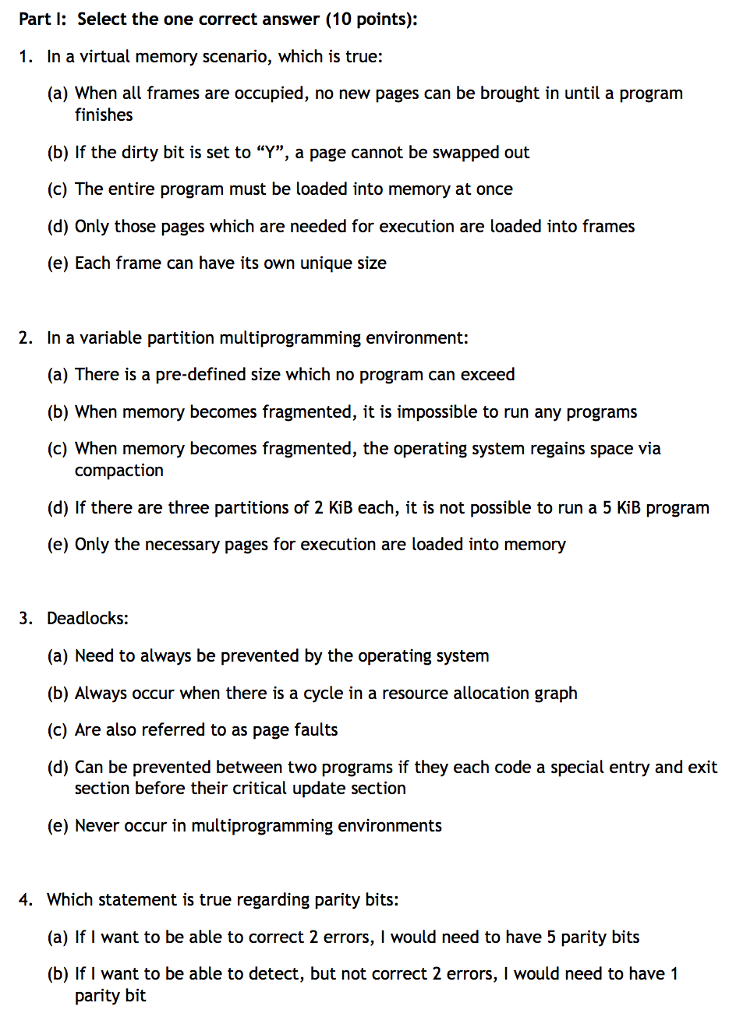
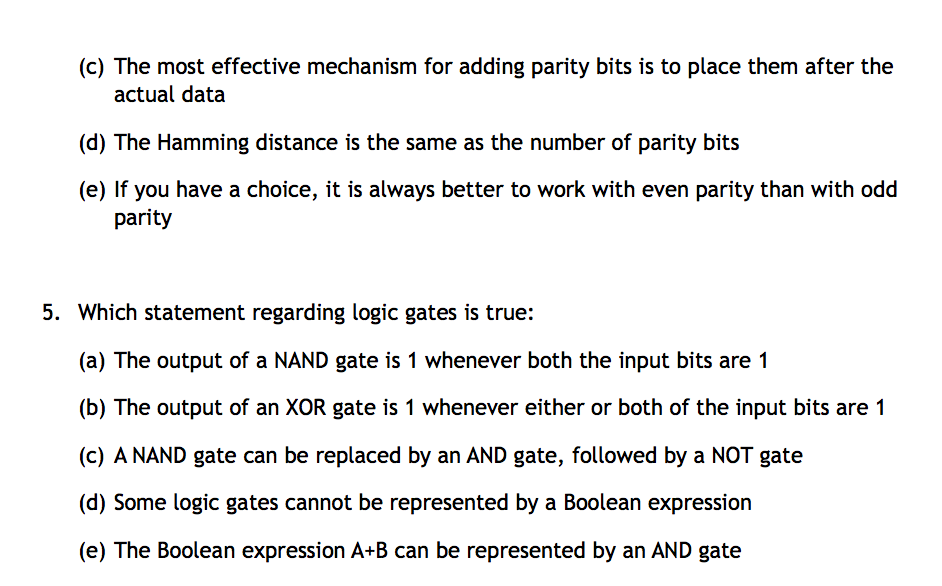
Part I: Select the one correct answer (10 points): 1. In a virtual memory scenario, which is true: (a) When all frames are occupied, no new pages can be brought in until a program finishes (b) If the dirty bit is set to "Y", a page cannot be swapped out (c) The entire program must be loaded into memory at once (d) Only those pages which are needed for execution are loaded into frames (e) Each frame can have its own unique size 2. In a variable partition multiprogramming environment: (a) There is a pre-defined size which no program can exceed (b) When memory becomes fragmented, it is impossible to run any programs (c) When memory becomes fragmented, the operating system regains space via compaction (d) If there are three partitions of 2 KiB each, it is not possible to run a 5 K?B program (e) Only the necessary pages for execution are loaded into memory 3. Deadlocks: (a) Need to always be prevented by the operating system (b) Always occur when there is a cycle in a resource allocation graph (c) Are also referred to as page faults (d) Can be prevented between two programs if they each code a special entry and exit section before their critical update section (e) Never occur in multiprogramming environments 4. Which statement is true regarding parity bits: (a) If I want to be able to correct 2 errors, I would need to have 5 parity bits (b) If I want to be able to detect, but not correct 2 errors, I would need to have 1 parity bit
Step by Step Solution
There are 3 Steps involved in it

Get step-by-step solutions from verified subject matter experts
 Study Help