







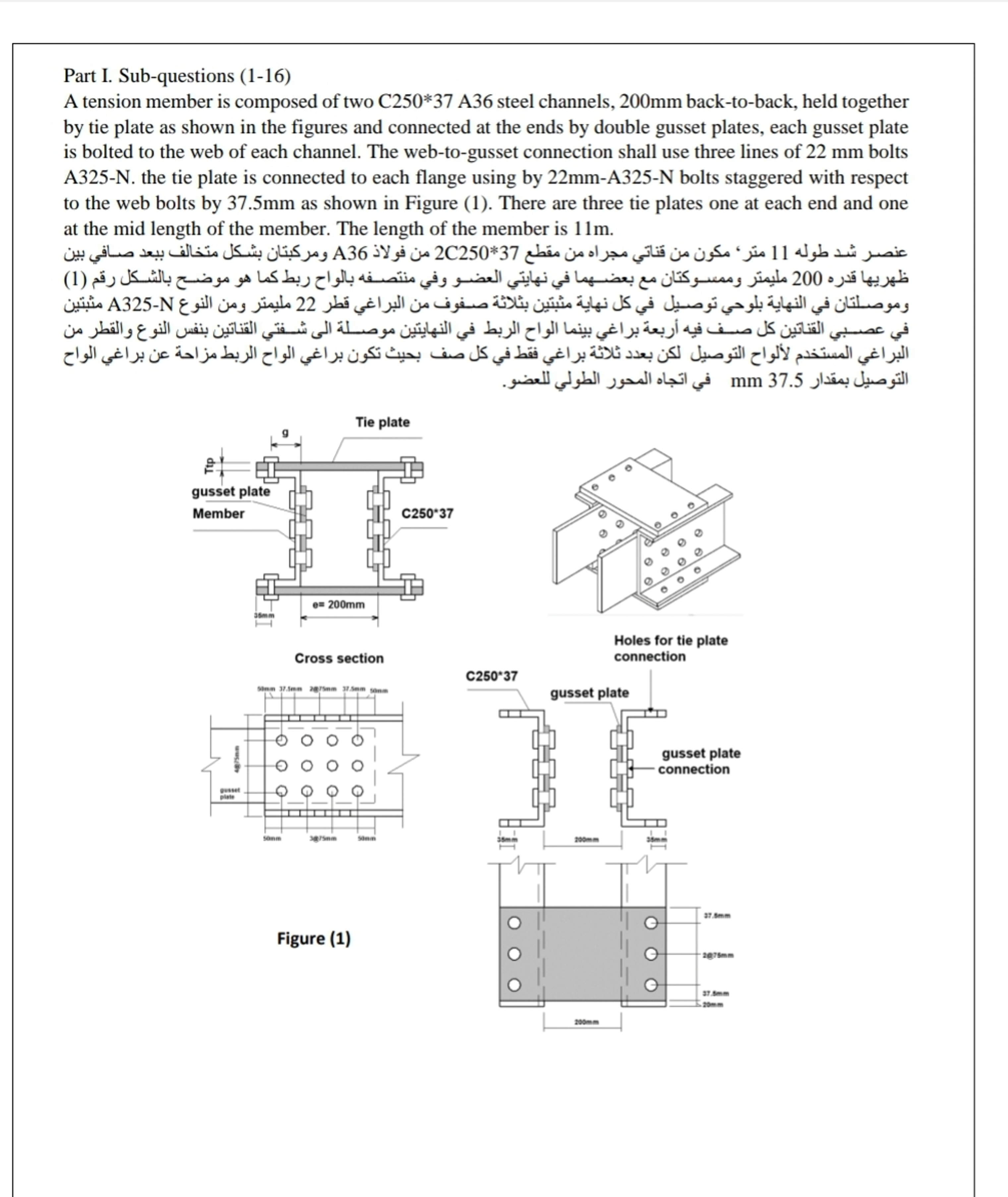
Question: Part I. Sub - questions ( 1 - 1 6 ) A tension member is composed of two C 2 5 0 * 3 7
Part I. Subquestions
A tension member is composed of two C A steel channels, mm backtoback, held together by tie plate as shown in the figures and connected at the ends by double gusset plates, each gusset plate is bolted to the web of each channel. The webtogusset connection shall use three lines of mm bolts mathrmAmathrmN the tie plate is connected to each flange using by mathrm~mmmathrmAmathrmN bolts staggered with respect to the web bolts by mm as shown in Figure There are three tie plates one at each end and one at the mid length of the member. The length of the member is m mm p For bearing to happen in the gusset plate and in the channel at the same time, knowing that the length of shearing in both gusset and channel are equal, and both are made of the same material, the thickness of one gusset plate shall be:
A Equal to tw of the channels.
B Equal to tf of the channels.
C Greater than mm
D A and C
A C
p For rupture failure and bearing failure for the case of "deformation is a design consideration", to happen in the mm wide gusset plate at the same time, the thickness of gusset plate shall be taken:
A mm
B Between and mm
C More than mm
D It is not possible for them to happen at the same time.
p The LRFD strength of the builtup member due to shear in connecting bolts is
A KN
B KN
C More than KN
D None of the above.
p For shear strength of bolts in the four flans of the builtup member in the tie plate connections to be equal to the shear strength of bolts in the gusset plate connections, based on shear in bolts only, the diameter of the tie plate bolts shall be:
B Twice as gusset plate bolts.
C This cannot happen.
D None of the above.
p The maximum permissible length of the shown member is:
A m
B m
C m
D None of the above.
p If the thickness of the gusset plate mathrm~mm the gross area for shear leftmathrmAmathrmgvright for block shear to occur in the built up member is:
A mm
B mm
C mm
D None of the above
p If the thickness of gusset plate mathrm~mm the net tension area leftmathrmAmathrmntright in order to calculate the block shear for
A mm
B mm
C mm
D None of the above
p For the above builtup member, Ub s equal to:
A
B
C
D None of the above.
p For block shear to happen in the above builtup member with three lines of bolts, the bolts in the middle
A Increase the section resistance.
B Decrease the section resistance.
C Will not affect the block shear strength of the member
D None of the above.
p As shown in Figure above, the edge distance of bolts in the gusset plate equal to the edge distance of the member, the block shear will happen in the gusset plate before the member if:
D None of the above.
Step by Step Solution
There are 3 Steps involved in it
1 Expert Approved Answer
Step: 1 Unlock

Question Has Been Solved by an Expert!
Get step-by-step solutions from verified subject matter experts
Step: 2 Unlock
Step: 3 Unlock
 Study Help