





Question: PART I. True or False. Write only the words true or false in the space provided. (2 points each) 1. The United States Constitution is
PART I. True or False. Write only the words

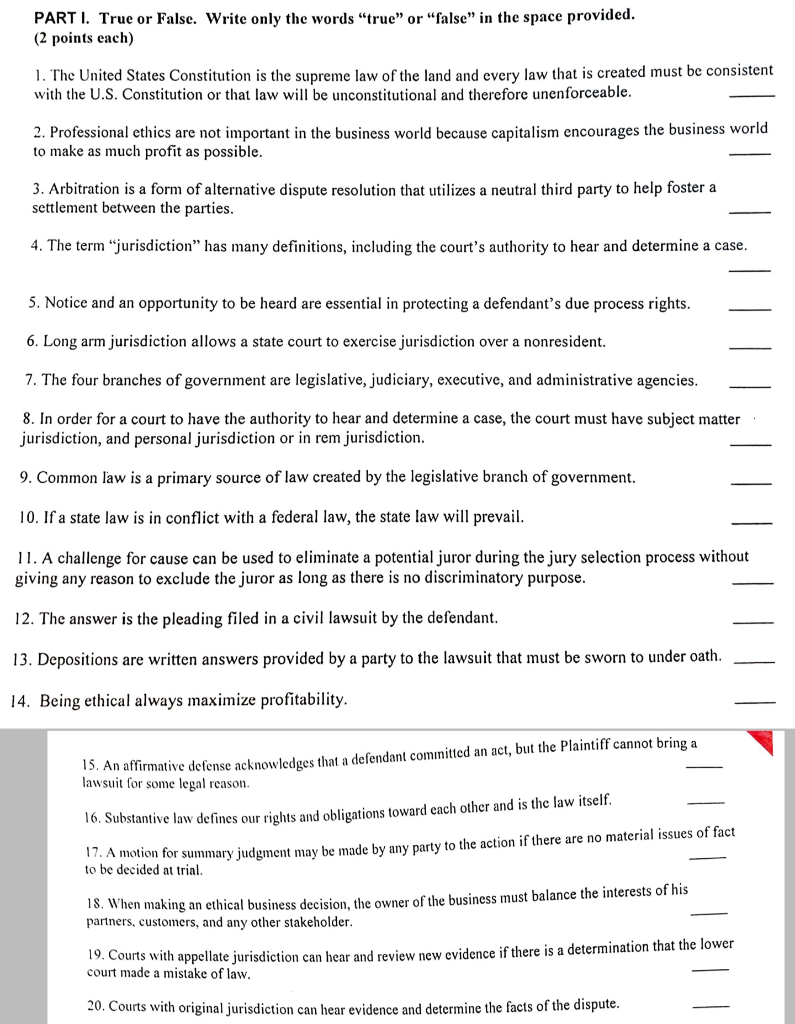
PART I. True or False. Write only the words "true" or "false" in the space provided. (2 points each) 1. The United States Constitution is the supreme law of the land and every law that is created must be consistent with the U.S. Constitution or that law will be unconstitutional and therefore unenforceable. 2. Professional ethics are not important in the business world because capitalism encourages the business world to make as much profit as possible. 3. Arbitration is a form of alternative dispute resolution that utilizes a neutral third party to help foster a settlement between the parties. 4. The term jurisdiction has many definitions, including the court's authority to hear and determine a case. 5. Notice and an opportunity to be heard are essential in protecting a defendant's due process rights. 6. Long arm jurisdiction allows a state court to exercise jurisdiction over a nonresident. 7. The four branches of government are legislative, judiciary, executive, and administrative agencies. 8. In order for a court to have the authority to hear and determine a case, the court must have subject matter. jurisdiction, and personal jurisdiction or in rem jurisdiction. 9. Common law is a primary source of law created by the legislative branch of government. 10. If a state law is in conflict with a federal law, the state law will prevail. 11. A challenge for cause can be used to eliminate a potential juror during the jury selection process without giving any reason to exclude the juror as long as there is no discriminatory purpose. 12. The answer is the pleading filed in a civil lawsuit by the defendant. 13. Depositions are written answers provided by a party to the lawsuit that must be sworn to under oath. 14. Being ethical always maximize profitability. n affirmative defense acknowledges that a defendant comunitted an act, but the plaintiff cannot bring a lawsuit for some legal reason. 10. Substantive law defines our rights and obligations toward each other and is the law itself. on for summary judgment may be made by any party to the action if there are no material issues of fact to be decided at trial. nen making an ethical business decision, the owner of the business must balance the interests of his partners, customers, and any other stakeholder. 9. Courts with appellate jurisdiction can hear and review new evidence if there is a determination that the lower court made a mistake of law. 20. Courts with original jurisdiction can hear evidence and determine the facts of the dispute

Step by Step Solution

There are 3 Steps involved in it

1 Expert Approved Answer
Step: 1 Unlock blur-text-image

Question Has Been Solved by an Expert!

Get step-by-step solutions from verified subject matter experts

Step: 2 Unlock
Step: 3 Unlock

Students Have Also Explored These Related General Management Questions!