



Question: PART I: TRUE/FALSE/UNCERTAIN QUESTIONS: TOTAL 60 MARKS (3.75 marks each). Indicate whether the following statements are true, false or uncertain. You do not have to
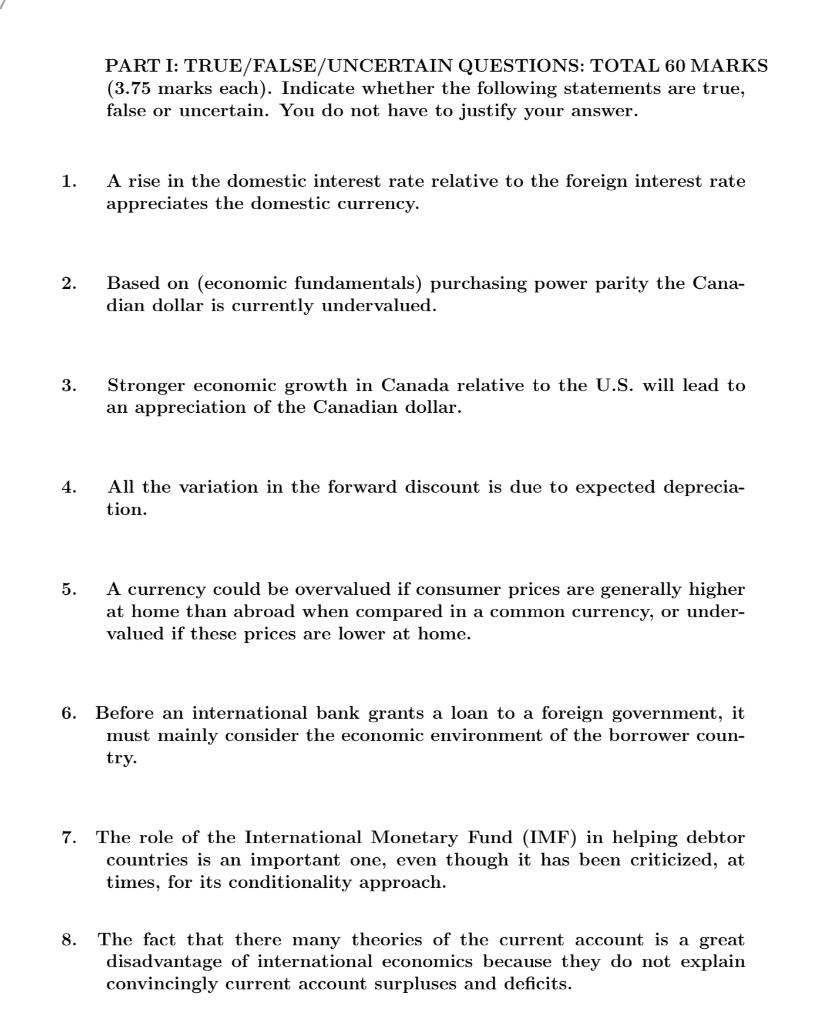
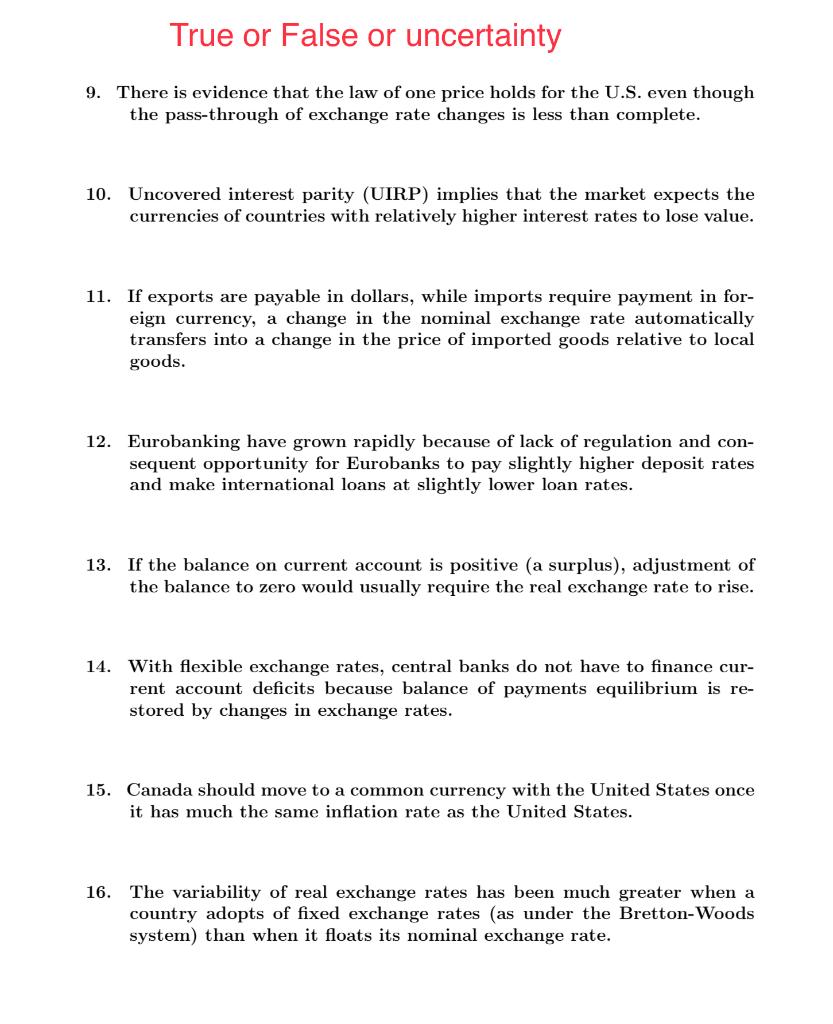
PART I: TRUE/FALSE/UNCERTAIN QUESTIONS: TOTAL 60 MARKS (3.75 marks each). Indicate whether the following statements are true, false or uncertain. You do not have to justify your answer. 1. A rise in the domestic interest rate relative to the foreign interest rate appreciates the domestic currency. 2. Based on (economic fundamentals) purchasing power parity the Cana- dian dollar is currently undervalued. 3. Stronger economic growth in Canada relative to the U.S. will lead to an appreciation of the Canadian dollar. 4. All the variation in the forward discount is due to expected deprecia- tion. 5. A currency could be overvalued if consumer prices are generally higher at home than abroad when compared in a common currency, or under- valued if these prices are lower at home. 6. Before an international bank grants a loan to a foreign government, it must mainly consider the economic environment of the borrower coun- try. 7. The role of the International Monetary Fund (IMF) in helping debtor countries is an important one, even though it has been criticized, at times, for its conditionality approach. 8. The fact that there many theories of the current account is a great disadvantage of international economics because they do not explain convincingly current account surpluses and deficits. True or False or uncertainty 9. There is evidence that the law of one price holds for the U.S. even though the pass-through of exchange rate changes is less than complete. 10. Uncovered interest parity (UIRP) implies that the market expects the currencies of countries with relatively higher interest rates to lose value. 11. If exports are payable in dollars, while imports require payment in for- eign currency, a change in the nominal exchange rate automatically transfers into a change in the price of imported goods relative to local goods. 12. Eurobanking have grown rapidly because of lack of regulation and con- sequent opportunity for Eurobanks to pay slightly higher deposit rates and make international loans at slightly lower loan rates. 13. If the balance on current account is positive (a surplus), adjustment of the balance to zero would usually require the real exchange rate to rise. 14. With flexible exchange rates, central banks do not have to finance cur- rent account deficits because balance of payments equilibrium is re- stored by changes in exchange rates. 15. Canada should move to a common currency with the United States once it has much the same inflation rate as the United States. 16. The variability of real exchange rates has been much greater when a country adopts of fixed exchange rates (as under the Bretton Woods system) than when it floats its nominal exchange rate. PART I: TRUE/FALSE/UNCERTAIN QUESTIONS: TOTAL 60 MARKS (3.75 marks each). Indicate whether the following statements are true, false or uncertain. You do not have to justify your answer. 1. A rise in the domestic interest rate relative to the foreign interest rate appreciates the domestic currency. 2. Based on (economic fundamentals) purchasing power parity the Cana- dian dollar is currently undervalued. 3. Stronger economic growth in Canada relative to the U.S. will lead to an appreciation of the Canadian dollar. 4. All the variation in the forward discount is due to expected deprecia- tion. 5. A currency could be overvalued if consumer prices are generally higher at home than abroad when compared in a common currency, or under- valued if these prices are lower at home. 6. Before an international bank grants a loan to a foreign government, it must mainly consider the economic environment of the borrower coun- try. 7. The role of the International Monetary Fund (IMF) in helping debtor countries is an important one, even though it has been criticized, at times, for its conditionality approach. 8. The fact that there many theories of the current account is a great disadvantage of international economics because they do not explain convincingly current account surpluses and deficits. True or False or uncertainty 9. There is evidence that the law of one price holds for the U.S. even though the pass-through of exchange rate changes is less than complete. 10. Uncovered interest parity (UIRP) implies that the market expects the currencies of countries with relatively higher interest rates to lose value. 11. If exports are payable in dollars, while imports require payment in for- eign currency, a change in the nominal exchange rate automatically transfers into a change in the price of imported goods relative to local goods. 12. Eurobanking have grown rapidly because of lack of regulation and con- sequent opportunity for Eurobanks to pay slightly higher deposit rates and make international loans at slightly lower loan rates. 13. If the balance on current account is positive (a surplus), adjustment of the balance to zero would usually require the real exchange rate to rise. 14. With flexible exchange rates, central banks do not have to finance cur- rent account deficits because balance of payments equilibrium is re- stored by changes in exchange rates. 15. Canada should move to a common currency with the United States once it has much the same inflation rate as the United States. 16. The variability of real exchange rates has been much greater when a country adopts of fixed exchange rates (as under the Bretton Woods system) than when it floats its nominal exchange rate
Step by Step Solution
There are 3 Steps involved in it

Get step-by-step solutions from verified subject matter experts