







Question: Part I: use the 8 inference rules (Simp. Conj. D.S., H.S., DIL, M.P., M.T., Add) to prove the following arguments. You are NOT allowed
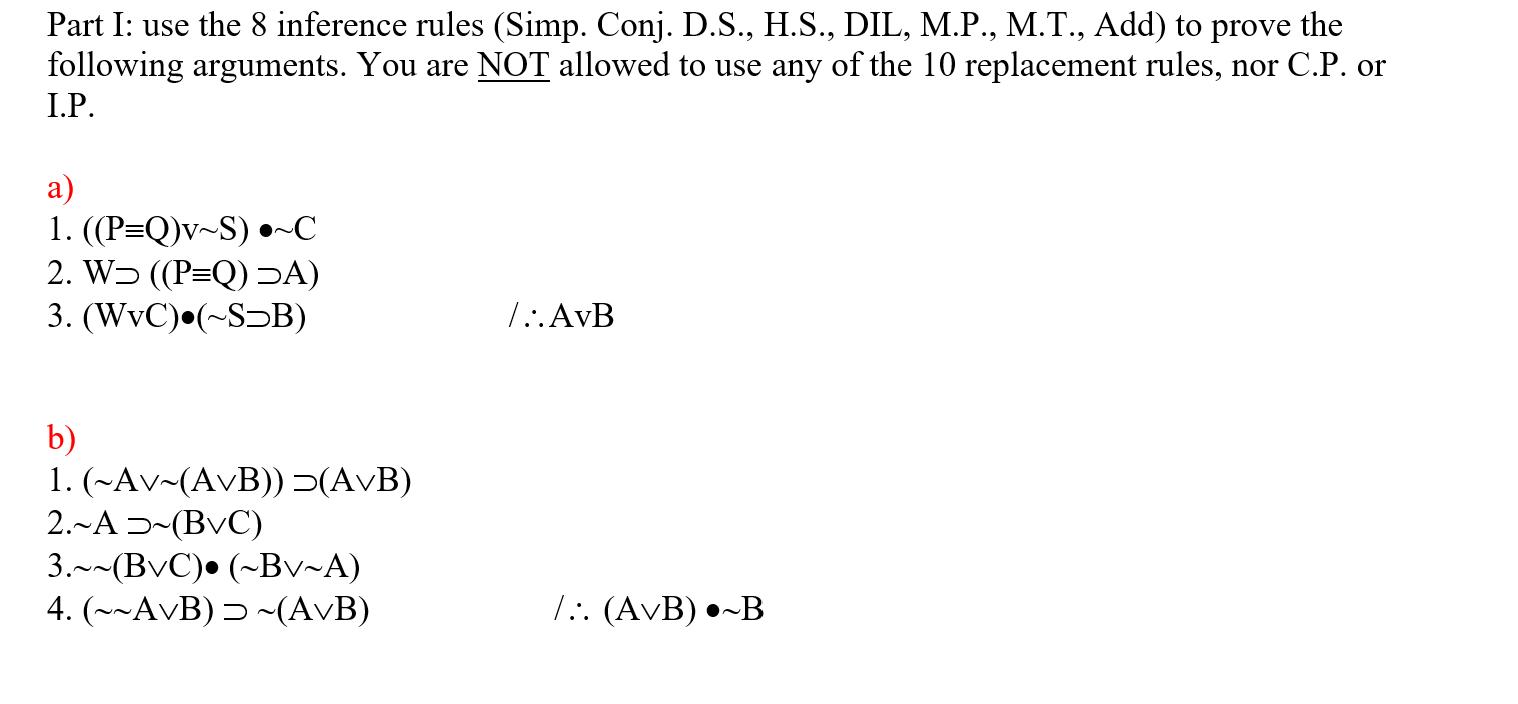
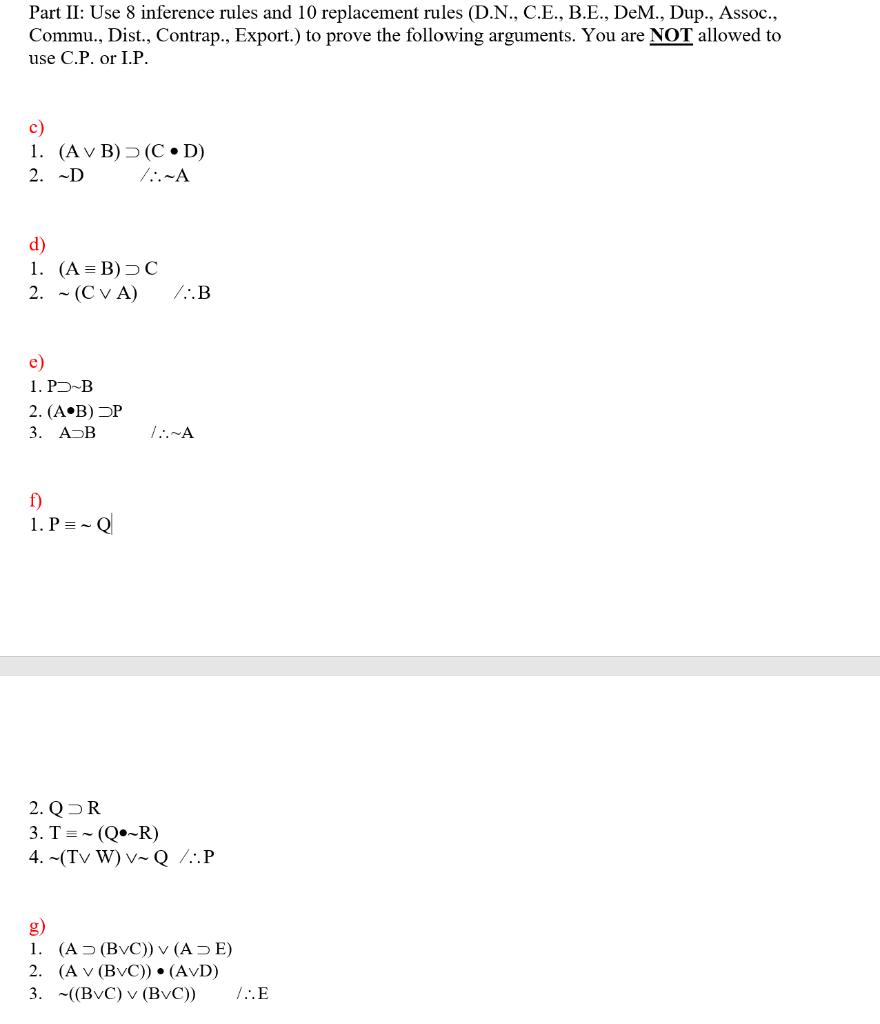
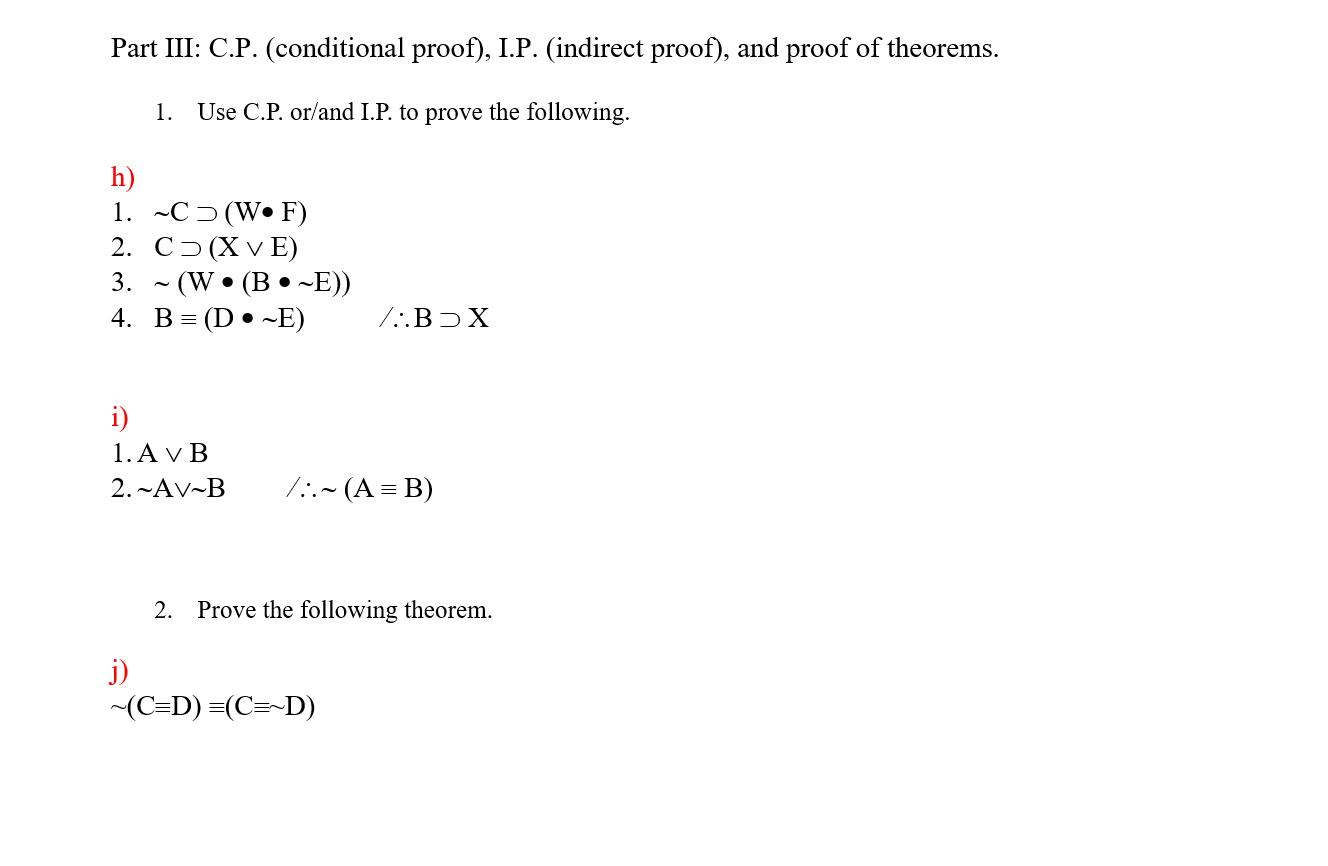
Part I: use the 8 inference rules (Simp. Conj. D.S., H.S., DIL, M.P., M.T., Add) to prove the following arguments. You are NOT allowed to use any of the 10 replacement rules, nor C.P. or I.P. a) 1. ((P=Q)v~S) ~C 2. W ((P=Q) DA) 3. (WvC) (~SDB) b) 1. (~Av~(AvB)) (AvB) 2.~A~(BVC) 3.~~(BvC) (~Bv~A) 4. (~~AvB) ~(AvB) / .. AvB /:. (AvB) ~B Part II: Use 8 inference rules and 10 replacement rules (D.N., C.E., B.E., DeM., Dup., Assoc., Commu., Dist., Contrap., Export.) to prove the following arguments. You are NOT allowed to use C.P. or I.P. c) 1. (A v B) (C. D) 2. D /:.~A d) 1. (AB) C 2.- (CVA) /:.B e) 1. P-B 2. (A B) OP 3. ADB f) 1. P = ~ Q /:~A 2. QOR 3. T (QR) 4.-(Tv W) v- Q /:.P 1. (A (BVC)) v (ADE) 2. (A v (BVC)) (AvD) 3. ((BVC) v (BvC)) /..E Part III: C.P. (conditional proof), I.P. (indirect proof), and proof of theorems. 1. Use C.P. or/and I.P. to prove the following. h) 1. ~C (W. F) 2. C (XVE) 3. ~ (W (B~E)) 4. B (DE) = i) 1. A V B 2. ~AV-B /::.BDX /:. ~ (A = B) 2. Prove the following theorem. j) ~(C=D) =(C=~D)
Step by Step Solution
3.41 Rating (151 Votes )
There are 3 Steps involved in it

Get step-by-step solutions from verified subject matter experts
 Study Help