







Question: PART II: COURNOT COMPETITORS Consider a quantity-setting oligopoly (Cournot model) where demand is linear and each rm's marginal cost is a constant c; for each
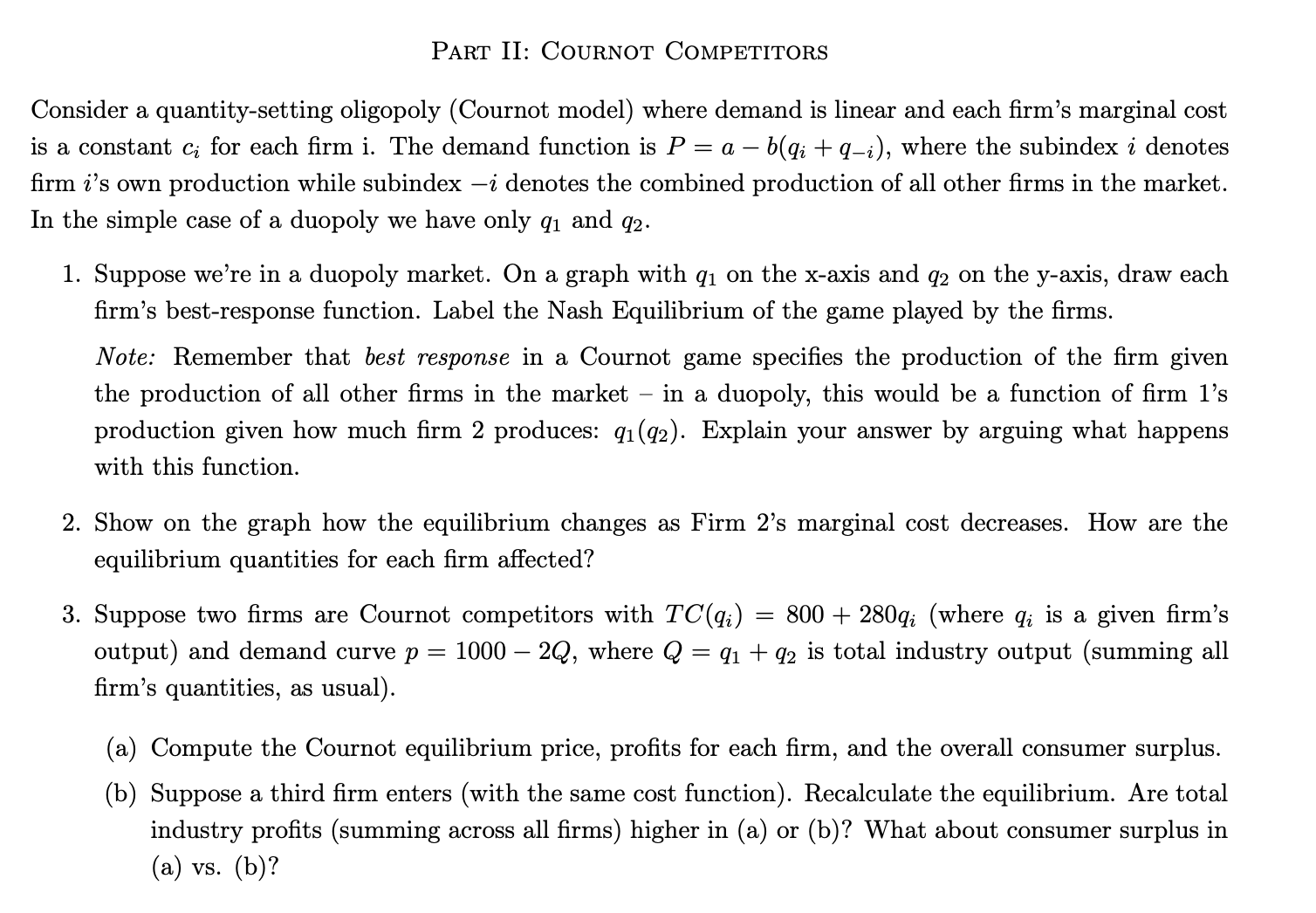
PART II: COURNOT COMPETITORS Consider a quantity-setting oligopoly (Cournot model) where demand is linear and each rm's marginal cost is a constant c; for each rm i. The demand function is P = a b(q.; + q_.;), where the subindex 2' denotes rm i's own production while subindex i denotes the combined production of all other rms in the market. In the simple case of a duopoly we have only ql and 9'2. 1. Suppose we're in a duopoly market. On a graph with (11 on the xaxis and (12 on the y-axis, draw each rm's best-response function. Label the Nash Equilibrium of the game played by the rms. Note: Remember that best response in a Cournot game species the production of the rm given the production of all other rms in the market in a dquoly, this would be a function of rm 1's production given how much rm 2 produces: (11012). Explain your answer by arguing what happens With this function. 2. Show on the graph how the equilibrium changes as Firm 2's marginal cost decreases. How are the equilibrium quantities for each rm affected? 3. Suppose two rms are Caurnot competitors with TC(q.;) = 800 + 280qz- (where qz- is a given rm's output) and demand curve 10 = 1000 262, Where Q = q1 + Q2 is total industry output (summing all rm's quantities, as usual). (a) Compute the Cournot equilibrium price, prots for each rm, and the overall consumer surplus. (b) Suppose a third rm enters (with the same cost function). Recalculate the equilibrium. Are total industry prots (summing across all rms) higher in (a) or (b)? What about consumer surplus in (a) vs. (1))
Step by Step Solution
There are 3 Steps involved in it

Get step-by-step solutions from verified subject matter experts
 Study Help