Question: Part II - Estimating Criterion-Related Validity Using Internal Data Instructions: To illustrate how an organization might analyze their own validation data and evaluate different selection
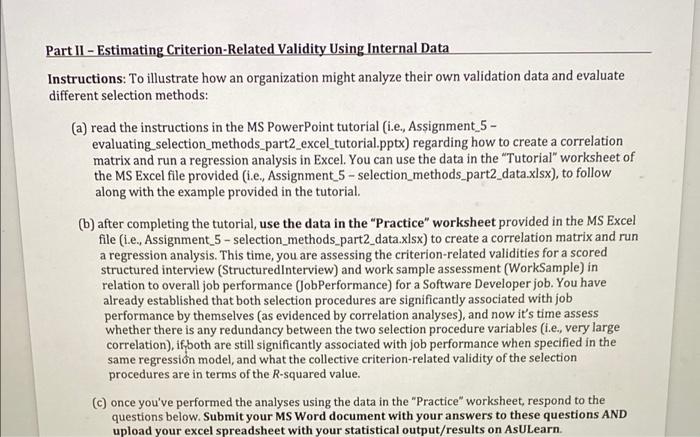
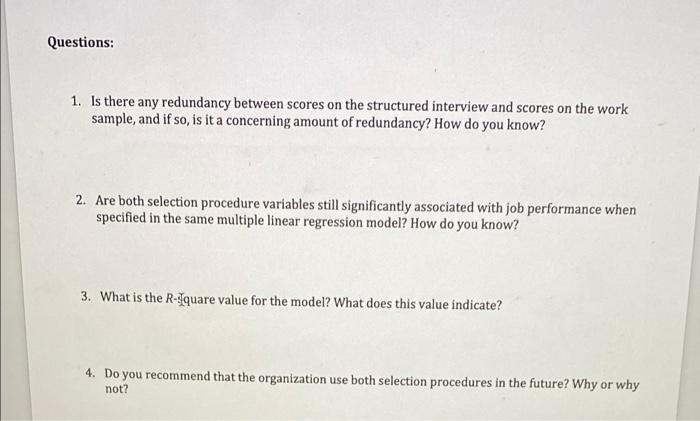
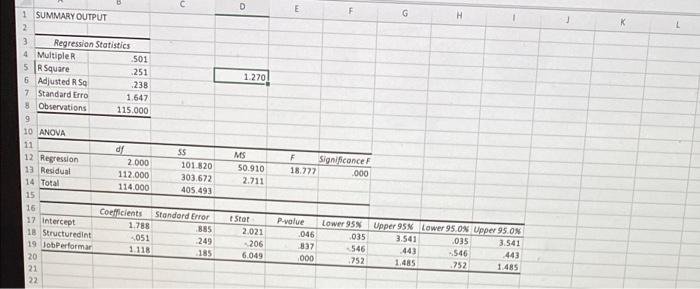
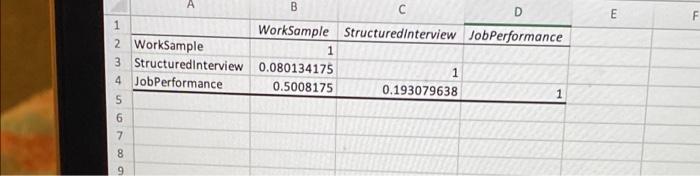
Part II - Estimating Criterion-Related Validity Using Internal Data Instructions: To illustrate how an organization might analyze their own validation data and evaluate different selection methods: (a) read the instructions in the MS PowerPoint tutorial (i.e., Assignment_5 evaluating_selection_methods_part2_excel_tutorial.pptx) regarding how to create a correlation matrix and run a regression analysis in Excel. You can use the data in the "Tutorial" worksheet of the MS Excel file provided (i.e., Assignment_5 - selection_methods_part2_data.xlsx), to follow along with the example provided in the tutorial. (b) after completing the tutorial, use the data in the "Practice" worksheet provided in the MS Excel file (i.e., Assignment_5 - selection_methods_part2_data.xlsx) to create a correlation matrix and run a regression analysis. This time, you are assessing the criterion-related validities for a scored structured interview (StructuredInterview) and work sample assessment (WorkSample) in relation to overall job performance (JobPerformance) for a Software Developer job. You have already established that both selection procedures are significantly associated with job performance by themselves (as evidenced by correlation analyses), and now it's time assess whether there is any redundancy between the two selection procedure variables (i.e., very large correlation), ifpoth are still significantly associated with job performance when specified in the same regression model, and what the collective criterion-related validity of the selection procedures are in terms of the R-squared value. (c) once you've performed the analyses using the data in the "Practice" worksheet, respond to the questions below. Submit your MS Word document with your answers to these questions AND 1. Is there any redundancy between scores on the structured interview and scores on the work sample, and if so, is it a concerning amount of redundancy? How do you know? 2. Are both selection procedure variables still significantly associated with job performance when specified in the same multiple linear regression model? How do you know? 3. What is the R - 4. Do you recommend that the organization use both selection procedures in the future? Why or why not? \begin{tabular}{|l|l|r|r|r|} \hline & \multicolumn{1}{|c}{ A } & \multicolumn{1}{c}{ B } & \multicolumn{1}{c|}{ C } & \multicolumn{1}{c|}{ D } \\ \hline 1 & & WorkSample & Structuredinterview & JobPerformance \\ \hline 2 & WorkSample & 1 & & \\ \hline 3 & Structuredinterview & 0.080134175 & & \\ \hline 4 & JobPerformance & 0.5008175 & 0.193079638 & \\ \cline { 2 - 6 } & & & & \\ 6 & & & & \\ \hline 7 & & & & \\ 8 & & & & \\ \hline \end{tabular} Part II - Estimating Criterion-Related Validity Using Internal Data Instructions: To illustrate how an organization might analyze their own validation data and evaluate different selection methods: (a) read the instructions in the MS PowerPoint tutorial (i.e., Assignment_5 evaluating_selection_methods_part2_excel_tutorial.pptx) regarding how to create a correlation matrix and run a regression analysis in Excel. You can use the data in the "Tutorial" worksheet of the MS Excel file provided (i.e., Assignment_5 - selection_methods_part2_data.xlsx), to follow along with the example provided in the tutorial. (b) after completing the tutorial, use the data in the "Practice" worksheet provided in the MS Excel file (i.e., Assignment_5 - selection_methods_part2_data.xlsx) to create a correlation matrix and run a regression analysis. This time, you are assessing the criterion-related validities for a scored structured interview (StructuredInterview) and work sample assessment (WorkSample) in relation to overall job performance (JobPerformance) for a Software Developer job. You have already established that both selection procedures are significantly associated with job performance by themselves (as evidenced by correlation analyses), and now it's time assess whether there is any redundancy between the two selection procedure variables (i.e., very large correlation), ifpoth are still significantly associated with job performance when specified in the same regression model, and what the collective criterion-related validity of the selection procedures are in terms of the R-squared value. (c) once you've performed the analyses using the data in the "Practice" worksheet, respond to the questions below. Submit your MS Word document with your answers to these questions AND 1. Is there any redundancy between scores on the structured interview and scores on the work sample, and if so, is it a concerning amount of redundancy? How do you know? 2. Are both selection procedure variables still significantly associated with job performance when specified in the same multiple linear regression model? How do you know? 3. What is the R - 4. Do you recommend that the organization use both selection procedures in the future? Why or why not? \begin{tabular}{|l|l|r|r|r|} \hline & \multicolumn{1}{|c}{ A } & \multicolumn{1}{c}{ B } & \multicolumn{1}{c|}{ C } & \multicolumn{1}{c|}{ D } \\ \hline 1 & & WorkSample & Structuredinterview & JobPerformance \\ \hline 2 & WorkSample & 1 & & \\ \hline 3 & Structuredinterview & 0.080134175 & & \\ \hline 4 & JobPerformance & 0.5008175 & 0.193079638 & \\ \cline { 2 - 6 } & & & & \\ 6 & & & & \\ \hline 7 & & & & \\ 8 & & & & \\ \hline \end{tabular}









 Study Help