Question: PART II: Multiple Choice. Choose the best answer. Write only the capital letter which corresponds to the answer in the space provided. (2 points each)
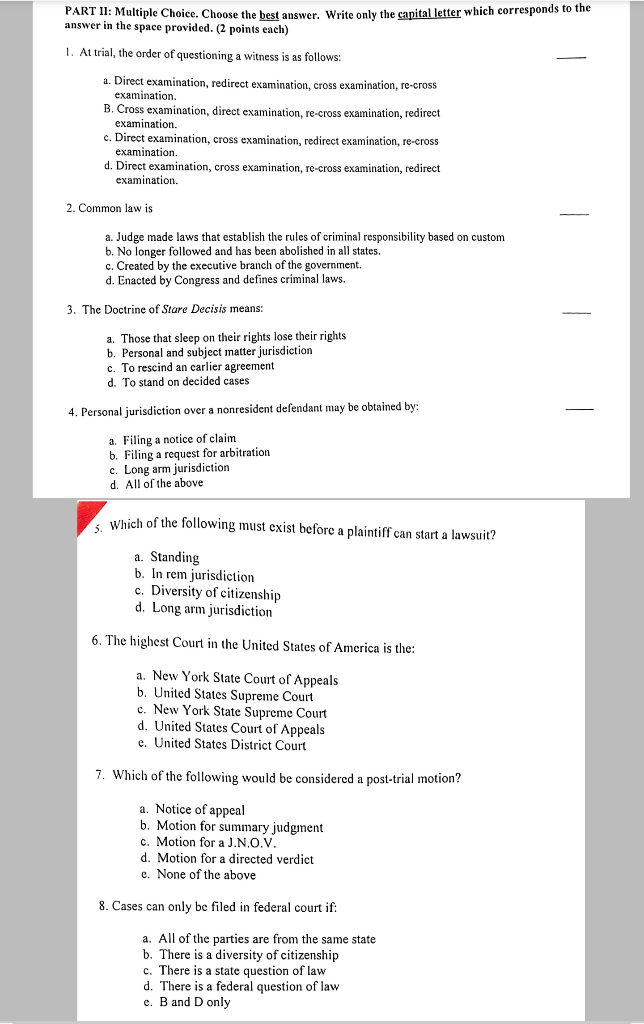
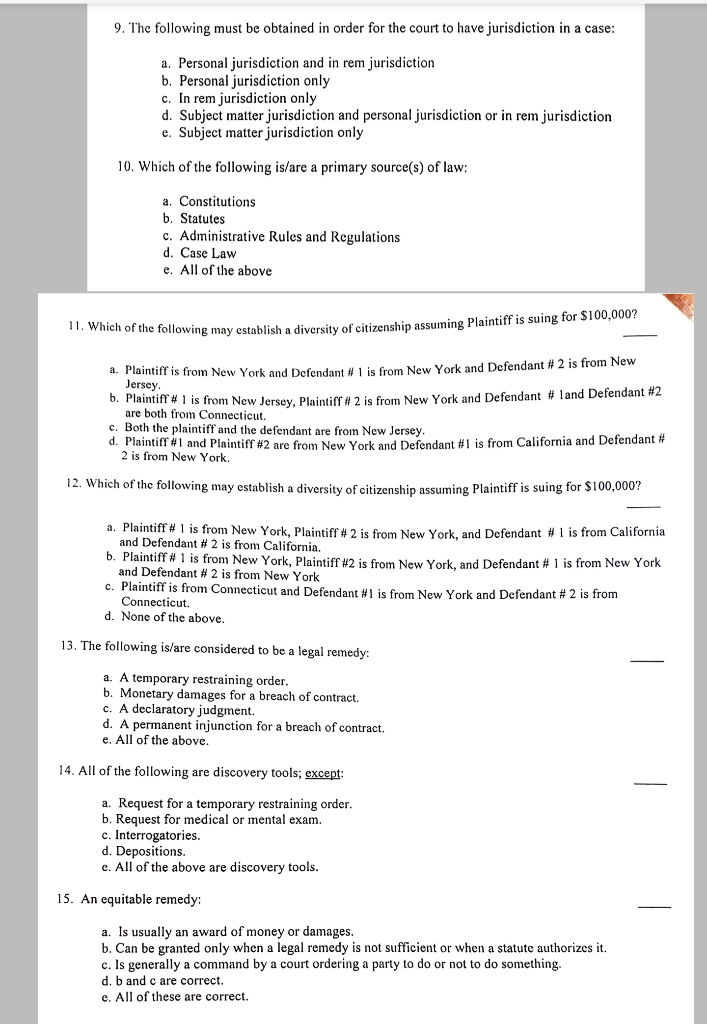
PART II: Multiple Choice. Choose the best answer. Write only the capital letter which corresponds to the answer in the space provided. (2 points each) 1. At trial, the order of questioning a witness is as follows: a. Direct examination, redirect examination, cross examination, re-cross examination. B. Cross examination, direct examination, re-cross examination, redirect examination. c. Direct examination, cross examination, redirect examination, re-cross examination. d. Direct examination, cross examination, ro-cross examination, redirect examination. 2. Common law is a. Judge made laws that establish the rules of criminal responsibility based on custom b. No longer followed and has been abolished in all states. c. Created by the executive branch of the government. d. Enacted by Congress and defines criminal laws. 3. The Doctrine of Stare Decisis means: a. Those that sleep on their rights lose their rights b. Personal and subject matter jurisdiction c. To rescind an earlier agreement d. To stand on decided cases 4. Personal jurisdiction over a nonresident defendant may be obtained by: a. Filing a notice of claim b. Filing a request for arbitration c. Long arm jurisdiction d. All of the above Which of the following must exist before a plaintiff can start a lawsuit? a. Standing b. In rem jurisdiction c. Diversity of citizenship d. Long arm jurisdiction 6. The highest Court in the United States of America is the: a. New York State Court of Appeals b. United States Supreme Court c. New York State Supreme Court d. United States Court of Appeals e. United States District Court 7. Which of the following would be considered a post-trial motion? a. Notice of appeal b. Motion for summary judgment c. Motion for a J.N.O.V. d. Motion for a directed verdict e. None of the above 8. Cases can only be filed in federal court if: a. All of the parties are from the same state b. There is a diversity of citizenship c. There is a state question of law d. There is a federal question of law e. B and D only 9. The following must be obtained in order for the court to have jurisdiction in a case: a. Personal jurisdiction and in rem jurisdiction b. Personal jurisdiction only c. In rem jurisdiction only d. Subject matter jurisdiction and personal jurisdiction or in rem jurisdiction e. Subject matter jurisdiction only 10. Which of the following is/are a primary source(s) of law: a. Constitutions b. Statutes c. Administrative Rules and Regulations d. Case Law e. All of the above 11. Which of the following may establish a diversity wing may establish a diversity of citizenship assuming Plaintiff is suing for $100,000? a. Plaintiff is from New York and Defendant #1 is from New York and Defendant # 2 is from New Jersey. b. Plaintifru is from Nomi New Jersey, Plaintiff # 2 is from New York and Defendant #land Defendant #2 are both from Connecticut. c. Both the plaintiff and the defendant are from New Jersey. d. Plaintiff #1 and Plaintiff #2 are from New York and Defendant #1 is from California and Defendant 2 is from New York. 12. Which of the following may establish a diversity of citizenshin assumine Plaintiff is suing for 100,00 a. Plaintiff # 1 is from New York, Plaintiff # 2 is from New York, and Defendant # 1 is from California and Defendant #2 is from California. b. Plaintiff # 1 is from New York, Plaintiff #2 is from New York, and Defendant # 1 is from New York and Defendant # 2 is from New York c. Plaintiff is from Connecticut and Defendant #1 is from New York and Defendant # 2 is from Connecticut. d. None of the above. 13. The following is/are considered to be a legal remedy: a. A temporary restraining order. b. Monetary damages for a breach of contract. c. A declaratory judgment. d. A permanent injunction for a breach of contract. e. All of the above. 14. All of the following are discovery tools; except: a. Request for a temporary restraining order. b. Request for medical or mental exam. c. Interrogatories. d. Depositions. e. All of the above are discovery tools. 15. An equitable remedy: a. Is usually an award of money or damages. b. Can be granted only when a legal remedy is not sufficient or when a statute authorizes it. c. Is generally a command by a court ordering a party to do or not to do something. d. b and c are correct. e. All of these are correct









 Study Help