







Question: Part II . Relationship between electric and magnetic fields ( Faraday ' s law ) Background One fascinating scientific discovery of the 1 9 t
Part II Relationship between electric and magnetic fields Faradays law
Background
One fascinating scientific discovery of the century was the realization that a varying magnetic field in time can produce electric current. This physical phenomenon was discovered by Michael Faraday, the British physicist and chemist pictured and made the foundation for the invention of electric motors. He also realized that the change of the flux of a magnetic field with respect to time is equivalent to the work done by the electric current to circulate through a wire that is immersed inside the magnetic field. Each and every electric motor "works" based on these two fundamental principles.
According to Faraday's law, an unsteady magnetic field B a magnetic field that changes in time is associated with an electric field based on the following equation
grad
In addition, the flux of the magnetic field through an immersed surface can be calculated as:
In which is the flux of the magnetic field through an immersed surface with the normal vector Accordingly, the work done by the electric current to circulate though the wire can be quantified as:
work
Problem
A dimensional magnetic field is given as:
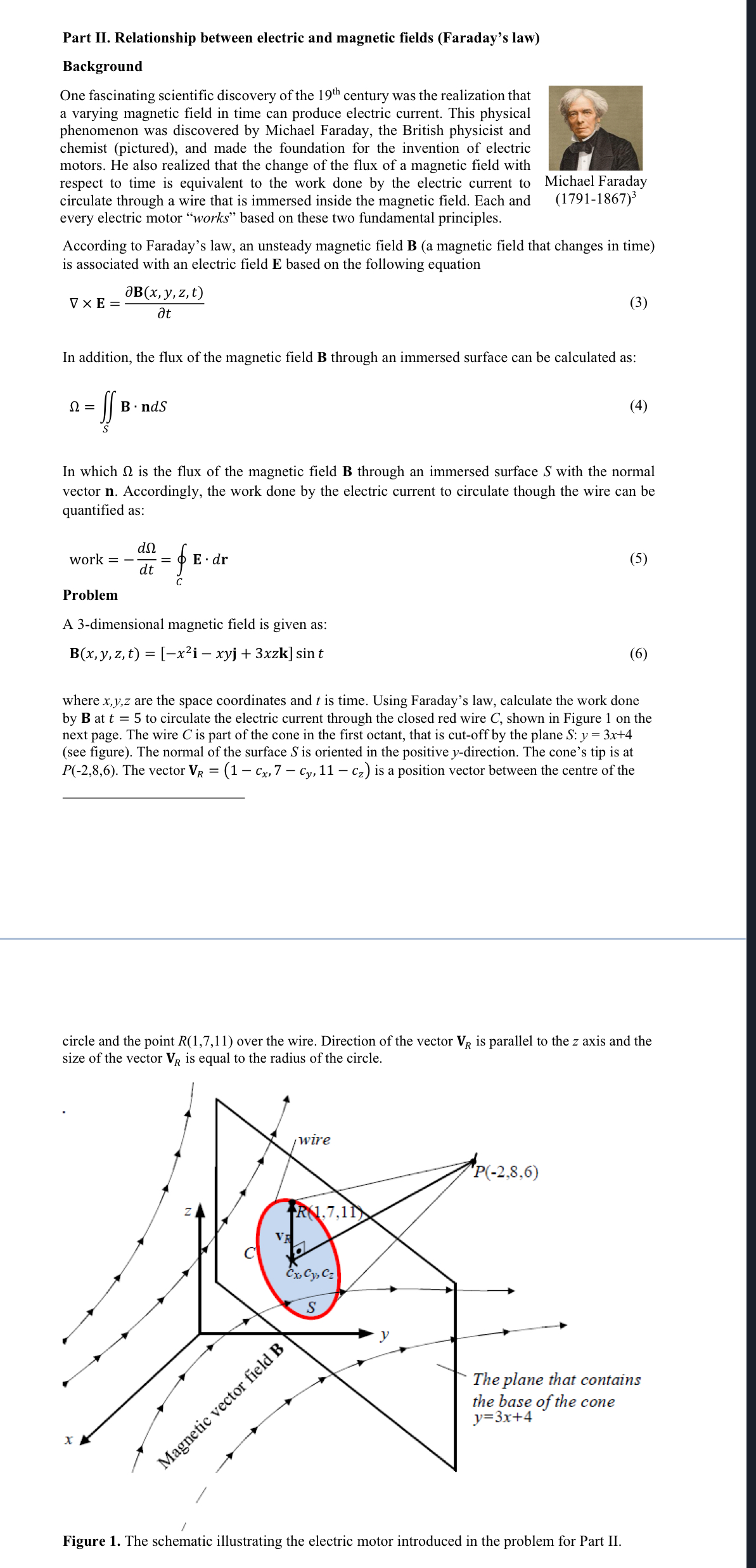
where are the space coordinates and is time. Using Faraday's law, calculate the work done by B at to circulate the electric current through the closed red wire shown in Figure on the next page. The wire is part of the cone in the first octant, that is cutoff by the plane :see figure The normal of the surface is oriented in the positive direction. The cone's tip is at The vector is a position vector between the centre of the
circle and the point over the wire. Direction of the vector is parallel to the axis and the size of the vector is equal to the radius of the circle.
Figure The schematic illustrating the electric motor introduced in the problem for Part II
Step by Step Solution
There are 3 Steps involved in it
1 Expert Approved Answer
Step: 1 Unlock

Question Has Been Solved by an Expert!
Get step-by-step solutions from verified subject matter experts
Step: 2 Unlock
Step: 3 Unlock
 Study Help