







Question: Part II The following function traverses the binary tree to locate the node with a given key value. struct tree _ node * search (
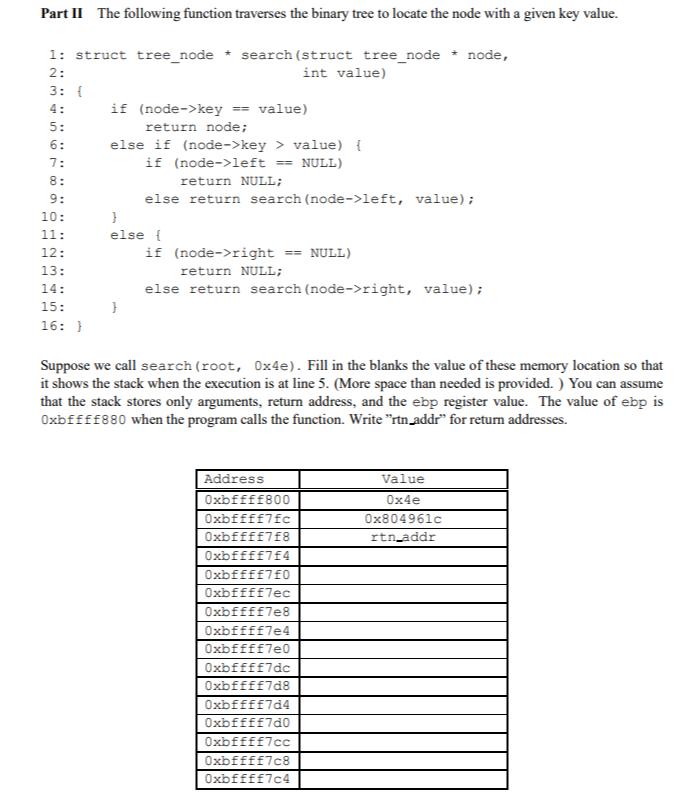
Part II The following function traverses the binary tree to locate the node with a given key value.
struct treenode searchstruct treenode node,
int value
i
if nodekey value
return node;
else if nodekey value i
if nodeleft NULL
return NULL;
else return searchnodeleft, value;
else
if noderight NULL
return NULL;
else return searchnoderight, value;
Suppose we call search root e Fill in the blanks the value of these memory location so that it shows the stack when the execution is at line More space than needed is provided. You can assume that the stack stores only arguments, return address, and the ebp register value. The value of ebp is ffff when the program calls the function. Write rtnaddr" for return addresses.
tableAddressValuexbffffxexbfffffcxcxbfffffrtnaddrxbfffffxbfffffxbffffecxbffffexbffffexbffffexbffffdcxbffffdxbffffdxbffffdxbffffccxbffffcxbffffc
Step by Step Solution
There are 3 Steps involved in it
1 Expert Approved Answer
Step: 1 Unlock

Question Has Been Solved by an Expert!
Get step-by-step solutions from verified subject matter experts
Step: 2 Unlock
Step: 3 Unlock
 Study Help