





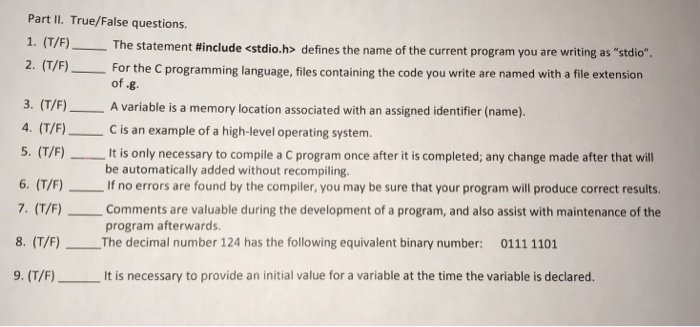
Question: Part II. True/False questions. 1. (T/ F) The statement #include defines the name of the current program you are writing as stdio. ) For the
 Part II. True/False questions. 1. (T/ F) The statement #include defines

Part II. True/False questions. 1. (T/ F) The statement #include defines the name of the current program you are writing as "stdio". ) For the C programming language, files containing the code you write are named with a file extension of .g. A variable is a memory location associated with an assigned identfer name), 3. (T/F) 4. (T/F) C is an example of a high-level operating system. 5. (T/F) It is only necessary to compile a C program once after it is completed; any change made after that will 6. (T/F)If no errors are found by the compiler, you may be sure that your program will produce correct results. 7. (T/F) Comments are valuable during the development of a program, and also assist with maintenance of the be automatically added without recompiling. program afterwards. The decimal number 124 has the following equivalent binary number: 0111 1101 8. (T/F) 9. (T/F) 1t is necessary to provide an initial value for a variable at the time the variable is declared

Step by Step Solution

There are 3 Steps involved in it

1 Expert Approved Answer
Step: 1 Unlock blur-text-image
Question Has Been Solved by an Expert!

Get step-by-step solutions from verified subject matter experts

Step: 2 Unlock
Step: 3 Unlock

Students Have Also Explored These Related Databases Questions!