





Question: PART III. NUMERICAL PROBLEMS. EACH QUESTION CARRY DIFFERENT MARKS. (TOTAL: 70 MARKS) QUESTION 1 Part A A company can decide how many additional labour hours
PART III. NUMERICAL PROBLEMS. EACH QUESTION CARRY

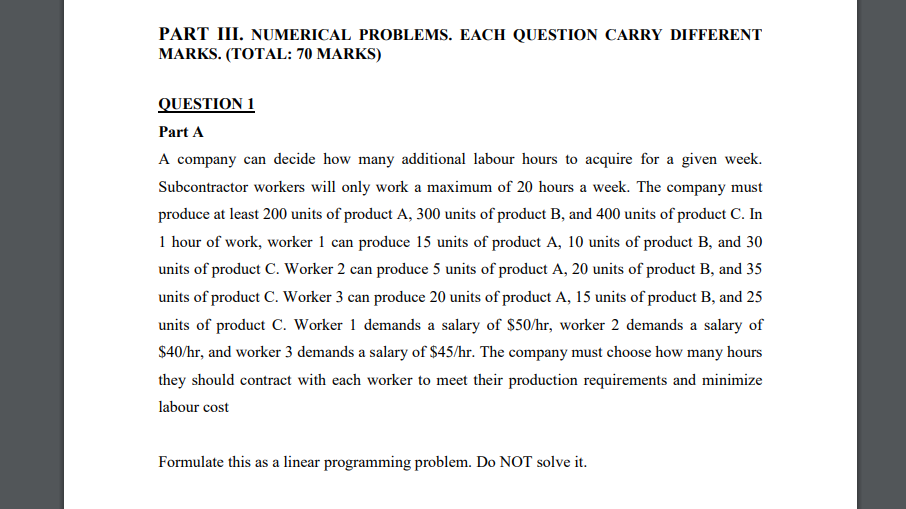
PART III. NUMERICAL PROBLEMS. EACH QUESTION CARRY DIFFERENT MARKS. (TOTAL: 70 MARKS) QUESTION 1 Part A A company can decide how many additional labour hours to acquire for a given week. Subcontractor workers will only work a maximum of 20 hours a week. The company must produce at least 200 units of product A, 300 units of product B, and 400 units of product C. In 1 hour of work, worker 1 can produce 15 units of product A, 10 units of product B, and 30 units of product C. Worker 2 can produce 5 units of product A, 20 units of product B, and 35 units of product C. Worker 3 can produce 20 units of product A, 15 units of product B, and 25 units of product C. Worker 1 demands a salary of $50/hr, worker 2 demands a salary of $40/hr, and worker 3 demands a salary of $45/hr. The company must choose how many hours they should contract with each worker to meet their production requirements and minimize labour cost Formulate this as a linear programming problem. Do NOT solve it

Step by Step Solution

There are 3 Steps involved in it

1 Expert Approved Answer
Step: 1 Unlock blur-text-image

Question Has Been Solved by an Expert!

Get step-by-step solutions from verified subject matter experts

Step: 2 Unlock
Step: 3 Unlock

Students Have Also Explored These Related General Management Questions!