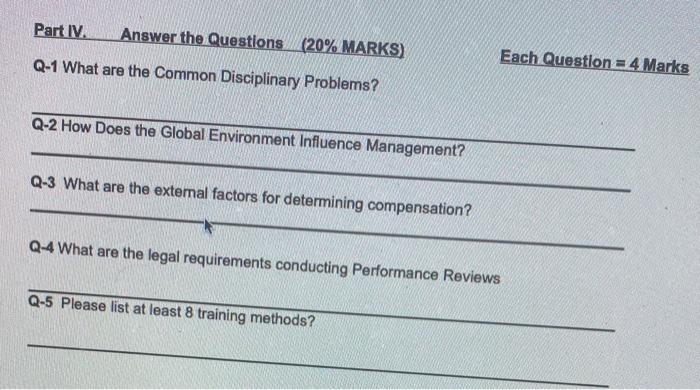
Question: Part IV. Answer the Questions (20% MARKS) Each Question = 4 Marks Q-1 What are the Common Disciplinary Problems? Q-2 How Does the Global Environment
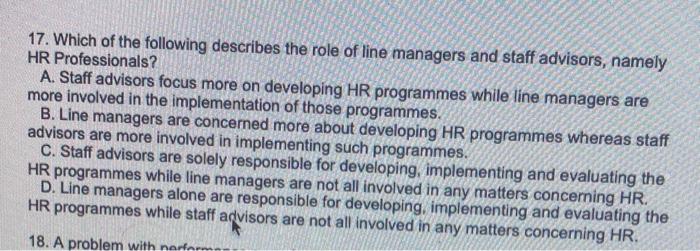
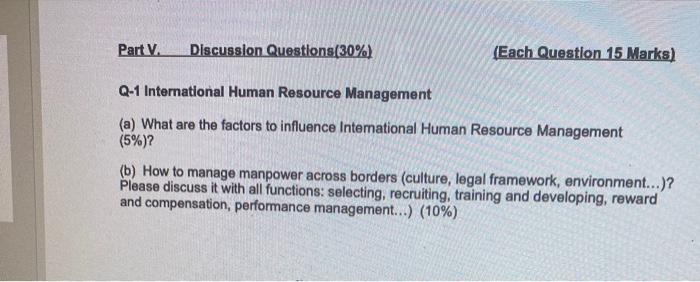
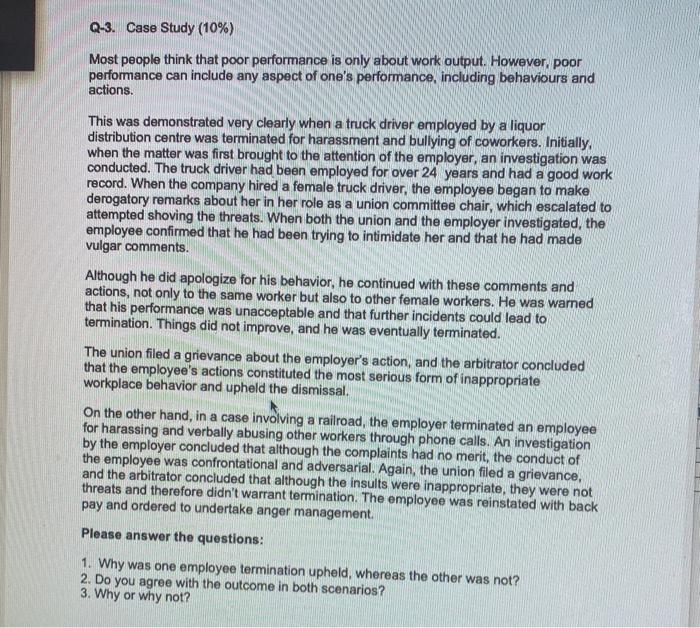
Part IV. Answer the Questions (20% MARKS) Each Question = 4 Marks Q-1 What are the Common Disciplinary Problems? Q-2 How Does the Global Environment Influence Management? Q-3 What are the external factors for determining compensation? Q-4 What are the legal requirements conducting Performance Reviews Q-5 Please list at least 8 training methods? 17. Which of the following describes the role of line managers and staff advisors, namely HR Professionals? A. Staff advisors focus more on developing HR programmes while line managers are more involved in the implementation of those programmes. B. Line managers are concerned more about developing HR programmes whereas staff advisors are more involved in implementing such programmes. C. Staff advisors are solely responsible for developing, implementing and evaluating the HR programmes while line managers are not all involved in any matters concerning HR. D. Line managers alone are responsible for developing, implementing and evaluating the HR programmes while staff advisors are not all involved in any matters concerning HR. 18. A problem with nerin Part V. Discussion Questions(30%) (Each Question 15 Marks) Q-1 International Human Resource Management (a) What are the factors to influence International Human Resource Management (5%)? (b) How to manage manpower across borders (culture, legal framework, environment...)? Please discuss it with all functions: selecting, recruiting, training and developing, reward and compensation, performance management...) (10%) Q-2. Presume you are a recruitment specialist. Please prepare your interview questions (at least ten questions) before your interview of a candidate for the next day for a job vacancy you select (5%). Q-3. Case Study (10% Q-3. Case Study (10%) Most people think that poor performance is only about work output. However, poor performance can include any aspect of one's performance, including behaviours and actions. This was demonstrated very clearly when a truck driver employed by a liquor distribution centre was terminated for harassment and bullying of coworkers. Initially, when the matter was first brought to the attention of the employer, an investigation was conducted. The truck driver had been employed for over 24 years and had a good work record. When the company hired a female truck driver, the employee began to make derogatory remarks about her in her role as a union committee chair, which escalated to attempted shoving the threats. When both the union and the employer investigated, the employee confirmed that he had been trying to intimidate her and that he had made vulgar comments. Although he did apologize for his behavior, he continued with these comments and actions, not only to the same worker but also to other female workers. He was warned that his performance was unacceptable and that further incidents could lead to termination. Things did not improve, and he was eventually terminated. The union filed a grievance about the employer's action, and the arbitrator concluded that the employee's actions constituted the most serious form of inappropriate workplace behavior and upheld the dismissal. On the other hand, in a case involving a railroad, the employer terminated an employee for harassing and verbally abusing other workers through phone calls. An investigation by the employer concluded that although the complaints had no merit, the conduct of the employee was confrontational and adversarial. Again, the union filed a grievance, and the arbitrator concluded that although the insults were inappropriate, they were not threats and therefore didn't warrant termination. The employee was reinstated with back pay and ordered to undertake anger management Please answer the questions: 1. Why was one employee termination upheld, whereas the other was not? 2. Do you agree with the outcome in both scenarios? 3. Why or why not










 Study Help