







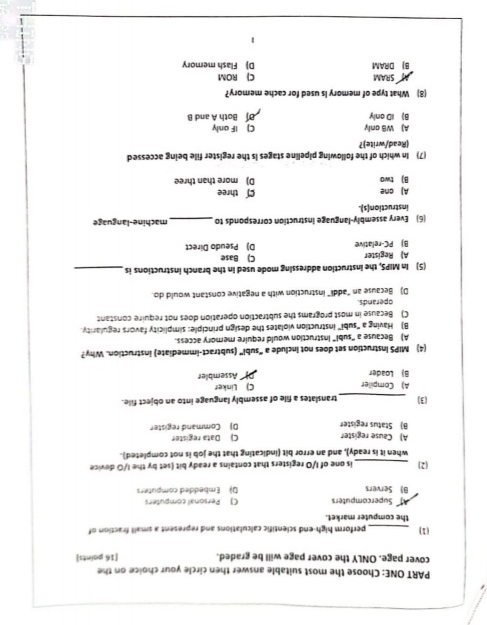
Question: PART ONE: Choose the most suitable answer then circle your choice on the cover page. ONLY the cover page will be graded. [ 1 6
PART ONE: Choose the most suitable answer then circle your choice on the cover page. ONLY the cover page will be graded.
points
perform highend scientific calculations and represent a small fraction of the computer market.
AT Supercomputers
C Fersonal computers
B Servers
Di Embedded computers
is one of registers that contains a ready bit set by the device when it is ready and an error bit indicating that the job is not completed
A Cause register
C Data register
B Status register
D Command register
translates a file of assembly language into an object file.
A Compiler
C Linker
a Loader
DY Assembler
MIPS Instruction set does not include a "subi" subtractimmediate instruction. Why?
A Because a "subi" Instruction would require memory access.
B Having a "subi" instruction violates the design principle: simplicity favors regularty.
C Because in mest programs the subtraction operation does not require constant aperands.
D Because an 'addi' instruction with a negative constant would do
In MIPS, the instruction addressing mode used in the branch instructions is
A Register
C Base
B PCrelative
D Pseudo Direct
Every assemblylanguage instruction corresponds to machinelanguage instructions
A cne
C three
B two
D more than three
In which of the fallowing plpeline stages is the register file being accessed Readwrite
A WB anly
C IF only
B ID anly
D Both A and
What type of memory is used for cache memory?
A SRAM
C ROM
B DRAM
D Flash memory
Step by Step Solution
There are 3 Steps involved in it
1 Expert Approved Answer
Step: 1 Unlock

Question Has Been Solved by an Expert!
Get step-by-step solutions from verified subject matter experts
Step: 2 Unlock
Step: 3 Unlock
 Study Help