







Question: PART ONE: Multiple Choice Questions: Select the best answer 3 points each Write your answer in the left margin next to the question answered 1.
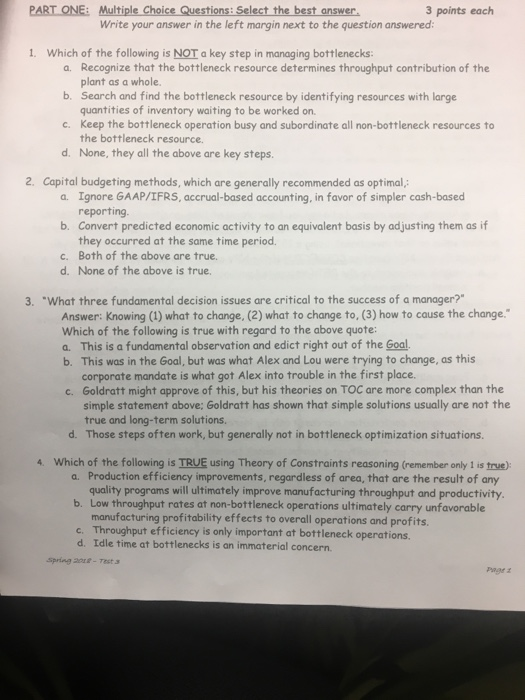
PART ONE: Multiple Choice Questions: Select the best answer 3 points each Write your answer in the left margin next to the question answered 1. Which of the following is NOT a key step in managing bottlenecks: Recognize that the bottleneck resource determines throughput contribution of the a. plant as a whole. quantities of inventory waiting to be worked on. the bottleneck resource. b. Search and find the bottleneck resource by identifying resources with large c. Keep the bottleneck operation busy and subordinate all non-bottleneck resources to d. None, they all the above are key steps. 2. Capital budgeting methods, which are generally recommended as optimal, Ignore GAAP/IFRS, accrual-based accounting, in favor of simpler cash-based reporting Convert predicted economic activity to an equivalent basis by adjusting them as if they occurred at the same time period. Both of the above are true. None of the above is true. a. b. c. d. 3. "What three fundamental decision issues are critical to the success of a manager?" Answer: Knowing (1) what to change, (2) what to change to, (3) how to cause the change Which of the following is true with regard to the above quote: a. This is a fundamental observation and edict right out of the Goal b. This was in the Goal, but was what Alex and Lou were trying to change, as this corporate mandate is what got Alex into trouble in the first place. Goldratt might approve of this, but his theories on TOC are more complex than the c. simple statement above; Goldratt has shown that simple solutions usually are not the true and long-term solutions. d. Those steps often work, but generally not in bottleneck optimization situations. 4 Which of the following is TRUE using Theory of Constraints reasoning (remember only 1 is trve): a. Production efficiency improvements, regardless of area, that are the result of amy quality programs will ultimately improve manufacturing throughput and productivity b. Low throughput rates at non-bottleneck operations ultimately carry unfavorable manufacturing profitability effects to overall operations and profits c. Throughput efficiency is only important at bottleneck operations d. Idle time at bottlenecks is an immaterial concern. spring apre- Test s Pagr a
Step by Step Solution
There are 3 Steps involved in it

Get step-by-step solutions from verified subject matter experts
 Study Help