







Question: Part Two covers non-leaf functions those that call another function Once again, a MIPS stack frame should conform to the format discussed in-class and in
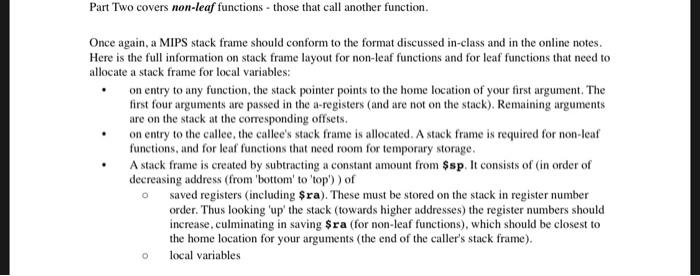
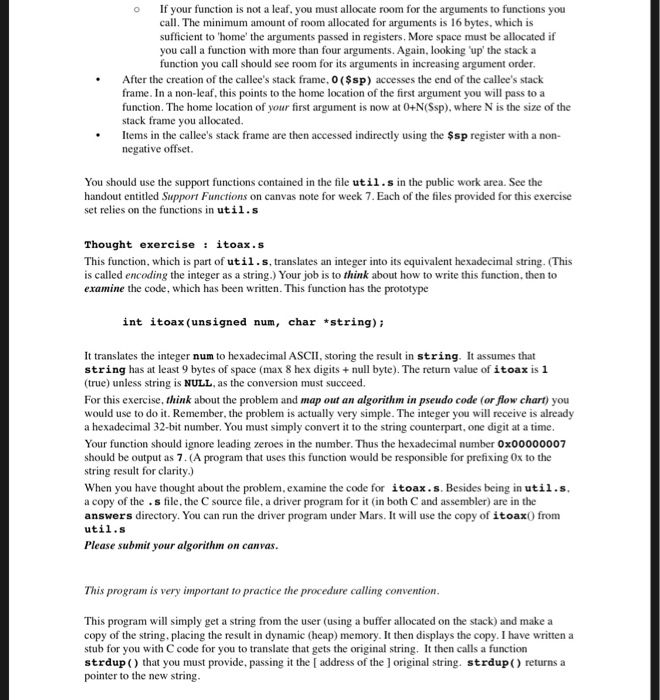
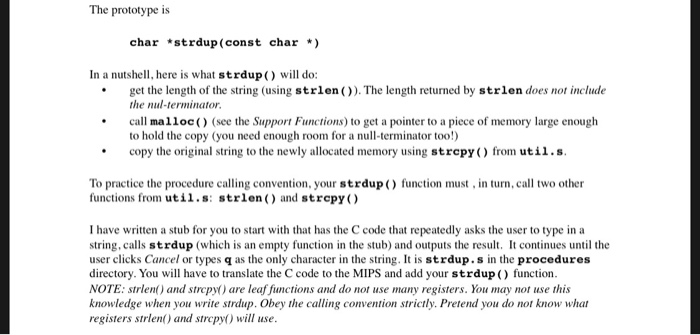
Part Two covers non-leaf functions those that call another function Once again, a MIPS stack frame should conform to the format discussed in-class and in the online notes Here is the full information on stack frame layout for non-leaf functions and for leaf functions that need to allocate a stack frame for local variables: on entry to any function, the stack pointer points to the home location of your first argument. The irst four arguments are passed in the a-registers (and are not on the stack). Remaining arguments are on the stack at the corresponding offsets on entry to the callee, the callee's stack frame is allocated. A stack frame is required for non-leaf functions, and for leaf functions that need room for temporary storage A stack frame is created by subtracting a constant amount from $sp. It consists of (in order of decreasing address (from 'bottom' to 'top)) of o saved registers (including $ra). These must be stored on the stack in register number order. Thus looking 'up' the stack (towards higher addresses) the register numbers should increase, culminating in saving $ra (for non-leaf functions), which should be closest to the home location for your arguments (the end of the caller's stack frame) o local variables Part Two covers non-leaf functions those that call another function Once again, a MIPS stack frame should conform to the format discussed in-class and in the online notes Here is the full information on stack frame layout for non-leaf functions and for leaf functions that need to allocate a stack frame for local variables: on entry to any function, the stack pointer points to the home location of your first argument. The irst four arguments are passed in the a-registers (and are not on the stack). Remaining arguments are on the stack at the corresponding offsets on entry to the callee, the callee's stack frame is allocated. A stack frame is required for non-leaf functions, and for leaf functions that need room for temporary storage A stack frame is created by subtracting a constant amount from $sp. It consists of (in order of decreasing address (from 'bottom' to 'top)) of o saved registers (including $ra). These must be stored on the stack in register number order. Thus looking 'up' the stack (towards higher addresses) the register numbers should increase, culminating in saving $ra (for non-leaf functions), which should be closest to the home location for your arguments (the end of the caller's stack frame) o local variables
Step by Step Solution
There are 3 Steps involved in it

Get step-by-step solutions from verified subject matter experts
 Study Help