Question: Part Two: Operational Recommendations : Read through the Preassessment Evaluation Summary (located in the Supporting Materials section) for each aspect of the TBL (people, profit,
-
 Part Two: Operational Recommendations: Read through the Preassessment Evaluation Summary (located in the Supporting Materials section) for each aspect of the TBL (people, profit, and planet). You will need to provide a detailed description of the initiatives that will create the needed improvement. You should note the organizational and societal value of the initiative along with the operational management techniques recommended to plan and complete each initiative. For each of your three initiatives, address the following:
 - Organizational Impacts: Describe the organizational benefits of each initiative, specifically noting the expected positive impact of completing each. Examples of positive impacts include better alignment to the organizations mission, vision, and culture statements; increased amounts of funds or resources saved; and improvements to the organizations brand.
- Societal Impacts: Describe the societal benefits of each initiative, specifically noting the expected positive impact of completing each. Examples of positive impacts include increased community building and positive environmental impact.
- Customer Impacts: Describe the consumer benefits of each selected initiative, specifically noting the expected positive impact of completing each. Examples of positive impacts include increased alignment to target markets, improved product access and availability, and improved customer satisfaction.
- Business Risks: Explain the business risks associated with prioritizing, planning, and resourcing each initiative and how these risks will be considered and monitored.
- Operational Management Techniques: Recommend an operational management strategy or technique (e.g., project management, lean manufacturing, or Six Sigma) that is appropriate to implement for each selected initiative, and explain why.
- Defining Requirements and Scope: Define the requirements for the successful implantation of each selected initiative as well as the scope of each. Describe how changes to the requirements and scope would impact timelines, budget, and risk.
- Roles and Responsibilities: Explain the key internal and external stakeholders who would be involved in planning and implementing each selected initiative, as well as why each identified stakeholder is needed to successfully implement the initiatives.
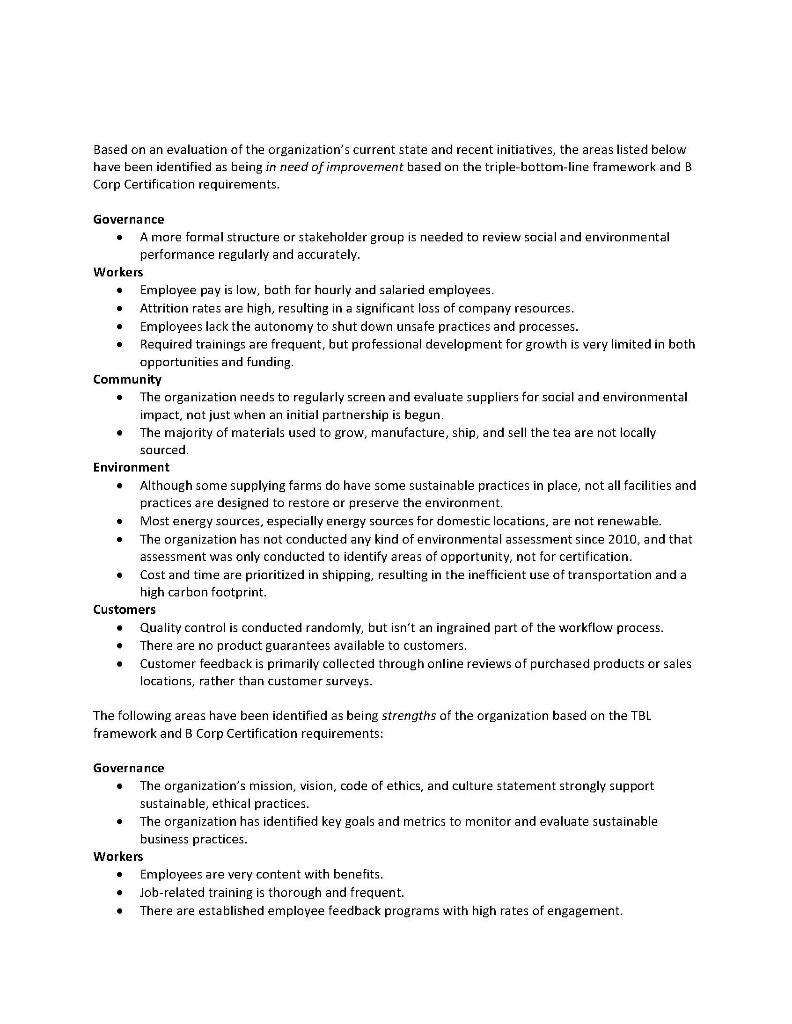
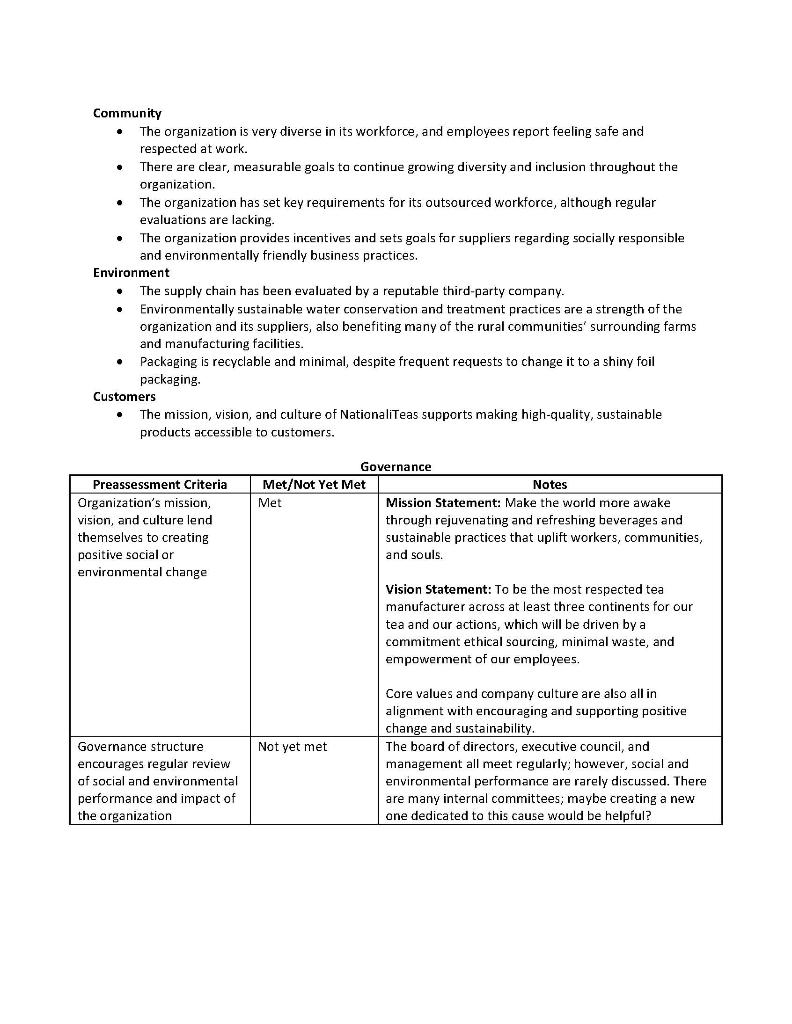
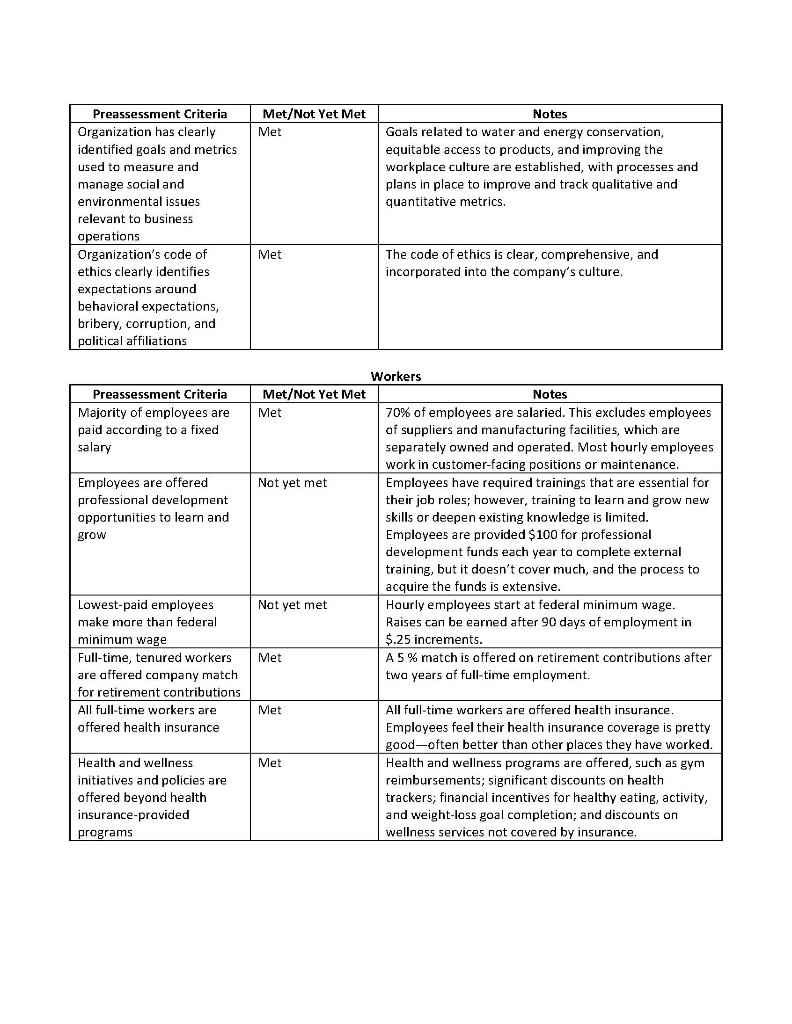
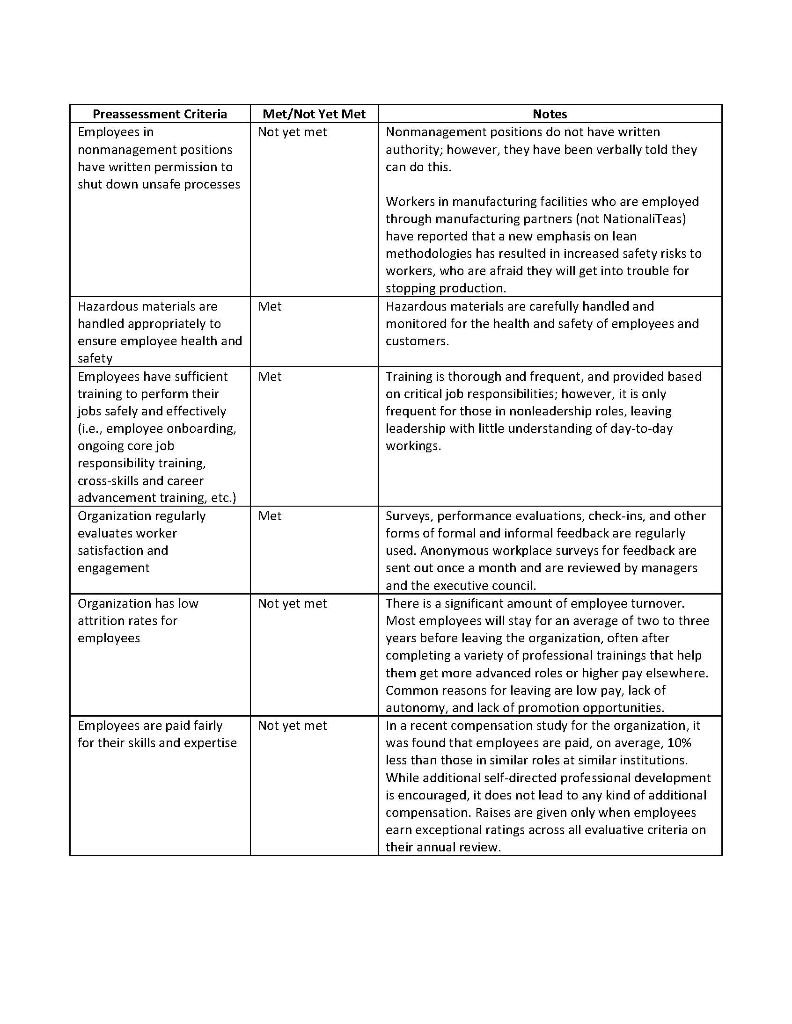
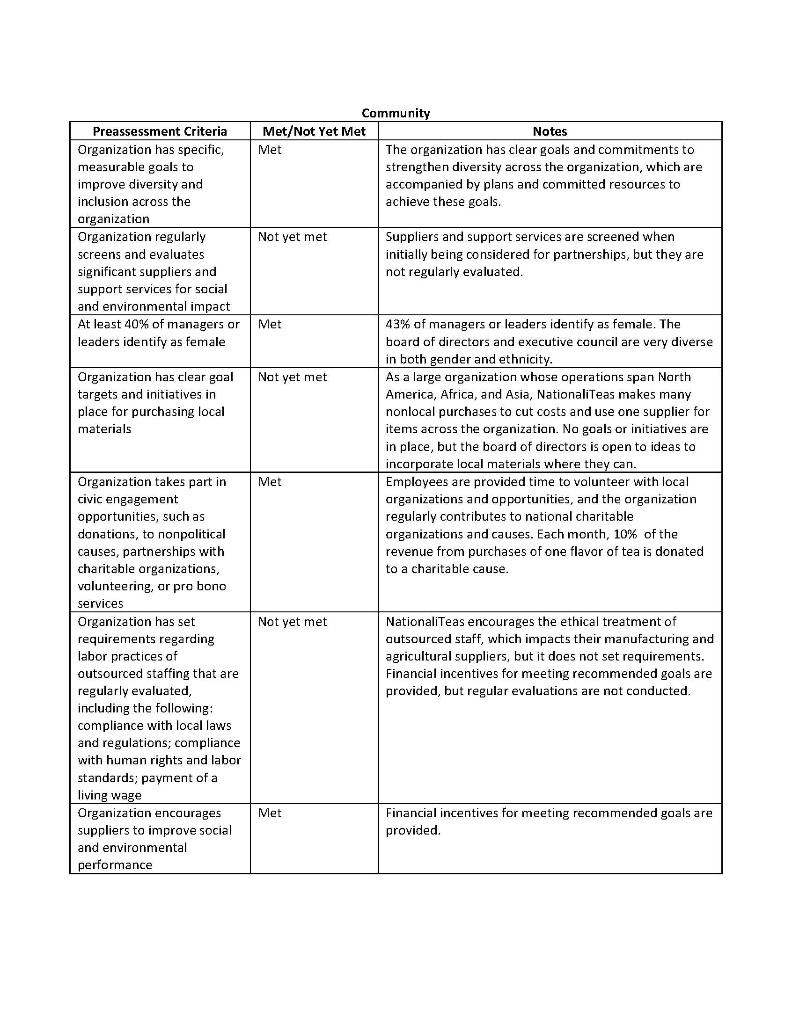
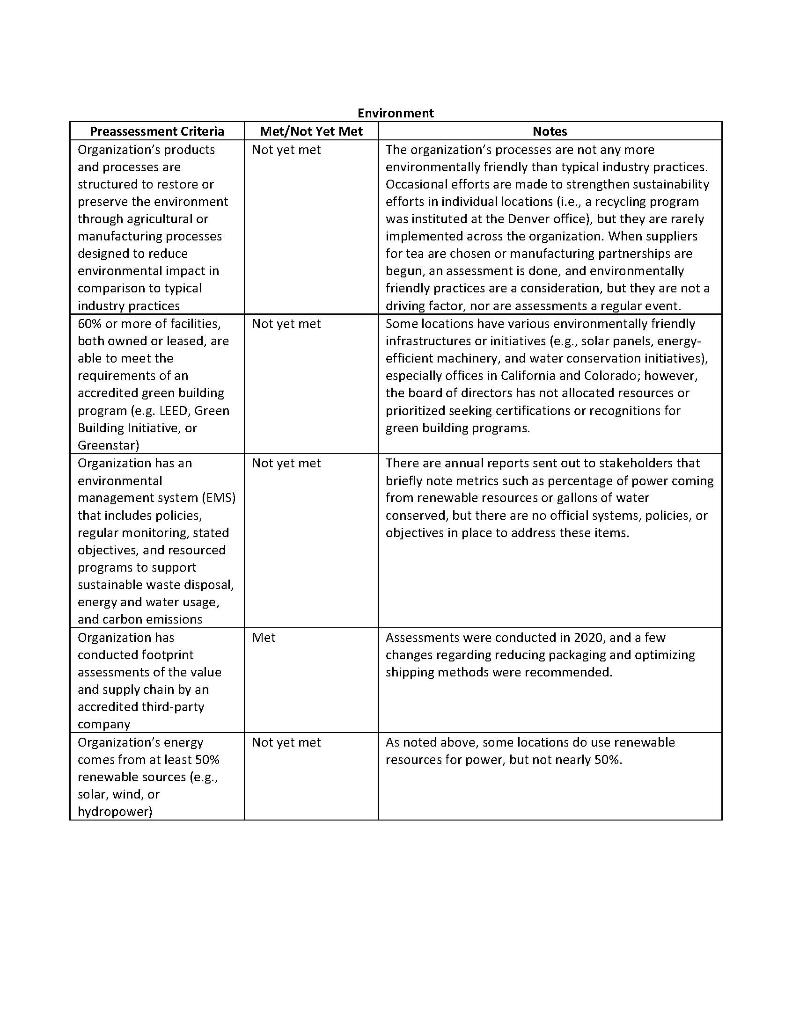
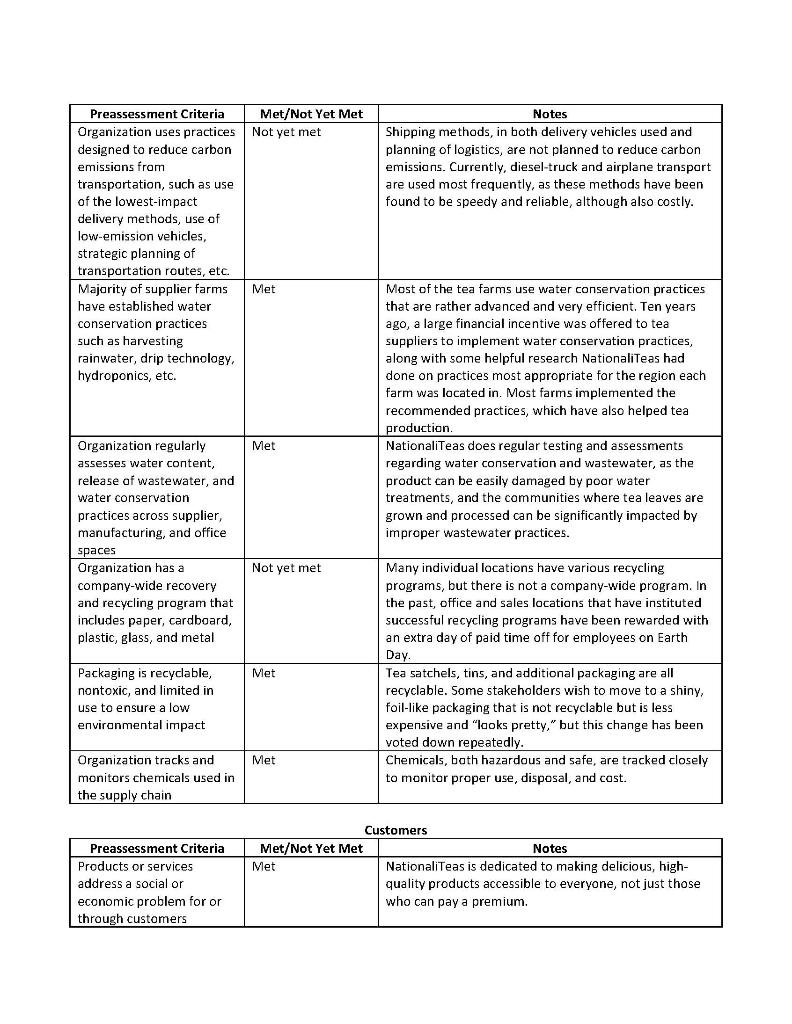
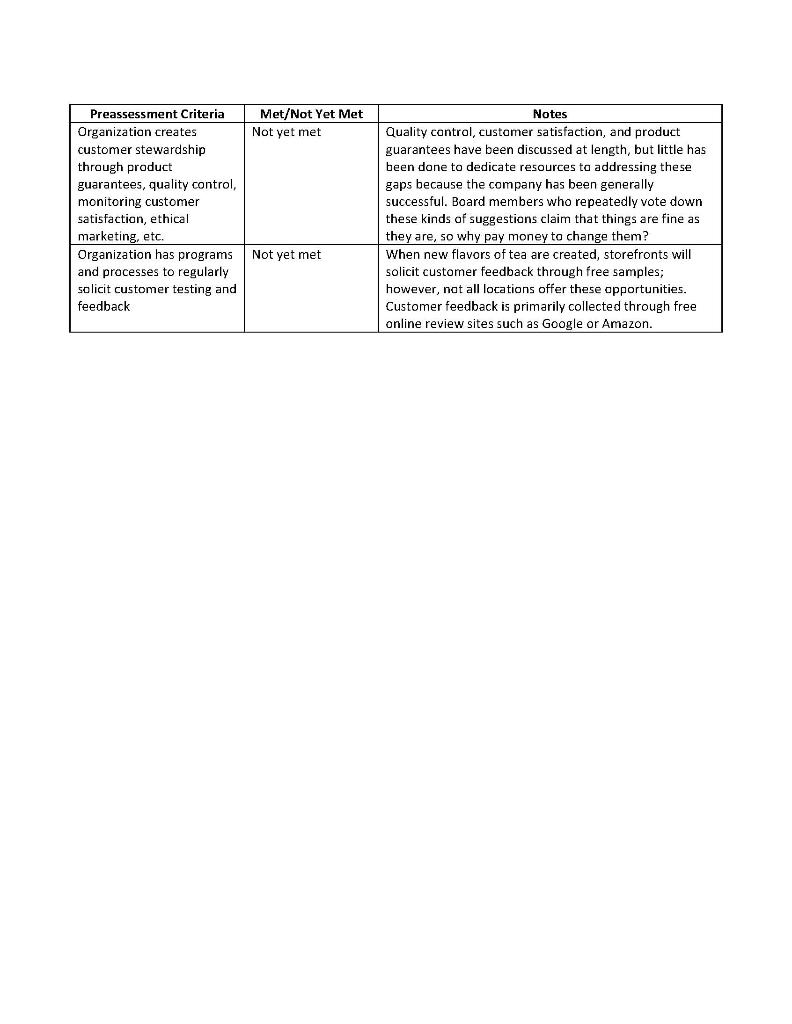
Based on an evaluation of the organization's current state and recent initiatives, the areas listed below have been identified as being in need of improvement based on the triple-bottom-line framework and B Corp Certification requirements. Governance . . A more formal structure or stakeholder group is needed to review social and environmental performance regularly and accurately. Workers Employee pay is low, both for hourly and salaried employees. Attrition rates are high, resulting in a significant loss of company resources. Employees lack the autonomy to shut down unsafe practices and processes. Required trainings are frequent, but professional development for growth is very limited in both opportunities and funding. Community The organization needs to regularly screen and evaluate suppliers for social and environmental impact, not just when an initial partnership is begun. The majority of materials used to grow, manufacture, ship, and sell the tea are not locally sourced. Environment . Although some supplying farms do have some sustainable practices in place, not all facilities and practices are designed to restore or preserve the environment. Most energy sources, especially energy sources for domestic locations, are not renewable. The organization has not conducted any kind of environmental assessment since 2010, and that assessment was only conducted to identify areas of opportunity, not for certification. Cost and time are prioritized in shipping, resulting in the inefficient use of transportation and a high carbon footprint. Customers Quality control is conducted randomly, but isn't an ingrained part of the workflow process. There are no product guarantees available to customers. Customer feedback is primarily collected through online reviews of purchased products or sales locations, rather than customer surveys. The following areas have been identified as being strengths of the organization based on the TBL framework and B Corp Certification requirements: . Governance The organization's mission, vision, code of ethics, and culture statement strongly support sustainable, ethical practices. The organization has identified key goals and metrics to monitor and evaluate sustainable business practices. Workers Employees are very content with benefits. Job-related training is thorough and frequent. There are established employee feedback programs with high rates of engagement. . . . . . Community The organization is very diverse in its workforce, and employees report feeling safe and respected at work. There are clear, measurable goals to continue growing diversity and inclusion throughout the organization. The organization has set key requirements for its outsourced workforce, although regular evaluations are lacking. The organization provides incentives and sets goals for suppliers regarding socially responsible and environmentally friendly business practices. Environment . The supply chain has been evaluated by a reputable third-party company. Environmentally sustainable water conservation and treatment practices are a strength of the organization and its suppliers, also benefiting many of the rural communities' surrounding farms and manufacturing facilities. Packaging is recyclable and minimal, despite frequent requests to change it to a shiny foil packaging. Customers The mission, vision, and culture of Nationaliteas supports making high-quality, sustainable products accessible to customers. . Governance Preassessment Criteria Met/Not Yet Met Notes Met Mission Statement: Make the world more awake Organization's mission, vision, and culture lend themselves to creating positive social or environmental change through rejuvenating and refreshing beverages and sustainable practices that uplift workers, communities, and souls. Vision Statement: To be the most respected tea manufacturer across at least three continents for our tea and our actions, which will be driven by a commitment ethical sourcing, minimal waste, and empowerment of our employees. Not yet met Governance structure encourages regular review of social and environmental performance and impact of the organization Core values and company culture are also all in alignment with encouraging and supporting positive change and sustainability. The board of directors, executive council, and management all meet regularly; however, social and environmental performance are rarely discussed. There are many internal committees; maybe creating a new one dedicated to this cause would be helpful? Preassessment Criteria Met/Not Yet Met Met Organization has clearly identified goals and metrics used to measure and manage social and environmental issues Notes Goals related to water and energy conservation, equitable access to products, and improving the workplace culture are established, with processes and plans in place to improve and track qualitative and quantitative metrics. relevant to business Met The code of ethics is clear, comprehensive, and incorporated into the company's culture. operations Organization's code of ethics clearly identifies expectations around behavioral expectations, bribery, corruption, and political affiliations Preassessment Criteria Majority of employees are paid according to a fixed salary Employees are offered professional development opportunities to learn and Workers Met/Not Yet Met Notes Met 70% of employees are salaried. This excludes employees of suppliers and manufacturing facilities, which are separately owned and operated. Most hourly employees work in customer-facing positions or maintenance. Not yet met Employees have required trainings that are essential for their job roles; however, training to learn and grow new skills or deepen existing knowledge is limited. Employees are provided $100 for professional development funds each year to complete external training, but it doesn't cover much, and the process to acquire the funds is extensive. Not yet met Hourly employees start at federal minimum wage. Raises can be earned after 90 days of employment in $.25 increments. Met A5% match is offered on retirement contributions after two years of full-time employment grow Lowest-paid employees make more than federal minimum wage Full-time, tenured workers are offered company match for retirement contributions All full-time workers are offered health insurance Met Met Health and wellness initiatives and policies are offered beyond health insurance provided All full-time workers are offered health insurance. Employees feel their health insurance coverage is pretty good-often better than other places they have worked. Health and wellness programs are offered, such as gym reimbursements; significant discounts on health trackers; financial incentives for healthy eating, activity, and weight-loss goal completion; and discounts on wellness services not covered by insurance programs Preassessment Criteria Met/Not Yet Met Not yet met Employees in nonmanagement positions have written permission to shut down unsafe processes Notes Nonmanagement positions do not have written authority; however, they have been verbally told they can do this. Workers in manufacturing facilities who are employed through manufacturing partners (not NationaliTeas) have reported that a new emphasis on lean methodologies has resulted in increased safety risks to workers, who are afraid they will get into trouble for stopping production. Hazardous materials are carefully handled and monitored for the health and safety of employees and customers Met Met Hazardous materials are handled appropriately to ensure employee health and safety Employees have sufficient training to perform their jobs safely and effectively (i.e., employee onboarding, ongoing core job responsibility training, cross-skills and career advancement training, etc.) Organization regularly evaluates worker satisfaction and Training is thorough and frequent, and provided based on critical job responsibilities; however, it is only frequent for those in nonleadership roles, leaving leadership with little understanding of day-to-day workings. Met engagement Not yet met Organization has low attrition rates for employees Surveys, performance evaluations, check-ins, and other forms of formal and informal feedback are regularly used. Anonymous workplace surveys for feedback are sent out once a month and are reviewed by managers and the executive council. There is a significant amount of employee turnover. Most employees will stay for an average of two to three years before leaving the organization, often after completing a variety of professional trainings that help them get more advanced roles or higher pay elsewhere. Common reasons for leaving are low pay, lack of autonomy, and lack of promotion opportunities. In a recent compensation study for the organization, it was found that employees are paid, on average, 10% less than those in similar roles at similar institutions. While additional self-directed professional development is encouraged, it does not lead to any kind of additional compensation. Raises are given only when employees earn exceptional ratings across all evaluative criteria on their annual review. Not yet met Employees are paid fairly for their skills and expertise Community Met/Not Yet Met Notes Met The organization has clear goals and commitments to strengthen diversity across the organization, which are accompanied by plans and committed resources to achieve these goals. Preassessment Criteria Organization has specific, measurable goals to improve diversity and inclusion across the organization Organization regularly screens and evaluates significant suppliers and support services for social and environmental impact At least 40% of managers or leaders identify as female Not yet met Suppliers and support services are screened when initially being considered for partnerships, but they are not regularly evaluated. Met Not yet met Organization has clear goal targets and initiatives in place for purchasing local materials 43% of managers or leaders identify as female. The board of directors and executive council are very diverse in both gender and ethnicity As a large organization whose operations span North America, Africa, and Asia, NationaliTeas makes many nonlocal purchases to cut costs and use one supplier for items across the organization. No goals or initiatives are in place, but the board of directors is open to ideas to incorporate local materials where they can. Employees are provided time to volunteer with local organizations and opportunities, and the organization regularly contributes to national charitable organizations and causes. Each month, 10% of the revenue from purchases of one flavor of tea is donated to a charitable cause. Met Not yet met Organization takes part in civic engagement opportunities, such as donations, to nonpolitical causes, partnerships with charitable organizations, volunteering, or pro bono services Organization has set requirements regarding labor practices of outsourced staffing that are regularly evaluated, including the following: compliance with local laws and regulations; compliance with human rights and labor standards; payment of a living wage Organization encourages suppliers to improve social and environmental performance NationaliTeas encourages the ethical treatment of autsourced staff, which impacts their manufacturing and agricultural suppliers, but it does not set requirements. Financial incentives for meeting recommended goals are provided, but regular evaluations are not conducted. Met Financial incentives for meeting recommended goals are provided Environment Preassessment Criteria Notes Met/Not Yet Met Not yet met Organization's products and processes are structured to restore or preserve the environment The organization's processes are not any more environmentally friendly than typical industry practices. Occasional efforts are made to strengthen sustainability efforts in individual locations (ie, a recycling program was instituted at the Denver office), but they are rarely implemented across the organization. When suppliers for tea are chosen or manufacturing partnerships are begun, an assessment is done, and environmentally friendly practices are a consideration, but they are not a driving factor, nor are assessments a regular event. Some locations have various environmentally friendly infrastructures ar initiatives (e.g., solar panels, energy- efficient machinery, and water conservation initiatives), especially offices in California and Colorado; however, the board of directors has not allocated resources or prioritized seeking certifications or recognitions for green building programs. Not yet met Not yet met through agricultural or manufacturing processes designed to reduce environmental impact in comparison to typical industry practices 60% or more of facilities, both owned or leased, are able to meet the requirements of an accredited green building program (e.g. LEED, Green Building Initiative, or Greenstar) Organization has an environmental management system (EMS) that includes policies, regular monitoring, stated objectives, and resourced programs to support sustainable waste disposal, energy and water usage, and carbon emissions Organization has conducted footprint assessments of the value and supply chain by an accredited third-party company Organization's energy comes from at least 50% renewable sources (e.g., solar, wind, or hydropower) ere are annual reports sent out to stakehold briefly note metrics such as percentage of power coming from renewable resources or gallons of water conserved, t there are no official systems, policies, or objectives in place to address these items. Met Assessments were conducted in 2020, and a few changes regarding reducing packaging and optimizing shipping methods were recommended. Not yet met As noted above, some locations do use renewable resources for power, but not nearly 50%. Notes Shipping methods, in both delivery vehicles used and planning of logistics, are not planned to reduce carbon emissions. Currently, diesel-truck and airplane transport are used most frequently, as these methods have been found to be speedy and reliable, although also costly. Preassessment Criteria Met/Not Yet Met Organization uses practices Not yet met designed to reduce carbon emissions fram transportation, such as use of the lowest-impact delivery methods, use of low-emission vehicles, strategic planning of transportation routes, etc. Majority of supplier farms Met have established water conservation practices such as harvesting rainwater, drip technology, hydroponics, etc. Most of the tea farms use water conservation practices that are rather advanced and very efficient. Ten years ago, a large financial incentive was offered to tea suppliers to implement water conservation practices, along with some helpful research Nationaliteas had done on practices most appropriate for the region each farm was located in. Most farms implemented the recommended practices, which have also helped tea production National Teas does regular testing and assessments regarding water conservation and wastewater, as the product can be easily damaged by poor water treatments, and the communities where tea leaves are grown and processed can be significantly impacted by improper wastewater practices. Met Organization regularly assesses water content, release of wastewater, and water conservation practices across supplier, manufacturing, and office spaces Not yet met Organization has a company-wide recovery and recycling program that includes paper, cardboard, plastic, glass, and metal Met Packaging is recyclable, nontoxic, and limited in use to ensure a low Many individual locations have various recycling programs, but there is not a company-wide program. In the past, office and sales locations that have instituted successful recycling programs have been rewarded with an extra day of paid time off for employees on Earth Day. Tea satchels, tins, and additional packaging are all recyclable. Some stakeholders wish to move to a shiny, foil-like packaging that is not recyclable but is less expensive and "looks pretty," but this change has been voted down repeatedly. Chemicals, both hazardous and safe, are tracked closely to monitor proper use, disposal, and cast. environmental impact Organization tracks and Met monitors chemicals used in the supply chain Customers Preassessment Criteria Met/Not Yet Met Met Products or services address a social or Notes NationaliTeas is dedicated to making delicious, high- quality products accessible to everyone, not just those who can pay a premium. economic problem for or through customers Preassessment Criteria Met/Not Yet Met Not yet met Organization creates customer stewardship through product guarantees, quality control, monitoring customer satisfaction, ethical marketing, etc. Organization has programs and processes to regularly solicit customer testing and feedback Notes Quality control, customer satisfaction, and product guarantees have been discussed at length, but little has been done to dedicate resources to addressing these gaps because the company has been generally successful. Board members who repeatedly vote down these kinds of suggestions claim that things are fine as they are, so why pay money to change them? When new flavors of tea are created, storefronts will solicit customer feedback through free samples; however, not all locations offer these opportunities. Customer feedback is primarily collected through free online review sites such as Google or Amazon. Not yet met









 Study Help