







Question: Part:-2 Discussion question: Page: - Please read Chapter 2 JOB PERFORMANCE carefully and then give your answers on the basis of your understanding. 4. Consider

Part:-2 Discussion question: Page: - Please read Chapter 2 JOB PERFORMANCE carefully and then give your answers on the basis of your understanding. 4. Consider how you would react to 360-degree feedback. If you were the one receiving the feedback, whose views would you value most: your managers or your peers? If you were asked to assess a peer, would you want your opinion to affect that peers raises or promotions? (2 Marks) (Min words 200-300) Important Note: - Support your submission with course material concepts, principles, and theories from the textbook and at least two scholarly, peer-reviewed journal articles.
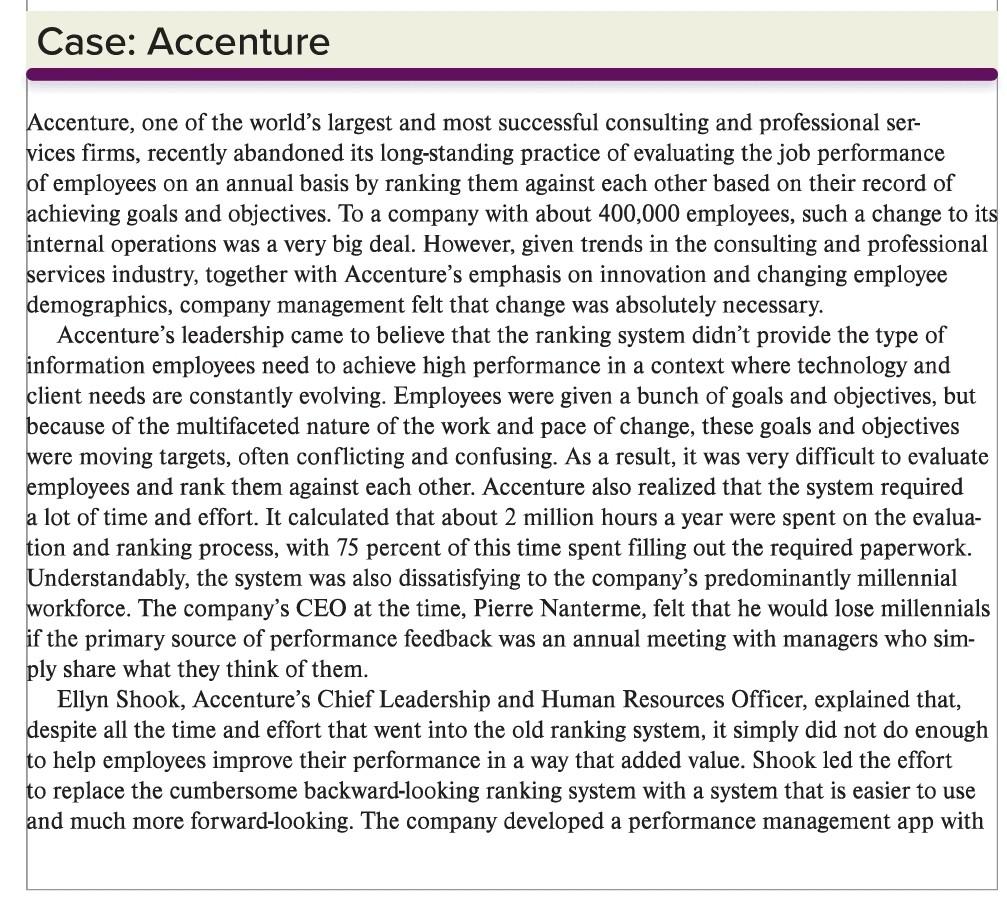
Case: Accenture Accenture, one of the world's largest and most successful consulting and professional ser- vices firms, recently abandoned its long-standing practice of evaluating the job performance of employees on an annual basis by ranking them against each other based on their record of achieving goals and objectives. To a company with about 400,000 employees, such a change to its internal operations was a very big deal. However, given trends in the consulting and professional services industry, together with Accenture's emphasis on innovation and changing employee demographics, company management felt that change was absolutely necessary. Accenture's leadership came to believe that the ranking system didn't provide the type of information employees need to achieve high performance in a context where technology and client needs are constantly evolving. Employees were given a bunch of goals and objectives, but because of the multifaceted nature of the work and pace of change, these goals and objectives were moving targets, often conflicting and confusing. As a result, it was very difficult to evaluate employees and rank them against each other. Accenture also realized that the system required a lot of time and effort. It calculated that about 2 million hours a year were spent on the evalua- tion and ranking process, with 75 percent of this time spent filling out the required paperwork. Understandably, the system was also dissatisfying to the company's predominantly millennial workforce. The company's CEO at the time, Pierre Nanterme, felt that he would lose millennials if the primary source of performance feedback was an annual meeting with managers who sim- ply share what they think of them. Ellyn Shook, Accenture's Chief Leadership and Human Resources Officer, explained that, despite all the time and effort that went into the old ranking system, it simply did not do enough to help employees improve their performance in a way that added value. Shook led the effort to replace the cumbersome backward-looking ranking system with a system that is easier to use and much more forward-looking. The company developed a performance management app with voice recognition that works on mobile devices. Employees use the app whenever they wish to ask for and receive immediate feedback from coworkers. This way they can apply it immediately to improve their skills. Accenture reports that their new program has been successful. The app is visited over 70,000 times a day, employee mood has improved, and recruiters refer to the app during job interviews because they believe applicants consider it a selling pointStep by Step Solution
There are 3 Steps involved in it
1 Expert Approved Answer
Step: 1 Unlock

Question Has Been Solved by an Expert!
Get step-by-step solutions from verified subject matter experts
Step: 2 Unlock
Step: 3 Unlock
 Study Help