Question: Part-2: Discussion questions Please read Chapter 8 Pg-No. 279 & 281 carefully and then give your answers on the basis of your understanding. 4. Why
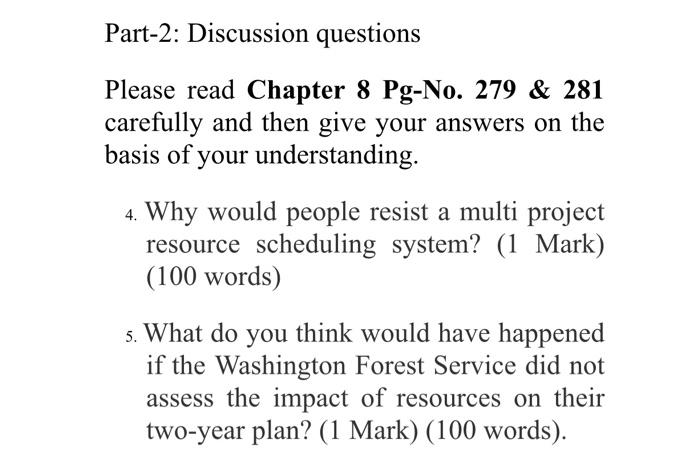
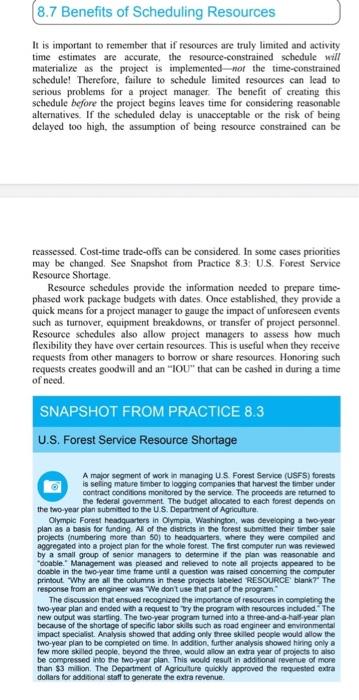
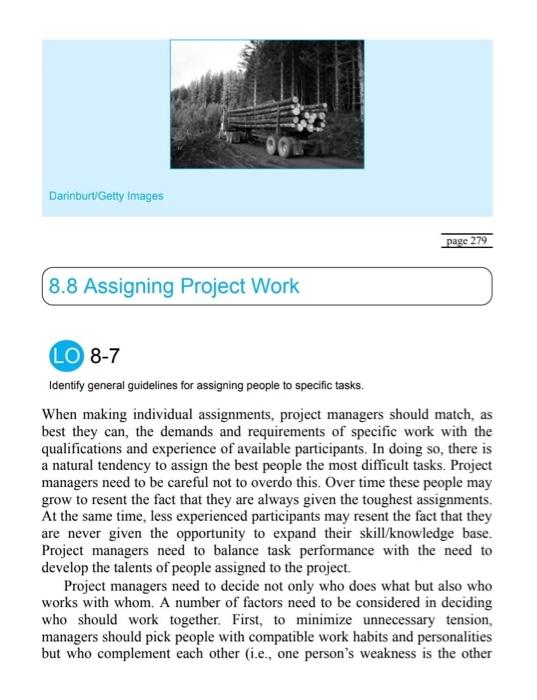
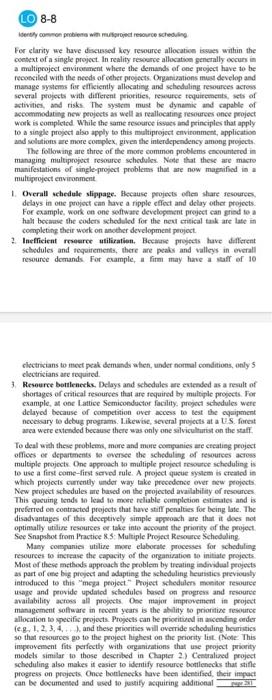
Part-2: Discussion questions Please read Chapter 8 Pg-No. 279 & 281 carefully and then give your answers on the basis of your understanding. 4. Why would people resist a multi project resource scheduling system? (1 Mark) (100 words) 5. What do you think would have happened if the Washington Forest Service did not assess the impact of resources on their two-year plan? (1 Mark) (100 words). (8.7 Benefits of Scheduling Resources It is important to remember that if resources are truly limited and activity time estimates are accurate, the resource-constrained schedule will materialize as the project is implemented not the time-constrained schedule! Therefore, failure to schedule limited resources can lead to serious problems for a project manager. The benefit of creating this schedule before the project begins leaves time for considering reasonable alternatives. If the scheduled delay is unacceptable or the risk of being delayed too high, the assumption of being resource constrained can be reassessed. Cost-time trade-offs can be considered. In some cases priorities may be changed. See Snapshot from Practice 8.3: U.S. Forest Service Resource Shortage. Resource schedules provide the information needed to prepare time- phased work package budgets with dates. Once established, they provide a quick means for a project manager to gauge the impact of unforeseen events such as turnover, equipment breakdowns, or transfer of project personnel. Resource schedules also allow project managers to assess how much flexibility they have over certain resources. This is useful when they receive requests from other managers to borrow or share resources. Honoring such requests creates goodwill and an "IOU" that can be cashed in during a time of need. SNAPSHOT FROM PRACTICE 8.3 U.S. Forest Service Resource Shortage A major segment of work in managing US Forest Service (USFS) forests is selling mature timber to logging companies that harvest the timber under contract conditions monitored by the service. The proceeds are returned to the federal government. The budget allocated to each forest depends on the two-year plan submitted to the U.S. Department of Agriculture. Olympic Forest headquarters in Olympia, Washington, was developing a two-year plan as a basis for funding. All of the districts in the forest submitted their timber sale projects (numbering more than 50) to headquarters, where they were compiled and aggregated into a project plan for the whole forest. The first computer run was reviewed by a small group of senior managers to determine if the plan was reasonable and "doable." Management was pleased and relieved to note all projects appeared to be doable in the two-year time frame unti a question was raised concerning the computer printout. "Why are all the columns in these projects labeled RESOURCE blank?" The response from an engineer was "We don't use that part of the program. The discussion that ensued recognized the importance of resources in completing the two-year plan and ended with a request to try the program with resources included. The new output was starting. The two-year program turned into a three-and-a-half-year plan because of the shortage of specific labor skills such as road engineer and environmental impact specialist. Analysis showed that adding only three skilled people would allow the two-year an to be con ieted time. In addition, further analysis sho hiring few more skilled people, beyond the three, would allow an extra year of projects to also be compressed into the two-year plan. This would result in additional revenue of more than $3 million. The Department of Agriculture quickly approved the requested extra dollars for additional staff to generate the extra revenue. Darinburt/Getty Images page 279 (8.8 Assigning Project Work LO 8-7 Identify general guidelines for assigning people to specific tasks. When making individual assignments, project managers should match, as best they can, the demands and requirements of specific work with the qualifications and experience of available participants. In doing so, there is a natural tendency to assign the best people the most difficult tasks. Project managers need to be careful not to overdo this. Over time these people may grow to resent the fact that they are always given the toughest assignments. At the same time, less experienced participants may resent the fact that they are never given the opportunity to expand their skill/knowledge base. Project managers need to balance task performance with the need to develop the talents of people assigned to the project. Project managers need to decide not only who does what but also who works with whom. A number of factors need to be considered in deciding who should work together. First, to minimize unnecessary tension, managers should pick people with compatible work habits and personalities but who complement each other (i.e., one person's weakness is the other LO 8-8 identity common problems with musproject resource scheduling For clarity we have discussed key resource allocation issues within the context of a single project. In reality resource allocation generally occurs in a multiproject environment where the demands of one project have to be reconciled with the needs of other projects. Organizations must develop and manage systems for efficiently allocating and scheduling resources across several projects with different priorities, resource requirements, sets of activities, and risks. The system must be dynamic and capable of accommodating new projects as well as reallocating resources once project work is completed. While the same resource issues and principles that apply to a single project also apply to this multiproject environment, application and solutions are more complex, given the interdependency among projects. The following are three of the more common problems encountered in managing multiproject resource schedules. Note that these are macro manifestations of single-project problems that are now magnified in a multiproject environment 1. Overall schedule slippage. Because projects often share resources, delays in one project can have a ripple effect and delay other projects. For example, work on one software development project can grind to a halt because the coders scheduled for the next critical task are late in completing their work on another development project. 2. Inefficient resource utilization. Because projects have different schedules and requirements, there are peaks and valleys in overall resource demands. For example, a firm may have a staff of 10 electricians to meet peak demands when, under normal conditions, only 5 electricians are required. 3. Resource bottlenecks. Delays and schedules are extended as a result of shortages of critical resources that are required by multiple projects. For example, at one Lattice Semiconductor facility project schedules were delayed because of competition over access to test the equipment necessary to debug programs. Likewise, several projects at a U.S. forest area were extended because there was only one silviculturist on the staff. To deal with these problems, more and more companies are creating project offices or departments to oversee the scheduling of resources across multiple projects. One approach to multiple project resource scheduling is to use a first come-first served rule. A project queue system is created in which projects currently under way take precedence over new projects New project schedules are based on the projected availability of resources This queuing tends to lead to more reliable completion estimates and is preferred on contracted projects that have stiff penalties for being late. The disadvantages of this deceptively simple approach are that it does not optimally utilize resources or take into account the priority of the project. See Snapshot from Practice 8.5: Multiple Project Resource Scheduling Many companies utilize more elaborate processes for scheduling resources to increase the capacity of the organization to initiate projects. Most of these methods approach the problem by treating individual projects as part of one big project and adapting the scheduling heuristics previously introduced to this "mega project Project schedulers monitor resource usage and provide updated schedules based on progress and resource availability across all projects. One major improvement in project management software in recent years is the ability to prioritize resource allocation to specific projects Projects can be prioritized in ascending order (eg, 1, 2, 3, 4, ), and these priorities will override scheduling heuristics so that resources go to the project highest on the priority list. (Note: This improvement fits perfectly with organizations that use project priority models similar to those described in Chapter 2.) Centralized project scheduling also makes it easier to identify resource bottlenecks that stifle progress on projects, Once bottlenecks have been identified, their impact can be documented and used to justify acquiring additional 21 person's strength). For example, one person may be brilliant at solving complex problems but sloppy at documenting his progress. It would be wise to pair this person with an individual who is good at paying attention to details. Experience is another factor. Veterans should be teamed up with new hires not only so they can share their experience but also to help socialize the newcomers to the customs and norms of the organization. Finally, future needs should be considered. If managers have some people who have never worked together before but who have to later on in the project, they may be wise to take advantage of opportunities to have these people work together early on so that they can become familiar with each other. Finally, see Snapshot from Practice 8.4: Managing Geeks for some interesting thoughts from the former CEO of Google on how to put together teams. SNAPSHOT FROM PRACTICE 8.4 Managing Geeks Eric Schmidt, after a successful career at Sun Microsystems, took over struggling Novell, Inc., and helped turn it around within two years. Four years later he became the CEO of Google. One of the keys to his success is his ability to manage the technical wizards who develop the sophisticated systems, hardware, and software that are the backbone of electronically driven companies. He uses the term "geek" (and he can, since he is one, with a Ph.D. in computer science) to describe this group of technologists who rule the cyberworld. Schmidt has some interesting ideas about assigning geeks to projects. He believes that putting geeks together in project teams with other geeks creates productive peer pressure. Geeks care a great deal about how other geeks perceive them. They are good at judging the quality of technical work and are quick to praise as well as criticize each other's work. Some geeks can be unbearably arrogant, but Schmidt claims that having them work together on projects is the best way to control them-by letting them control each other. At the same time, Schmidt argues that too many geeks spoil the soup. By this he means that when there are too many geeks on a development team, there is a tendency for intense technical navel gazing. Members lose sight of deadlines, and delays are inevitable. To combat this tendency, he recommends using geeks only in small groups. He urges breaking up large projects into smaller, more manageable projects so that small teams of geeks can be assigned to them. This keeps the project on time and makes the teams responsible to each other









 Study Help