







Question: Partial derivatives (a) For the functions below, evaluate all first and second derivatives, and simplify as much as possible. m (7/2+1), (x, y, 2)
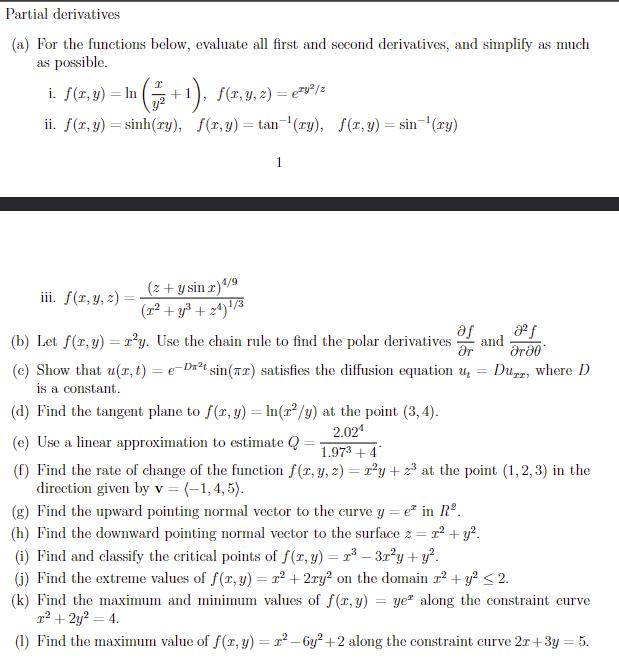
Partial derivatives (a) For the functions below, evaluate all first and second derivatives, and simplify as much as possible. m (7/2+1), (x, y, 2) = V/2 ii. f(z,g)=sinh(ry), f(2,3)=tan'(ry), f(r,y)=sin (ry) i. f(x, y) = In iii. f(x, y, z): 4/9 (z+ y sin r) (x + y +24)/3 1 af 8f r0* r (b) Let f(r, y) =ry. Use the chain rule to find the polar derivatives and -Da't sin(Tr) satisfies the diffusion equation u = Dur, where D (e) Show that u(x, t) = e is a constant. (d) Find the tangent plane to f(x, y) = ln(r2/y) at the point (3, 4). 2.024 (e) Use a linear approximation to estimate Q= 1.973 +4 (f) Find the rate of change of the function f(x, y, 2) = ry +2 at the point (1,2,3) in the direction given by v = (-1,4,5). (g) Find the upward pointing normal vector to the curve y = e in R. (h) Find the downward pointing normal vector to the surface z = 2 + y. (i) Find and classify the critical points of f(r, y)=r-3ry + y. (j) Find the extreme values of f(r, y) =r+2ry on the domain r + y 2. (k) Find the maximum and minimum values of f(x, y) = yer along the constraint curve 2 + 2y = 4. (1) Find the maximum value of f(x, y) = 2-6y+2 along the constraint curve 2r+3y = 5.
Step by Step Solution
3.48 Rating (164 Votes )
There are 3 Steps involved in it
a Lets evaluate the derivatives for each given function i fx y lnx 1 First derivatives fx 1 x 1 fy 0 ... View full answer

Get step-by-step solutions from verified subject matter experts
 Study Help