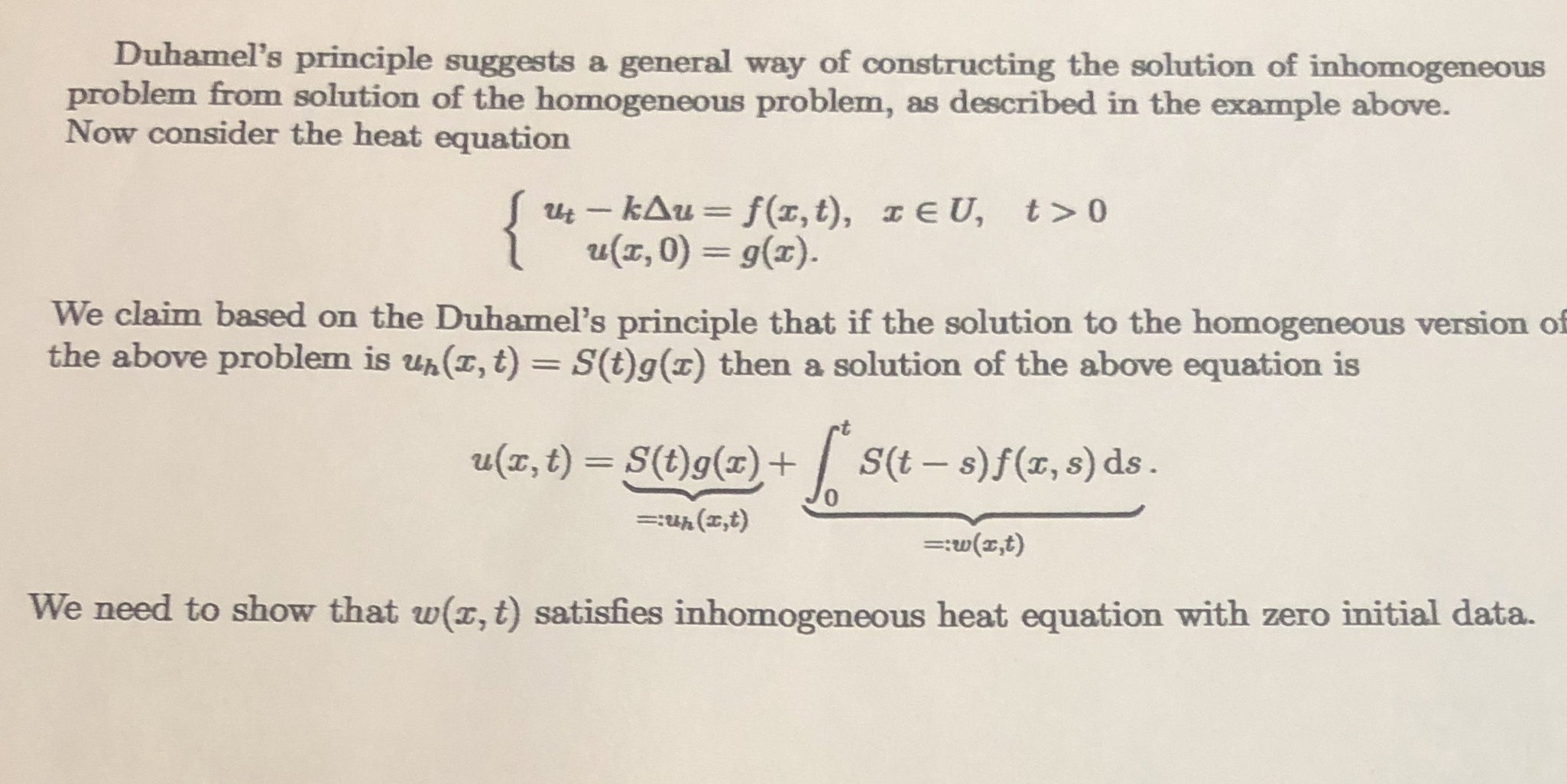
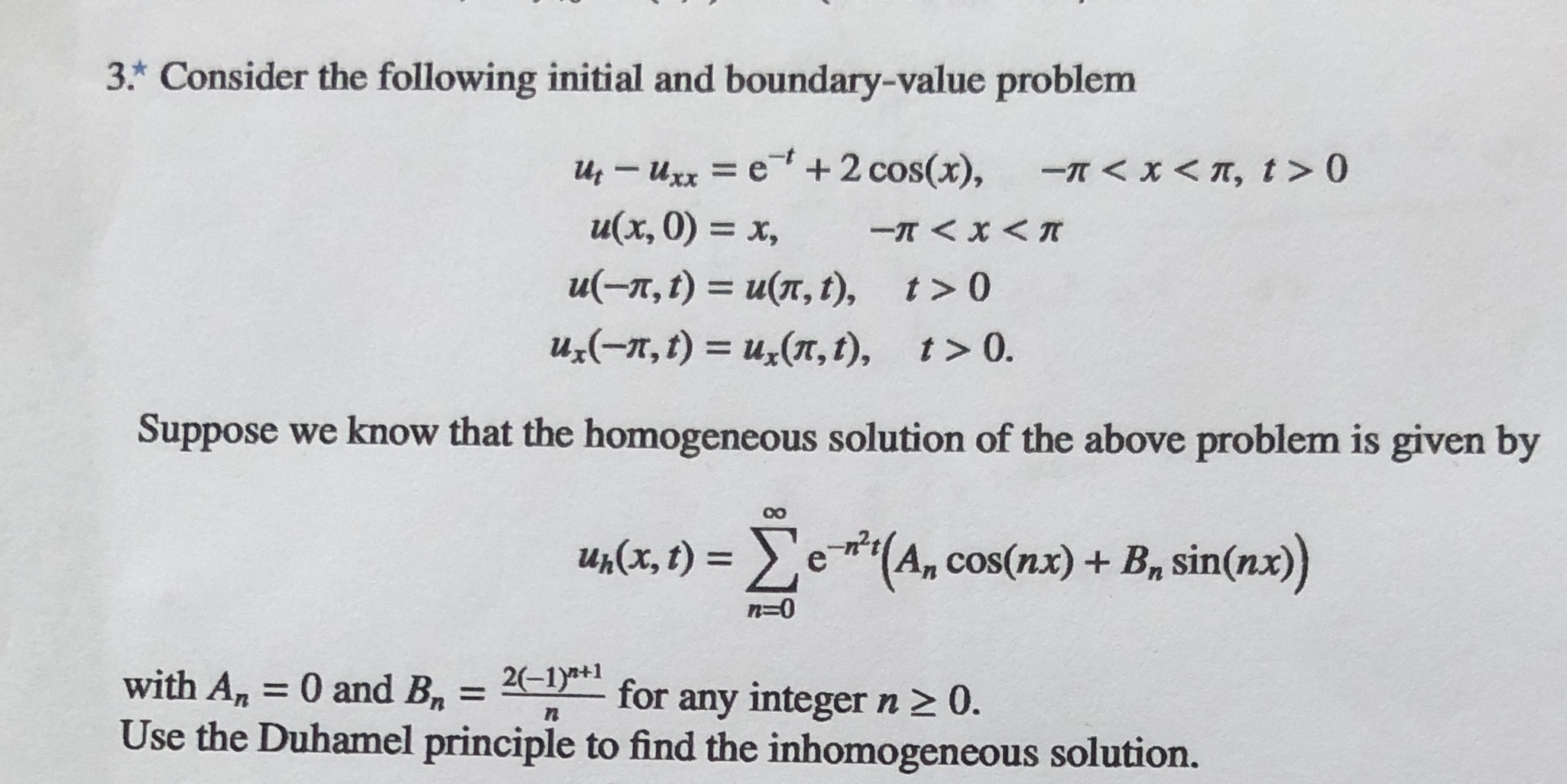
Question: Partial differential equations 3.* Consider the following initial and boundary-value problem Ut - Uxx = e+ 2cos(x), -TT 0 u(x, 0) = X, -IT 0

Partial differential equations
Partial differential equations 3.* Consider thePartial differential equations 3.* Consider the
3.* Consider the following initial and boundary-value problem Ut - Uxx = e"+ 2cos(x), -TT 0 u(x, 0) = X, -IT 0 Ux(-71, t) = ux(7, t), t>0. Suppose we know that the homogeneous solution of the above problem is given by un(x, t) = e n't( An cos(nx) + Bn sin(nx)) n= with An = 0 and By = 2(-1)"+1 n for any integer n 2 0. Use the Duhamel principle to find the inhomogeneous solution.Duhamel's principle suggests a general way of constructing the solution of inhomogeneous problem from solution of the homogeneous problem, as described in the example above. Now consider the heat equation ut - KAu = f(x, t), IEU, t>0 u(x, 0) = g(I). We claim based on the Duhamel's principle that if the solution to the homogeneous version of the above problem is un(I, t) = S(t)g(r) then a solution of the above equation is u(x, t) = S(t)g(I) + S(t - s)f(x, s) ds . o =:uh (x,t) =:w(x,t) We need to show that w(x, t) satisfies inhomogeneous heat equation with zero initial data

Step by Step Solution

There are 3 Steps involved in it

1 Expert Approved Answer
Step: 1 Unlock blur-text-image

Question Has Been Solved by an Expert!

Get step-by-step solutions from verified subject matter experts

Step: 2 Unlock
Step: 3 Unlock

Students Have Also Explored These Related Mathematics Questions!