







Question: Partial Question 21 2/3 pts More than one answer to this question is correct. Select all of the correct answers and only the correct answers
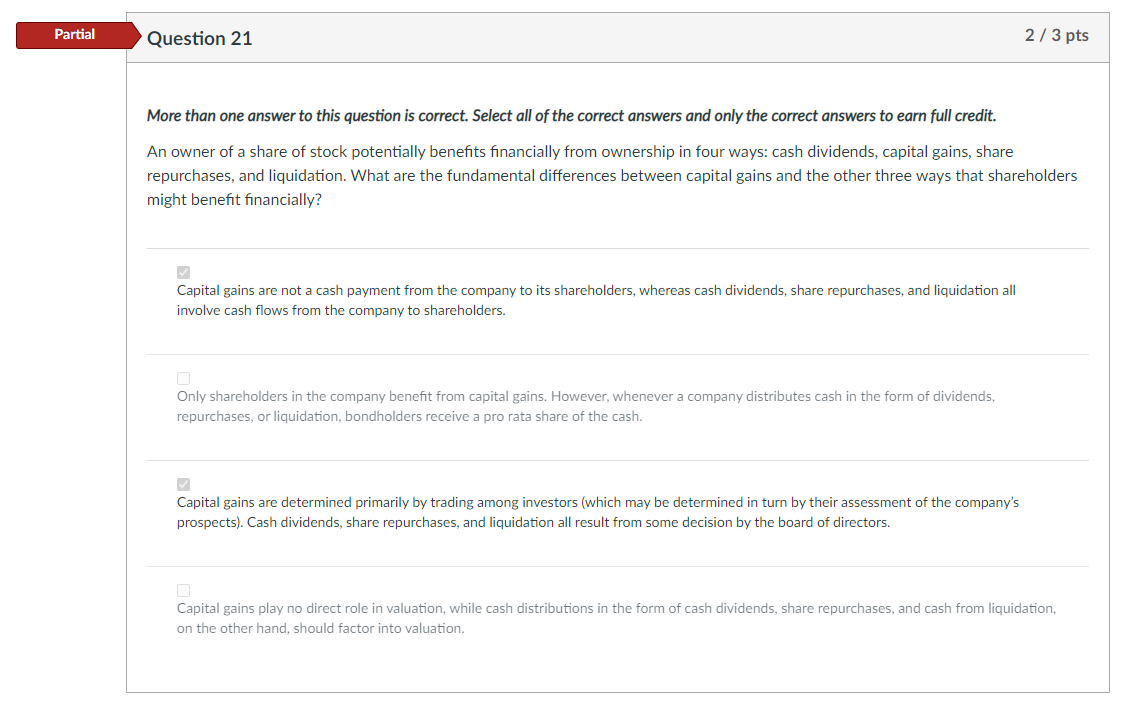
Partial Question 21 2/3 pts More than one answer to this question is correct. Select all of the correct answers and only the correct answers to earn full credit. An owner of a share of stock potentially benefits financially from ownership in four ways: cash dividends, capital gains, share repurchases, and liquidation. What are the fundamental differences between capital gains and the other three ways that shareholders might benefit financially? Capital gains are not a cash payment from the company to its shareholders, whereas cash dividends, share repurchases, and liquidation all involve cash flows from the company to shareholders. Only shareholders in the company benefit from capital gains. However, whenever a company distributes cash in the form of dividends, repurchases, or liquidation, bondholders receive a pro rata share of the cash. Capital gains are determined primarily by trading among investors (which may be determined in turn by their assessment of the company's prospects). Cash dividends, share repurchases, and liquidation all result from some decision by the board of directors. Capital gains play no direct role in valuation, while cash distributions in the form of cash dividends, share repurchases, and cash from liquidation, on the other hand, should factor into valuation
Step by Step Solution
There are 3 Steps involved in it

Get step-by-step solutions from verified subject matter experts
 Study Help