







Question: Participating Notes (guide to study for Quiz over Chapter 2) Once again, you must get Cengage Mind Tap for your homework! Each transaction below occurs
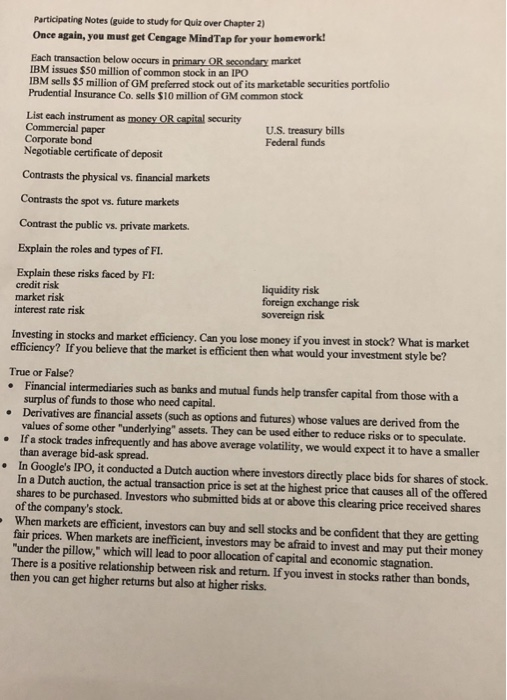
Participating Notes (guide to study for Quiz over Chapter 2) Once again, you must get Cengage Mind Tap for your homework! Each transaction below occurs in primary OR secondary market IBM issues $50 million of common stock in an IPO IBM sells $5 million of OM preferred stock out of its marketable securities portfolio Prudential Insurance Co sells $10 million of GM common stock List cach instrument as money OR capital security Commercial paper Corporate bond Negotiable certificate of deposit U.S. treasury bills Federal funds Contrasts the physical vs, financial markets Contrasts the spot vs. future markets Contrast the public vs. private markets. Explain the roles and types of FI. Explain these risks faced by FI: credit risk market risk interest rate risk liquidity risk foreign exchange risk sovereign risk Investing in stocks and market efficiency. Can you lose money if you invest in stock? What is market efficiency? If you believe that the market is efficient then what would your investment style be? True or False? Financial intermediaries such as banks and mutual funds help transfer capital from those with a surplus of funds to those who need capital. Derivatives are financial assets (such as options and futures) whose values are derived from the values of some other "underlying assets. They can be used either to reduce risks or to speculate. If a stock trades infrequently and has above average volatility, we would expect it to have a smaller than average bid-ask spread. In Google's IPO, it conducted a Dutch auction where investors directly place bids for shares of stock. In a Dutch auction, the actual transaction price is set at the highest price that causes all of the offered shares to be purchased. Investors who submitted bids at or above this clearing price received shares of the company's stock. When markets are efficient, investors can buy and sell stocks and be confident that they are getting fair prices. When markets are inefficient, investors may be afraid to invest and may put their money "under the pillow," which will lead to poor allocation of capital and economic stagnation. There is a positive relationship between risk and return. If you invest in stocks rather than bonds, then you can get higher returns but also at higher risks
Step by Step Solution
There are 3 Steps involved in it

Get step-by-step solutions from verified subject matter experts
 Study Help