







Question: Particularly, he used a previously-published experimental procedure--Remote Association Test (RAT)--to manipulate ego threat, and a previously-published 20-item State Self-Esteem Scale to measure self-esteem (subjects' responses
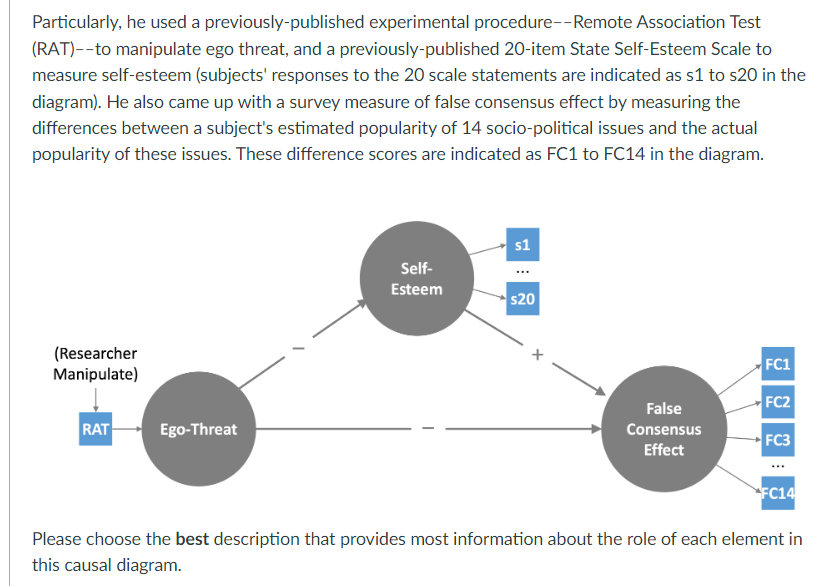
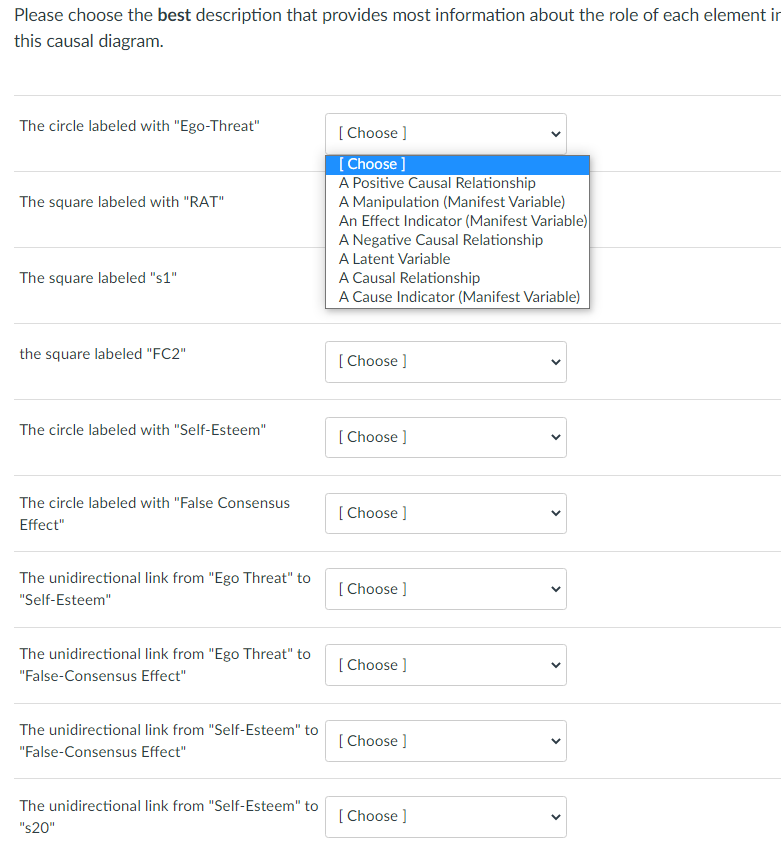
Particularly, he used a previously-published experimental procedure--Remote Association Test (RAT)--to manipulate ego threat, and a previously-published 20-item State Self-Esteem Scale to measure self-esteem (subjects' responses to the 20 scale statements are indicated as s1 to 520 in the diagram). He also came up with a survey measure of false consensus effect by measuring the differences between a subject's estimated popularity of 14 socio-political issues and the actual popularity of these issues. These difference scores are indicated as FC1 to FC14 in the diagram. s1 Self- Esteem s20 + (Researcher Manipulate) FC1 FC2 RAT Ego-Threat False Consensus Effect FC3 FC14 Please choose the best description that provides most information about the role of each element in this causal diagram. Please choose the best description that provides most information about the role of each element in this causal diagram. The circle labeled with "Ego-Threat" The square labeled with "RAT" [Choose ] [Choose ] A Positive Causal Relationship A Manipulation (Manifest Variable) An Effect Indicator (Manifest Variable) A Negative Causal Relationship A Latent Variable A Causal Relationship A Cause Indicator (Manifest Variable) The square labeled "s1" the square labeled "FC2" [Choose ] The circle labeled with "Self-Esteem" [Choose ] V The circle labeled with "False Consensus Effect" [Choose ] The unidirectional link from "Self-Esteem" to "False-Consensus Effect" [Choose ] The unidirectional link from "Self-Esteem" to "s20" [ Choose ] Particularly, he used a previously-published experimental procedure--Remote Association Test (RAT)--to manipulate ego threat, and a previously-published 20-item State Self-Esteem Scale to measure self-esteem (subjects' responses to the 20 scale statements are indicated as s1 to 520 in the diagram). He also came up with a survey measure of false consensus effect by measuring the differences between a subject's estimated popularity of 14 socio-political issues and the actual popularity of these issues. These difference scores are indicated as FC1 to FC14 in the diagram. s1 Self- Esteem s20 + (Researcher Manipulate) FC1 FC2 RAT Ego-Threat False Consensus Effect FC3 FC14 Please choose the best description that provides most information about the role of each element in this causal diagram. Please choose the best description that provides most information about the role of each element in this causal diagram. The circle labeled with "Ego-Threat" The square labeled with "RAT" [Choose ] [Choose ] A Positive Causal Relationship A Manipulation (Manifest Variable) An Effect Indicator (Manifest Variable) A Negative Causal Relationship A Latent Variable A Causal Relationship A Cause Indicator (Manifest Variable) The square labeled "s1" the square labeled "FC2" [Choose ] The circle labeled with "Self-Esteem" [Choose ] V The circle labeled with "False Consensus Effect" [Choose ] The unidirectional link from "Self-Esteem" to "False-Consensus Effect" [Choose ] The unidirectional link from "Self-Esteem" to "s20" [ Choose ]
Step by Step Solution
There are 3 Steps involved in it

Get step-by-step solutions from verified subject matter experts
 Study Help