







Question: Passage I ( 1 - 7 ) Objects falling in air do not continue to accelerate indefinitely as they fall. A falling object reaches a
Passage I
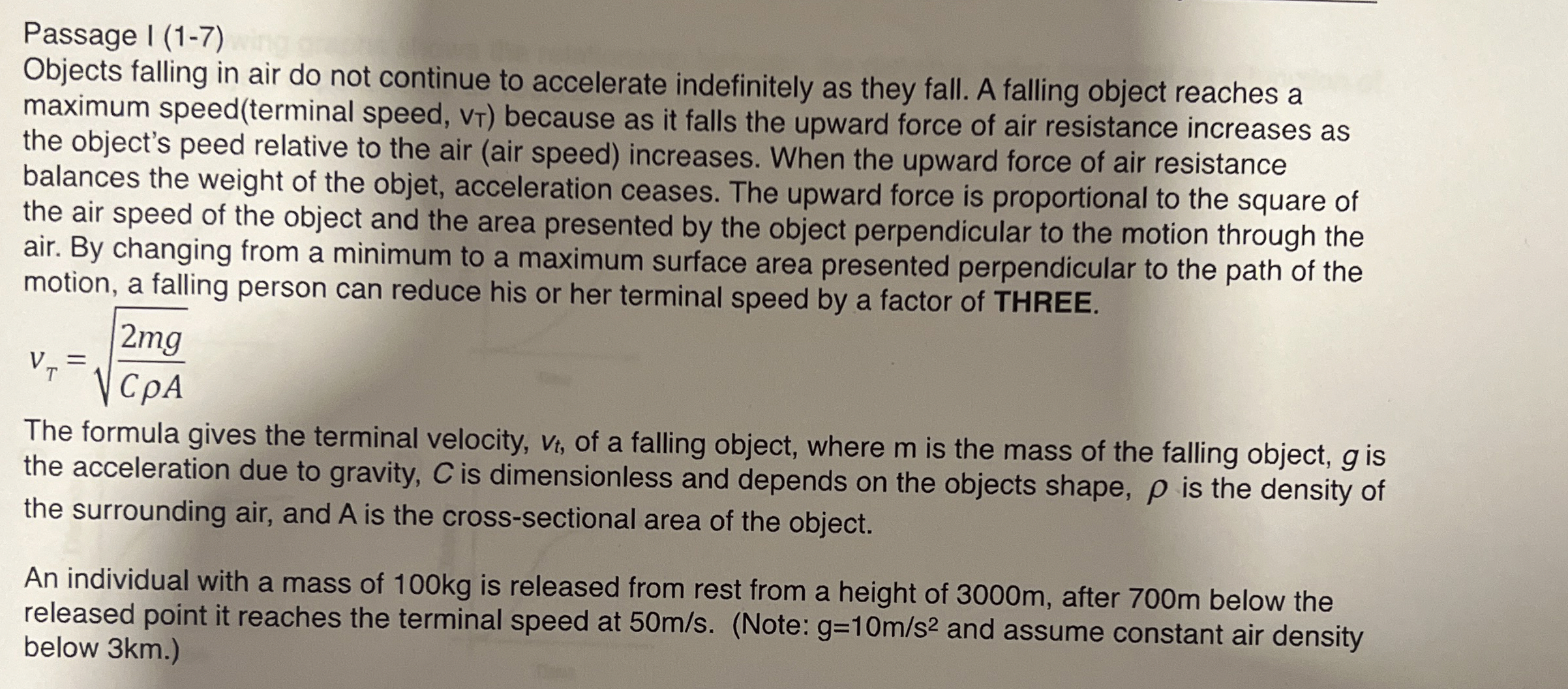
Objects falling in air do not continue to accelerate indefinitely as they fall. A falling object reaches a maximum speedterminal speed, because as it falls the upward force of air resistance increases as the object's peed relative to the air air speed increases. When the upward force of air resistance balances the weight of the objet, acceleration ceases. The upward force is proportional to the square of the air speed of the object and the area presented by the object perpendicular to the motion through the air. By changing from a minimum to a maximum surface area presented perpendicular to the path of the motion, a falling person can reduce his or her terminal speed by a factor of THREE.
The formula gives the terminal velocity, of a falling object, where is the mass of the falling object, is the acceleration due to gravity, is dimensionless and depends on the objects shape, is the density of the surrounding air, and is the crosssectional area of the object.
An individual with a mass of kg is released from rest from a height of m after m below the released point it reaches the terminal speed at Note: and assume constant air density below km
Step by Step Solution
There are 3 Steps involved in it
1 Expert Approved Answer
Step: 1 Unlock

Question Has Been Solved by an Expert!
Get step-by-step solutions from verified subject matter experts
Step: 2 Unlock
Step: 3 Unlock
 Study Help