







Question: PaThis elementary problem begins to explore propagation delay and transmission delay, two central concepts in data networking, Consider two hosts, A and B. connected by
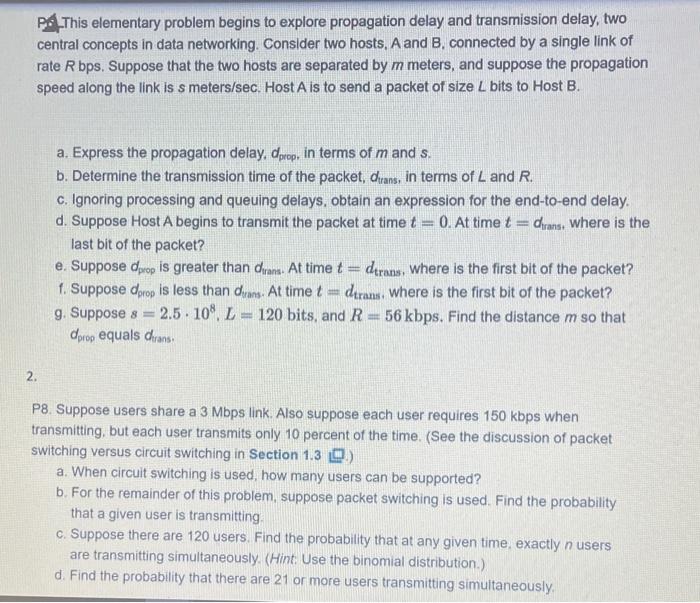
PaThis elementary problem begins to explore propagation delay and transmission delay, two central concepts in data networking, Consider two hosts, A and B. connected by a single link of rate Rbps. Suppose that the two hosts are separated by m meters, and suppose the propagation speed along the link is s meters/sec. Host A is to send a packet of size L bits to Host B. a. Express the propagation delay, dprop, in terms of m and s. b. Determine the transmission time of the packet, durans, in terms of L and R. c. Ignoring processing and queuing delays, obtain an expression for the end-to-end delay. d. Suppose Host A begins to transmit the packet at time t = 0. At time t dyrans, where is the last bit of the packet? e. Suppose dprop is greater than dirans. At time t= dtrans, where is the first bit of the packet? 1. Suppose dprop is less than dyans. At timet dtrans, where is the first bit of the packet? g. Suppose 8 = 2.5 . 10. L = 120 bits, and R-56 kbps. Find the distance m so that dprop equals derans 2. P8. Suppose users share a 3 Mbps link. Also suppose each user requires 150 kbps when transmitting, but each user transmits only 10 percent of the time. (See the discussion of packet switching versus circuit switching in Section 1.3 ) a. When circuit switching is used, how many users can be supported? b. For the remainder of this problem, suppose packet switching is used. Find the probability that a given user is transmitting, c. Suppose there are 120 users. Find the probability that at any given time, exactly n users are transmitting simultaneously. (Hint Use the binomial distribution.) d. Find the probability that there are 21 or more users transmitting simultaneously
Step by Step Solution
There are 3 Steps involved in it

Get step-by-step solutions from verified subject matter experts
 Study Help