



Question: Payoff Table Min-case Ever since graduating you have been working as an analyst trainee for a financial conglomerate. Every trainee is rotated through four areas;
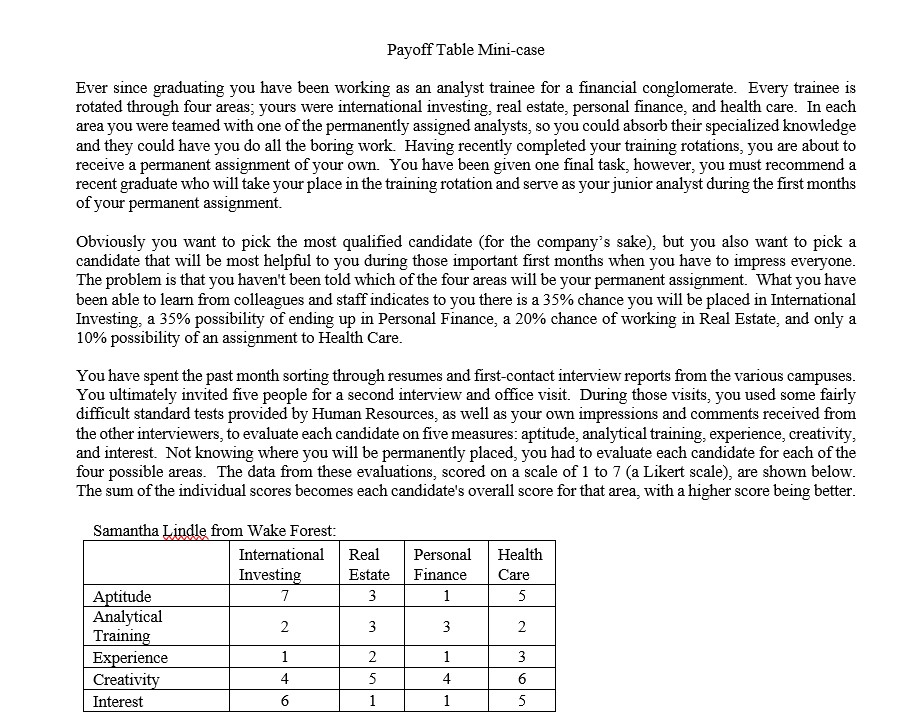
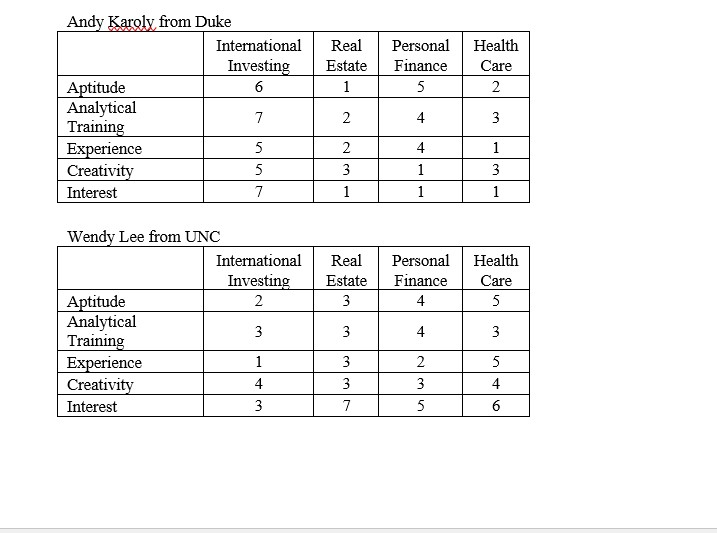
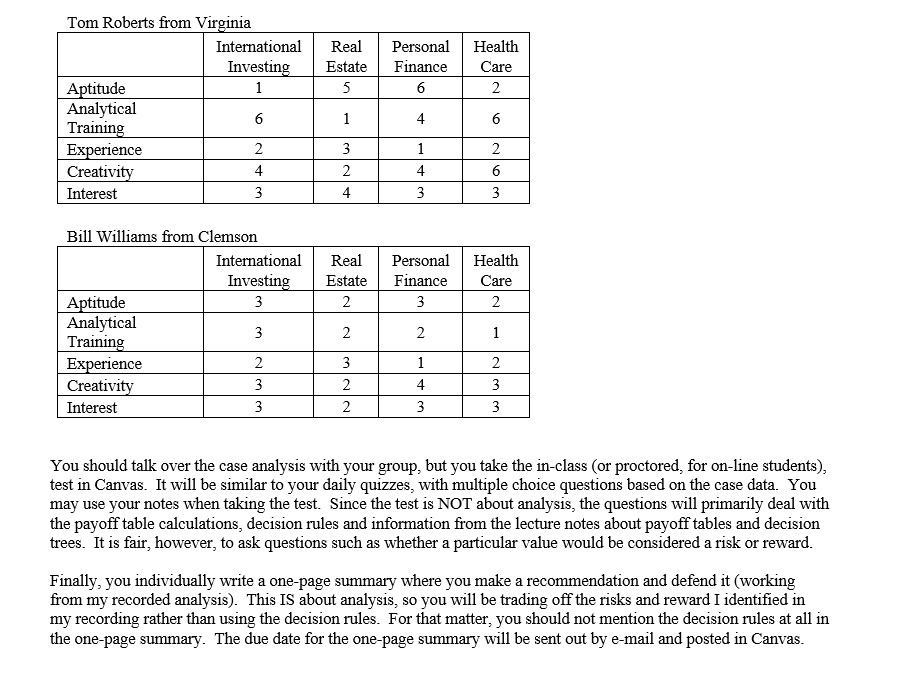
Payoff Table Min-case Ever since graduating you have been working as an analyst trainee for a financial conglomerate. Every trainee is rotated through four areas; yours were international investing, real estate, personal finance, and health care. In each area you were teamed with one of the permanently assigned analysts, so you could absorb their specialized knowledge and they could have you do all the boring work. Having recently completed your training rotations, you are about to receive a permanent assignment of your own. You have been given one final task, however, you must recommend a recent graduate who will take your place in the training rotation and serve as your junior analyst during the first months of your permanent assignment. Obviously you want to pick the most qualified candidate (for the company's sake), but you also want to pick a candidate that will be most helpful to you during those important first months when you have to impress everyone. The problem is that you haven't been told which of the four areas will be your permanent assignment. What you have been able to learn from colleagues and staff indicates to you there is a 35% chance you will be placed in International Investing, a 35% possibility of ending up in Personal Finance, a 20% chance of working in Real Estate, and only a 10% possibility of an assignment to Health Care. You have spent the past month sorting through resumes and first-contact interview reports from the various campuses. You ultimately invited five people for a second interview and office visit. During those visits, you used some fairly difficult standard tests provided by Human Resources, as well as your own impressions and comments received from the other interviewers, to evaluate each candidate on five measures: aptitude, analytical training, experience, creativity, and interest. Not knowing where you will be permanently placed, you had to evaluate each candidate for each of the four possible areas. The data from these evaluations, scored on a scale of 1 to 7 (a Likert scale), are shown below. The sum of the individual scores becomes each candidate's overall score for that area, with a higher score being better. Samantha T indle from Wake Fnrest A -. 1_- TY F1R. Th-1_- Tom Roherte from Viroinia Ri11 w/illiame from rlamenn You should talk over the case analysis with your group, but you take the in-class (or proctored, for on-line students), test in Canvas. It will be similar to your daily quizzes, with multiple choice questions based on the case data. You may use your notes when taking the test. Since the test is NOT about analysis, the questions will primarily deal with the payoff table calculations, decision rules and information from the lecture notes about payoff tables and decision trees. It is fair, however, to ask questions such as whether a particular value would be considered a risk or reward. Finally, you individually write a one-page summary where you make a recommendation and defend it (working from my recorded analysis). This IS about analysis, so you will be trading off the risks and reward I identified in my recording rather than using the decision rules. For that matter, you should not mention the decision rules at all in the one-page summary. The due date for the one-page summary will be sent out by e-mail and posted in Canvas
Step by Step Solution
There are 3 Steps involved in it

Get step-by-step solutions from verified subject matter experts