



Question: Peer discussion responce to Depending on the viewpoint and standards employed for assessment, the Personal Responsibility and Work Opportunity Reconciliation Act ( PRWORA ) of
Peer discussion responce to
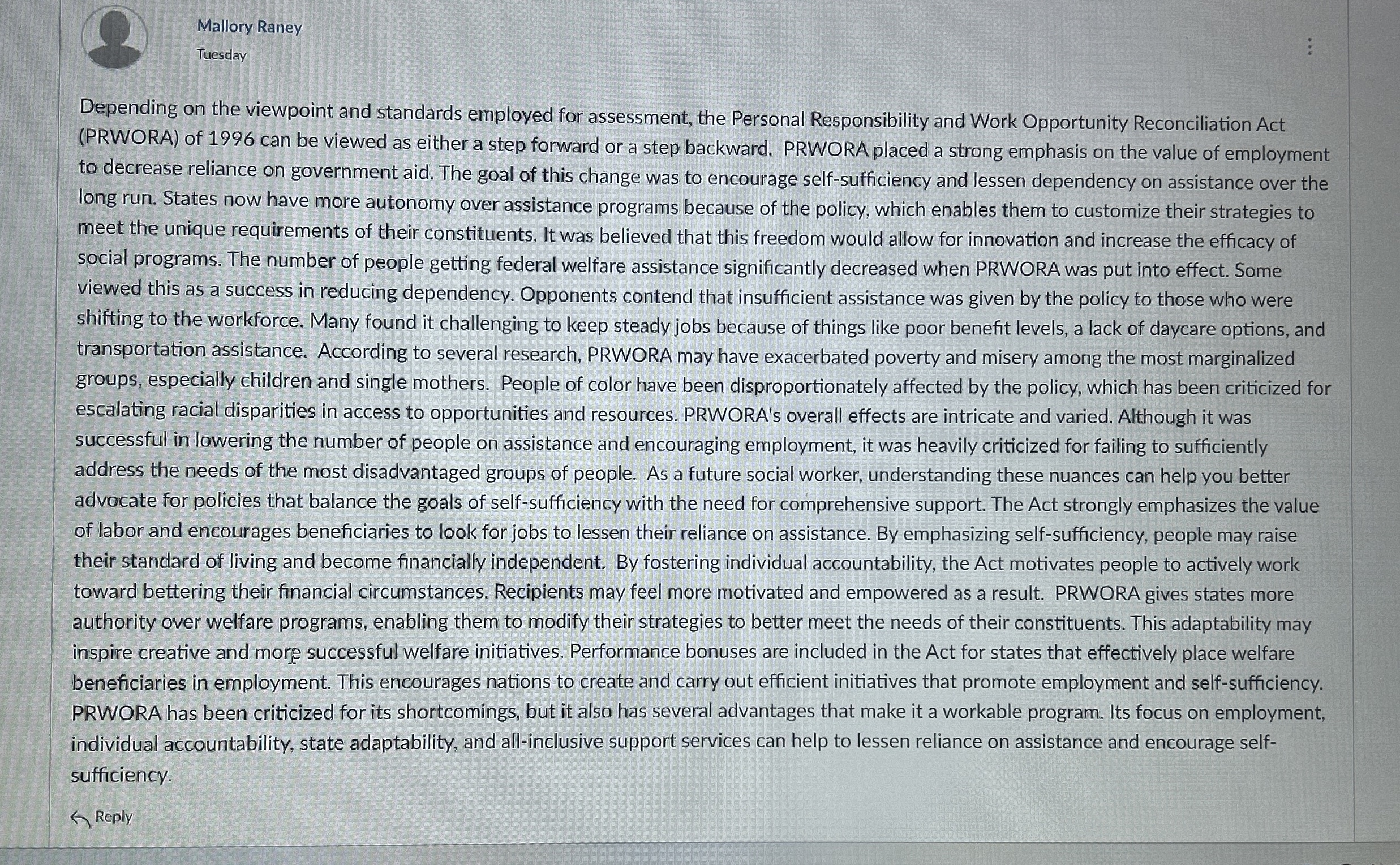
Depending on the viewpoint and standards employed for assessment, the Personal Responsibility and Work Opportunity Reconciliation Act PRWORA of can be viewed as either a step forward or a step backward. PRWORA placed a strong emphasis on the value of employment to decrease reliance on government aid. The goal of this change was to encourage selfsufficiency and lessen dependency on assistance over the long run. States now have more autonomy over assistance programs because of the policy, which enables them to customize their strategies to meet the unique requirements of their constituents. It was believed that this freedom would allow for innovation and increase the efficacy of social programs. The number of people getting federal welfare assistance significantly decreased when PRWORA was put into effect. Some viewed this as a success in reducing dependency. Opponents contend that insufficient assistance was given by the policy to those who were shifting to the workforce. Many found it challenging to keep steady jobs because of things like poor benefit levels, a lack of daycare options, and transportation assistance. According to several research, PRWORA may have exacerbated poverty and misery among the most marginalized groups, especially children and single mothers. People of color have been disproportionately affected by the policy, which has been criticized for escalating racial disparities in access to opportunities and resources. PRWORA's overall effects are intricate and varied. Although it was successful in lowering the number of people on assistance and encouraging employment, it was heavily criticized for failing to sufficiently address the needs of the most disadvantaged groups of people. As a future social worker, understanding these nuances can help you better advocate for policies that balance the goals of selfsufficiency with the need for comprehensive support. The Act strongly emphasizes the value of labor and encourages beneficiaries to look for jobs to lessen their reliance on assistance. By emphasizing selfsufficiency, people may raise their standard of living and become financially independent. By fostering individual accountability, the Act motivates people to actively work toward bettering their financial circumstances. Recipients may feel more motivated and empowered as a result. PRWORA gives states more authority over welfare programs, enabling them to modify their strategies to better meet the needs of their constituents. This adaptability may inspire creative and more successful welfare initiatives. Performance bonuses are included in the Act for states that effectively place welfare beneficiaries in employment. This encourages nations to create and carry out efficient initiatives that promote employment and selfsufficiency. PRWORA has been criticized for its shortcomings, but it also has several advantages that make it a workable program. Its focus on employment, individual accountability, state adaptability, and allinclusive support services can help to lessen reliance on assistance and encourage selfsufficiency.
Reply
Step by Step Solution
There are 3 Steps involved in it
1 Expert Approved Answer
Step: 1 Unlock

Question Has Been Solved by an Expert!
Get step-by-step solutions from verified subject matter experts
Step: 2 Unlock
Step: 3 Unlock