







Question: Perform the test for the non-additive join property (lossless join) for the relation R(A_1, A_2, A_3, A_4, A_5), and the decompositions D_a, D_b, D_c, D_d
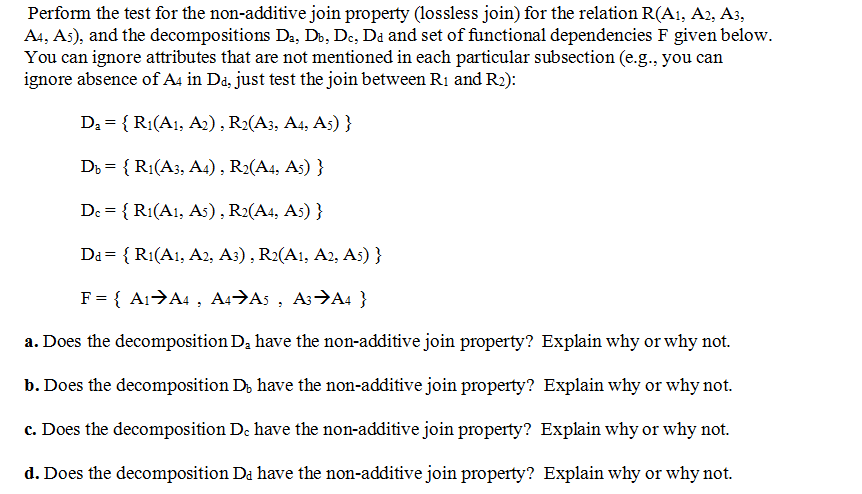
Perform the test for the non-additive join property (lossless join) for the relation R(A_1, A_2, A_3, A_4, A_5), and the decompositions D_a, D_b, D_c, D_d and set of functional dependencies F given below. You can ignore attributes that are not mentioned in each particular subsection (e.g., you can ignore absence of A_4 in D_d, just test the join between R_1 and R_2): D_a = {R_1 (A_1, A_2), R_2 (A_3, A_4, A_5)} D_b = {R_1 (A_3, A_4), R_2 (A_4, A_5)} D_c = {R_1 (A_1, A_5), R_2 (A_4, A_5)} D_d= {R_1 (A_1, A_2, A_5), R_2(A_1, A_2, A_5)} F = {A_1 rightarrow A_4, A_4 rightarrow A_5, A_3 rightarrow A_4} a. Does the decomposition D_a have the non-additive join property? Explain why or why not. b. Does the decomposition D_b have the non-additive join property? Explain why or why not. c. Does the decomposition D_c have the non-additive join property? Explain why or why not. d. Does the decomposition D_d have the non-additive join property? Explain why or why not
Step by Step Solution
There are 3 Steps involved in it

Get step-by-step solutions from verified subject matter experts
 Study Help