



Question: Performance Management, Training and Compensation at Agilent Technologies (Note: The Case is common for all questions that follow) Agilent Technologies, a leading test and measurement
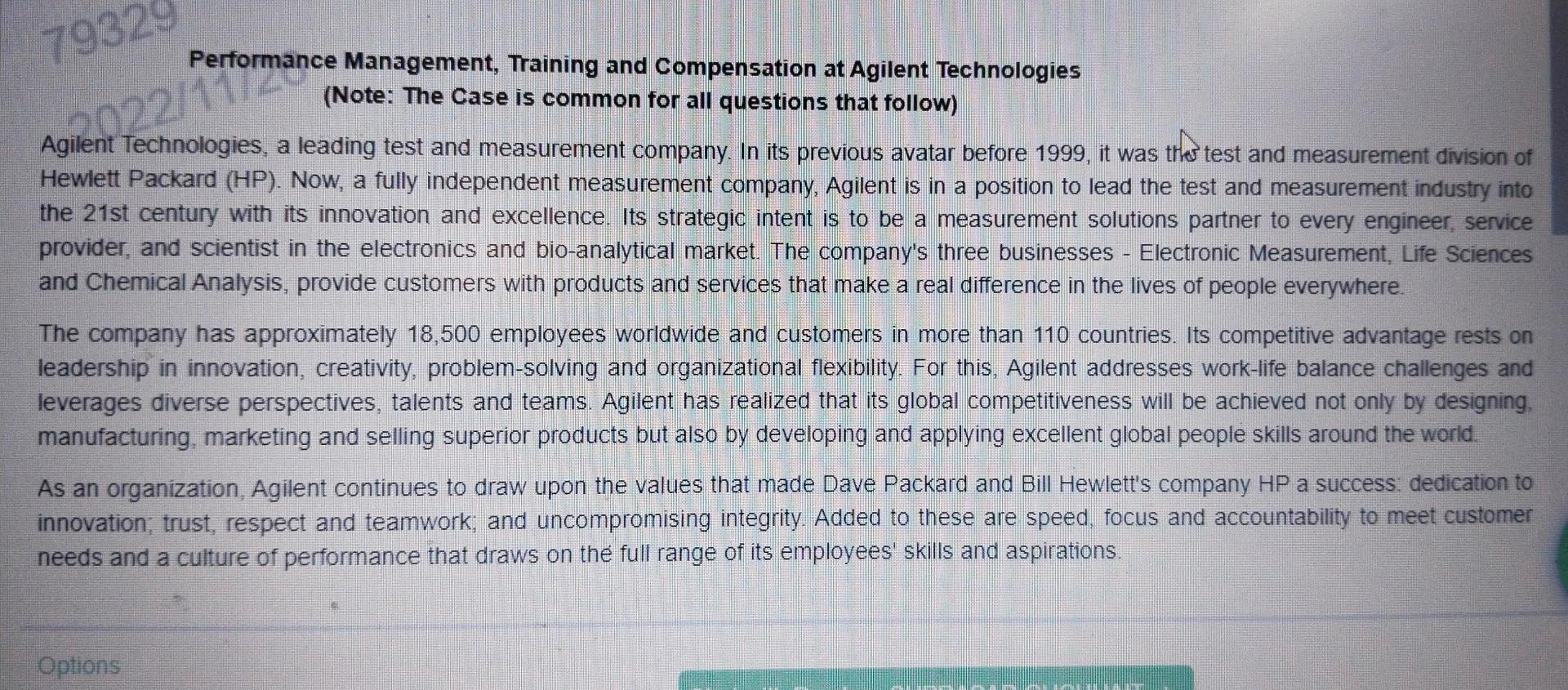
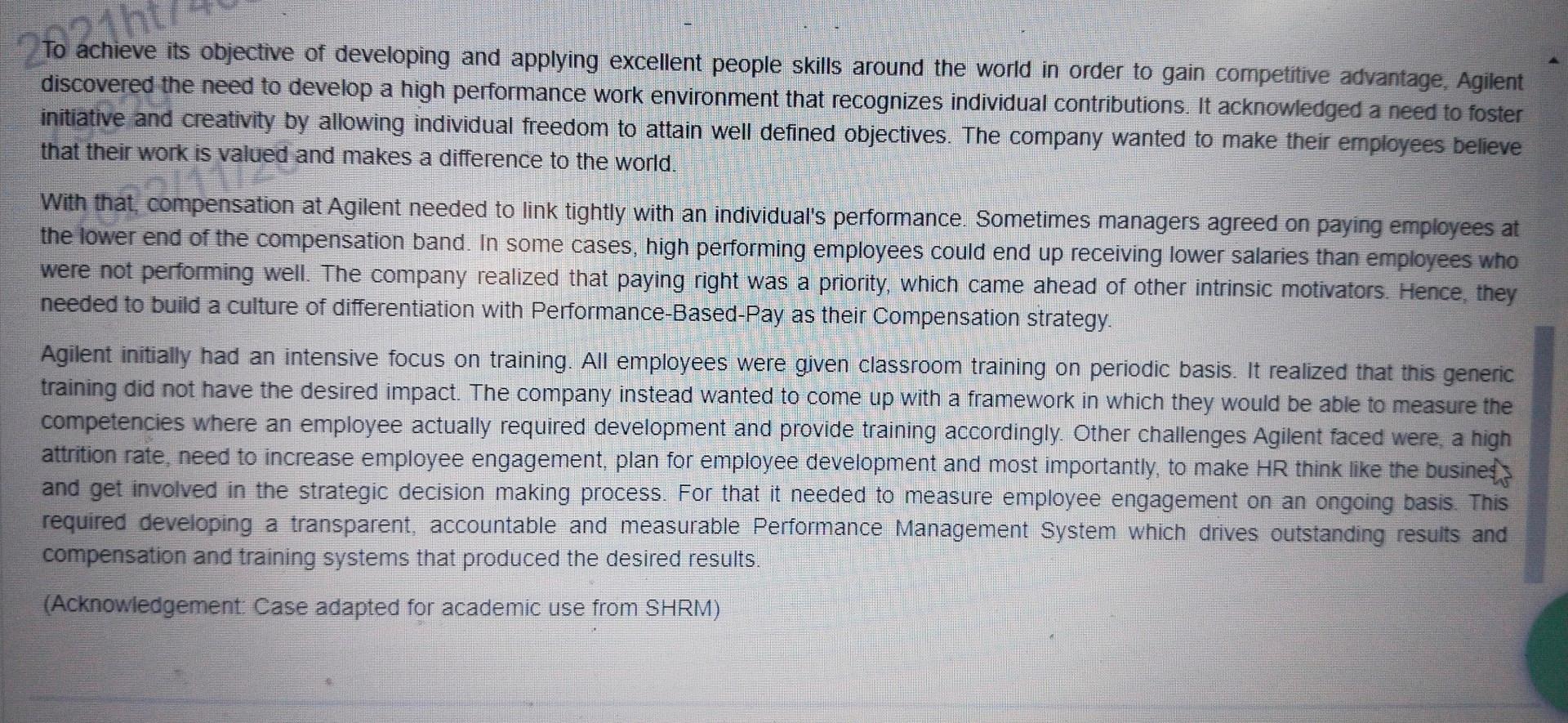

Performance Management, Training and Compensation at Agilent Technologies (Note: The Case is common for all questions that follow) Agilent Technologies, a leading test and measurement company. In its previous avatar before 1999, it was thes test and measurement division of Hewlett Packard (HP). Now, a fully independent measurement company, Agilent is in a position to lead the test and measurement industry into the 21 st century with its innovation and excellence. Its strategic intent is to be a measurement solutions partner to every engineer, service provider, and scientist in the electronics and bio-analytical market. The company's three businesses - Electronic Measurement, Life Sciences and Chemical Analysis, provide customers with products and services that make a real difference in the lives of people everywhere. The company has approximately 18,500 employees worldwide and customers in more than 110 countries. Its competitive advantage rests on leadership in innovation, creativity, problem-solving and organizational flexibility. For this, Agilent addresses work-life balance challenges and leverages diverse perspectives, talents and teams. Agilent has realized that its global competitiveness will be achieved not only by designing. manufacturing, marketing and selling superior products but also by developing and applying excellent global people skills around the world. As an organization, Agilent continues to draw upon the values that made Dave Packard and Bill Hewlett's company HP a success: dedication to innovation; trust, respect and teamwork; and uncompromising integrity. Added to these are speed, focus and accountability to meet customer needs and a culture of performance that draws on the full range of its employees' skills and aspirations. To achieve its objective of developing and applying excellent people skills around the world in order to gain competitive advantage, Agilent discovered the need to develop a high performance work environment that recognizes individual contributions. It acknowledged a need to foster initiative and creativity by allowing individual freedom to attain well defined objectives. The company wanted to make their employees believe that their work is valued and makes a difference to the world. With that, compensation at Agilent needed to link tightly with an individual's performance. Sometimes managers agreed on paying employees at the lower end of the compensation band. In some cases, high performing employees could end up receiving lower salaries than employees who were not performing well. The company realized that paying right was a priority, which came ahead of other intrinsic motivators. Hence, they needed to build a culture of differentiation with Performance-Based-Pay as their Compensation strategy. Agilent initially had an intensive focus on training. All employees were given classroom training on periodic basis. It realized that this generic training did not have the desired impact. The company instead wanted to come up with a framework in which they would be able to measure the competencies where an employee actually required development and provide training accordingly. Other challenges Agilent faced were, a high attrition rate, need to increase employee engagement, plan for employee development and most importantly, to make HR think like the busineds s and get involved in the strategic decision making process. For that it needed to measure employee engagement on an ongoing basis. This required developing a transparent, accountable and measurable Performance Management System which drives outstanding results and compensation and training systems that produced the desired results. (Acknowledgement: Case adapted for academic use from SHRM) Q. It is mentioned in the case, that the generic training given by Agilent did not have the desired impact. Conduct a 4 step training needs assessment based on the information given in the case, and based on your findings develop the instructional objectives for the training to be given to the employees of the organization. [12+3=15]
Step by Step Solution
There are 3 Steps involved in it
1 Expert Approved Answer
Step: 1 Unlock

Question Has Been Solved by an Expert!
Get step-by-step solutions from verified subject matter experts
Step: 2 Unlock
Step: 3 Unlock