







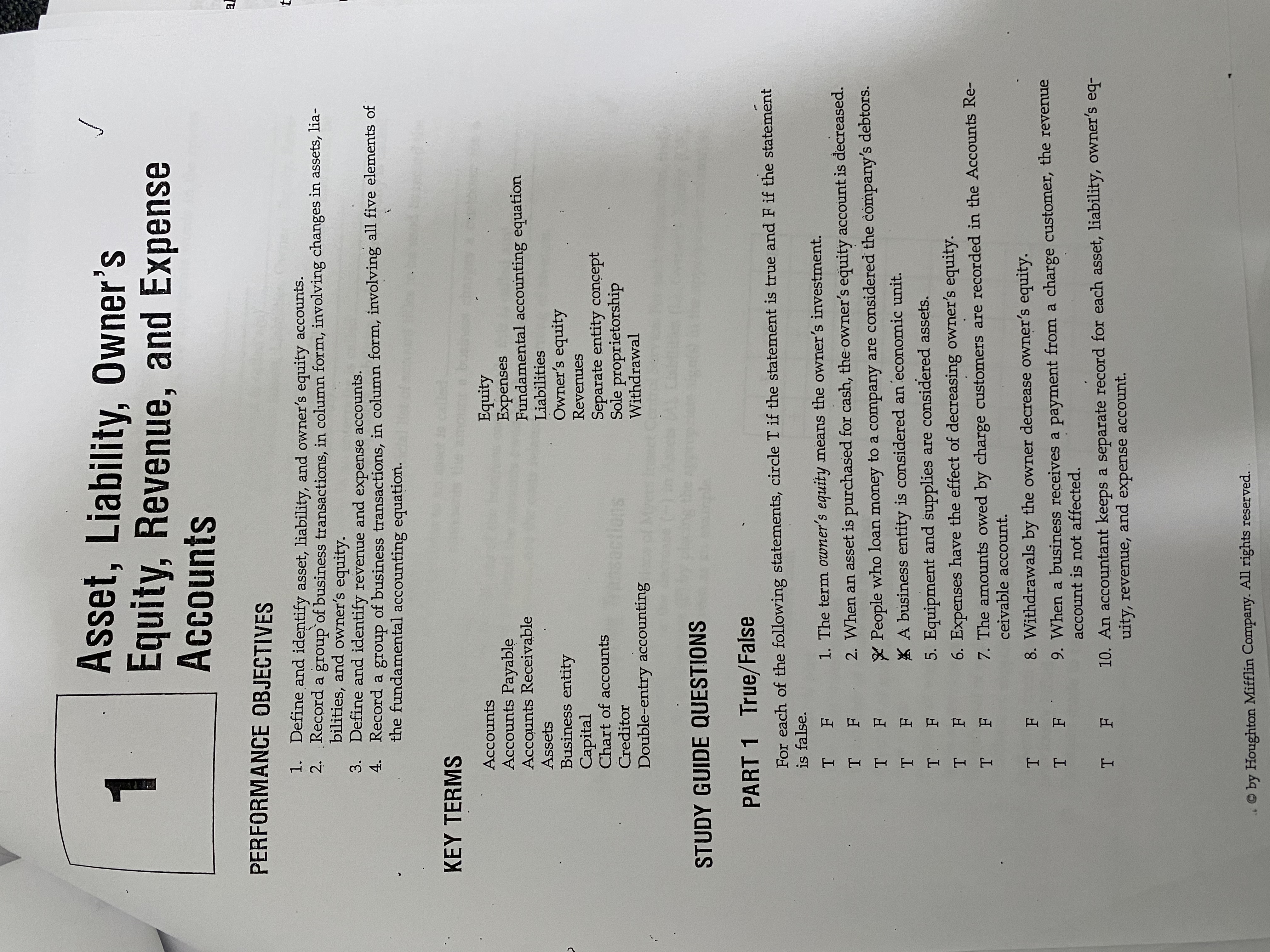
Question: PERFORMANCE OBJECTIVES Define and identify asset, liability, and owner's equity accounts. Record a group of business transactions, in column form, involving changes in assets, lia
PERFORMANCE OBJECTIVES
Define and identify asset, liability, and owner's equity accounts.
Record a group of business transactions, in column form, involving changes in assets, lia
bilities, and owner's equity.
Define and identify revenue and expense accounts.
Record a group of business transactions, in column form, involving all five elements of
the fundamental accounting equation.
KEY TERIMS
Accounts
Accounts Payable
Accounts Receivable
Assets
Business entity
Capital
Chart of accounts
Creditor
Doubleentry accounting
Equity
Expenses
Fundamental accounting equation
Liabilities
Owner's equity
Revenues
Separate entity concept
Sole proprietorship
Withdrawal
STUDY GUIDE QUESTIONS
PART TrueFalse
For each of the following statements, circle if the statement is true and if the statement
is false.
T
T
T F
T
T F
The term owner's equity means the owner's investment.
When an asset is purchased for cash, the owner's equity account is decreased.
People who loan money to a company are considered the company's debtors.
A business entity is considered an economic unit.
Equipment and supplies are considered assets.
Expenses have the effect of decreasing owner's equity.
The amounts owed by charge customers are recorded in the Accounts Re
ceivable account.
Withdrawals by the owner decrease owner's equity.
When a business receives a payment from a charge customer, the revenue
account is not affected.
An accountant keeps a separate record for each asset, liability, owner's eq
uity, revenue, and expense account.
Step by Step Solution
There are 3 Steps involved in it
1 Expert Approved Answer
Step: 1 Unlock

Question Has Been Solved by an Expert!
Get step-by-step solutions from verified subject matter experts
Step: 2 Unlock
Step: 3 Unlock
 Study Help