



Question: Permeable dike fields are built from rows of timber piles. They do not block the flow, but rather slow it down due to the
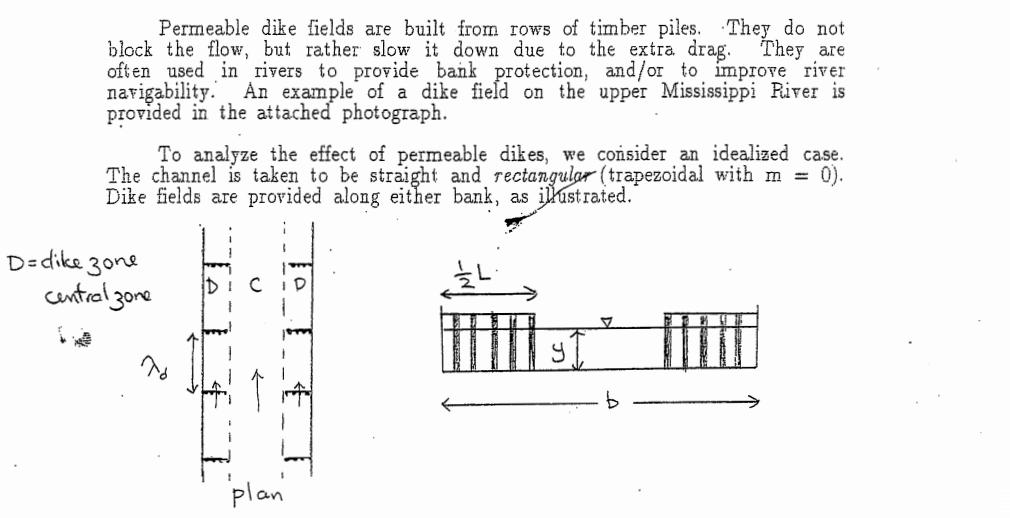
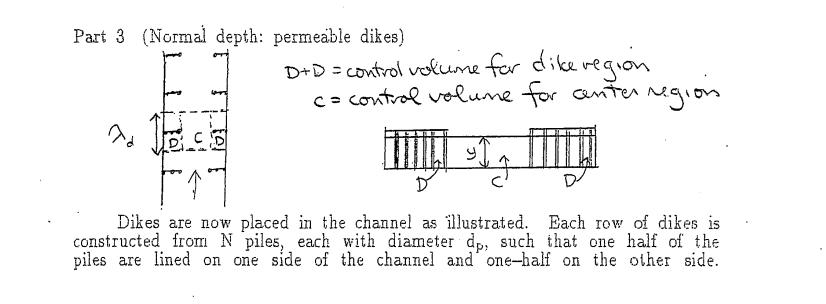
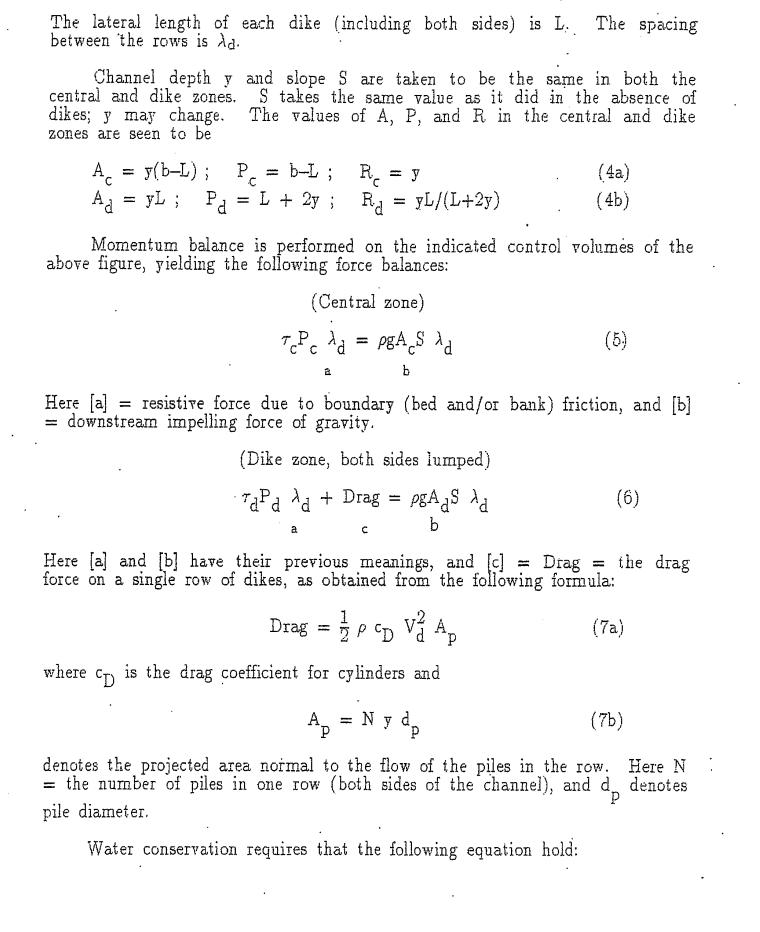
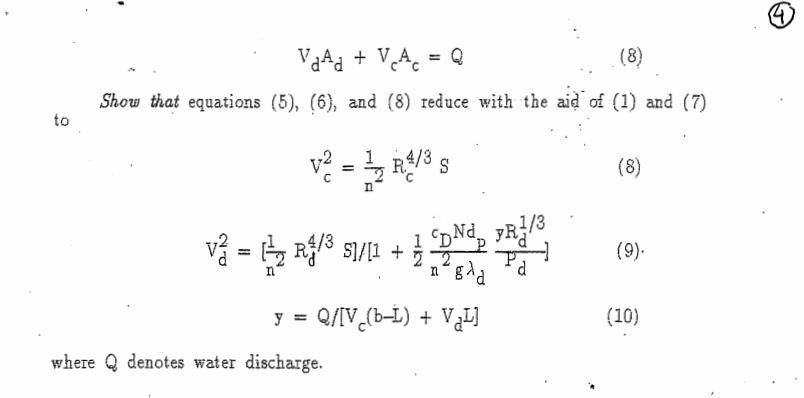
Permeable dike fields are built from rows of timber piles. They do not block the flow, but rather slow it down due to the extra drag. They are often used in rivers to provide bank protection, and/or to improve river navigability. An example of a dike field on the upper Mississippi River is provided in the attached photograph. To analyze the effect of permeable dikes, we consider an idealized case. The channel is taken to be straight and rectangular (trapezoidal with m = 0). Dike fields are provided along either bank, as illustrated. D=dike zone central zone C DI C D T plan 7 Part 3 (Normal depth: permeable dikes) D+D = control volume for dike region ca control volume for center regions. = Jel Dikes are now placed in the channel as illustrated. Each row of dikes is constructed from N piles, each with diameter dp, such that one half of the piles are lined on one side of the channel and one-half on the other side. The lateral length of each dike (including both sides) is L. The spacing between the rows is Ad. Channel depth y and slope S are taken to be the same in both the central and dike zones. S takes the same value as it did in the absence of dikes; y may change. The values of A, P, and R in the central and dike zones are seen to be A = y(b-L); Pc = b-L; A = yL; P = L + 2y; d Re R = y Rd = yL/(L+2y) Momentum balance is performed on the indicated control volumes of the above figure, yielding the following force balances: (Central zone) a = pgA S Ad Here [a] = resistive force due to boundary (bed and/or bank) friction, and [b] = downstream impelling force of gravity. (Dike zone, both sides lumped) TaPad + Drag + Drag = pgAS d b (4a) (4b) Drag = p VA P CD Ap where CD is the drag coefficient for cylinders and (5) Here [a] and [b] have their previous meanings, and [c] = Drag = the drag force on a single row of dikes, as obtained from the following formula: (7a) A = Ny dp P (6) (7b) denotes the projected area normal to the flow of the piles in the row. Here N = the number of piles in one row (both sides of the channel), and d, denotes pile diameter. Water conservation requires that the following equation hold: to F VaA + VA = Q (8) Show that equations (5), (6), and (8) reduce with the aid of (1) and (7) 28 v = 12 R/ S n v = [R/ 51/[1 + 1/ n = CDN where denotes water discharge. 22 ngad Q/[V (b-L) + VL] FR/3 Pa d (8) (9). (10)
Step by Step Solution
3.46 Rating (159 Votes )
There are 3 Steps involved in it
Answer Ans Here first they use the mathematical formulas related to cross secti... View full answer

Get step-by-step solutions from verified subject matter experts