







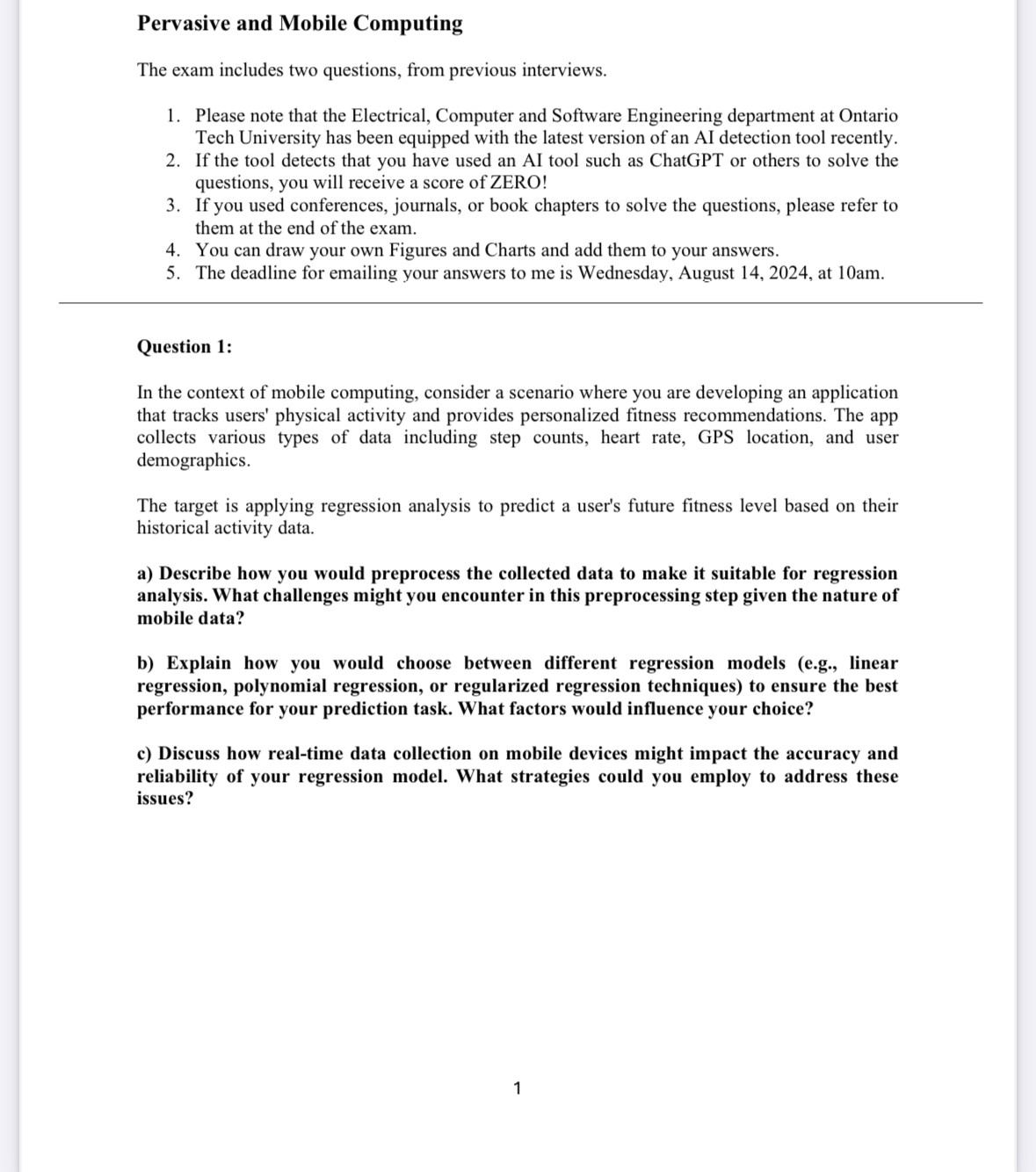
Question: Pervasive and Mobile Computing The exam includes two questions, from previous interviews. Please note that the Electrical, Computer and Software Engineering department at Ontario Tech
Pervasive and Mobile Computing
The exam includes two questions, from previous interviews.
Please note that the Electrical, Computer and Software Engineering department at Ontario Tech University has been equipped with the latest version of an AI detection tool recently.
If the tool detects that you have used an AI tool such as ChatGPT or others to solve the questions, you will receive a score of ZERO!
If you used conferences, journals, or book chapters to solve the questions, please refer to them at the end of the exam.
You can draw your own Figures and Charts and add them to your answers.
The deadline for emailing your answers to me is Wednesday, August at am
Question :
In the context of mobile computing, consider a scenario where you are developing an application that tracks users' physical activity and provides personalized fitness recommendations. The app collects various types of data including step counts, heart rate, GPS location, and user demographics.
The target is applying regression analysis to predict a user's future fitness level based on their historical activity data.
a Describe how you would preprocess the collected data to make it suitable for regression analysis. What challenges might you encounter in this preprocessing step given the nature of mobile data?
b Explain how you would choose between different regression models eg linear regression, polynomial regression, or regularized regression techniques to ensure the best performance for your prediction task. What factors would influence your choice?
c Discuss how realtime data collection on mobile devices might impact the accuracy and reliability of your regression model. What strategies could you employ to address these issues?
Step by Step Solution
There are 3 Steps involved in it
1 Expert Approved Answer
Step: 1 Unlock

Question Has Been Solved by an Expert!
Get step-by-step solutions from verified subject matter experts
Step: 2 Unlock
Step: 3 Unlock
 Study Help