







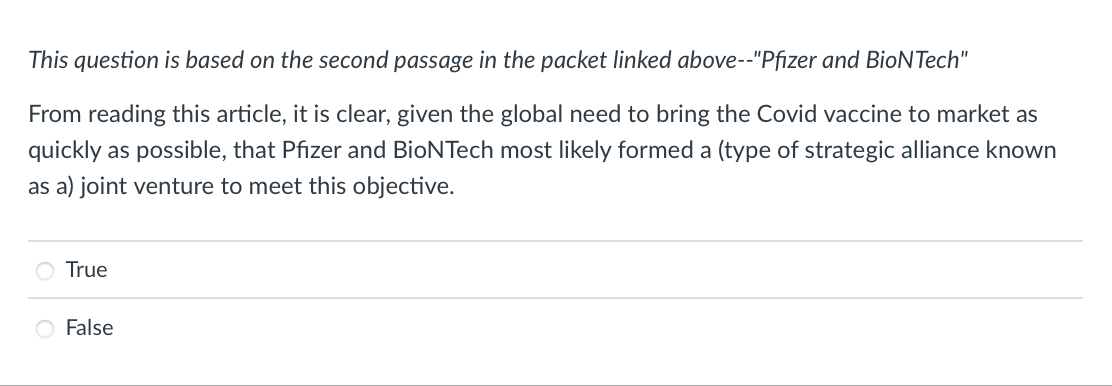
Question: Pfizer and BioNTech (This article is from 2021) Pfizer Inc. aims to expand its vaccine business by becoming a leader in the new gene-based technology
Pfizer and BioNTech (This article is from 2021) Pfizer Inc. aims to expand its vaccine business by becoming a leader in the new gene-based technology behind its successful Covid-19 shots. Pfizer will develop new shots using the technology, called mRNA, to target other viruses and pathogens beyond the coronavirus, Chief Executive Albert Bourla said in an interview. He said the companys scientists and engineers gained a decades worth of experience in the past year working on the Covid-19 vaccine with Germanys BioNTech, and is ready to pursue mRNA on its own. There is a technology that has proven dramatic impact and dramatic potential, Mr. Bourla said. We are the best positioned company right now to take it to the next step because of our size and our expertise. Pfizer will increase R&D in the technology, including adding at least 50 employees whose assignments will include mRNA, and it will harness the new mRNA manufacturing network it assembled in the past year to compete. Pfizers vaccine business already includes one of the worlds top-selling shots, pneumococcal vaccine Prevnar 13, which last year had almost $6 billion in sales. A next- generation pneumonia shot is under review by regulators with a decision expected this summer, and the company has other vaccines in the works. More vaccines could reduce Pfizers reliance for growth on its cancer drugs, which now make up about one-quarter of sales and a third of the New York-based companys overall product pipeline. Pfizer also has shots in the works using older vaccine technologies. One that aims to prevent a certain type of colon infection is in late-stage testing, as is one for preventing respiratory syncytial virus in infants by vaccinating the expectant mother. It is also developing a vaccine with French biotech Valneva SE for Lyme disease and has plans to form alliances with several other biotech companies working in the same area. Success in vaccines is challenging because they usually take more than a decade to develop, with many failing during testing. Moreover, mRNA technology is unproven beyond Covid-19, and competitors such as Cambridge, Mass.-based Moderna Inc. have more experience with it.
Pfizers first foray into the technology came in 2018 when it partnered with BioNTech to make an influenza vaccine based on the German firms mRNA platform. The partnership led to the companies Covid-19 collaboration a year ago, following on BioNTechs initial work on the vaccine. Pfizer came on board to accelerate development, manufacturing and distribution. The two companies will continue to collaborate on Covid-19 shots. But now after completing crucial steps such as designing and conducting clinical trials and securing specialized raw materials for manufacturing, Pfizer is confident it can do mRNA vaccines alone, Mr. Bourla said. Mr. Bourla said the high-stakes bet to pursue a Covid-19 vaccineand to do so without government funding validates his decision for Pfizer to rely on its own pipeline for growth. Pfizer has increased R&D spending by 21% since Mr. Bourla took the helm in early 2019. Key to making mRNA vaccines is sufficient manufacturing capacity, and Pfizer built a custom production network. Making mRNA vaccines requires special equipment and raw materials that werent widely available prior to the pandemic. Pfizer scientists learned how to produce key ingredients for the shot that they once relied on suppliers to obtain. Another reason for committing to mRNA, Mr. Bourla said, is that Pfizer anticipates producing the Covid-19 shots for at least several years on the expectation that booster shots will be needed annually or every few years to maintain protection. Pfizer, which is splitting Covid-19 vaccine profit evenly with BioNTech, has said it expects roughly $15 billion in sales from the vaccine this year. Mr. Bourla hopes Pfizer can develop future vaccines in less than a year, mirroring the progress of the Covid-19 vaccine, but said that would be tough without the unorthodox development steps taken during the pandemic, or regulators changing how they work.
Step by Step Solution
There are 3 Steps involved in it

Get step-by-step solutions from verified subject matter experts
 Study Help