







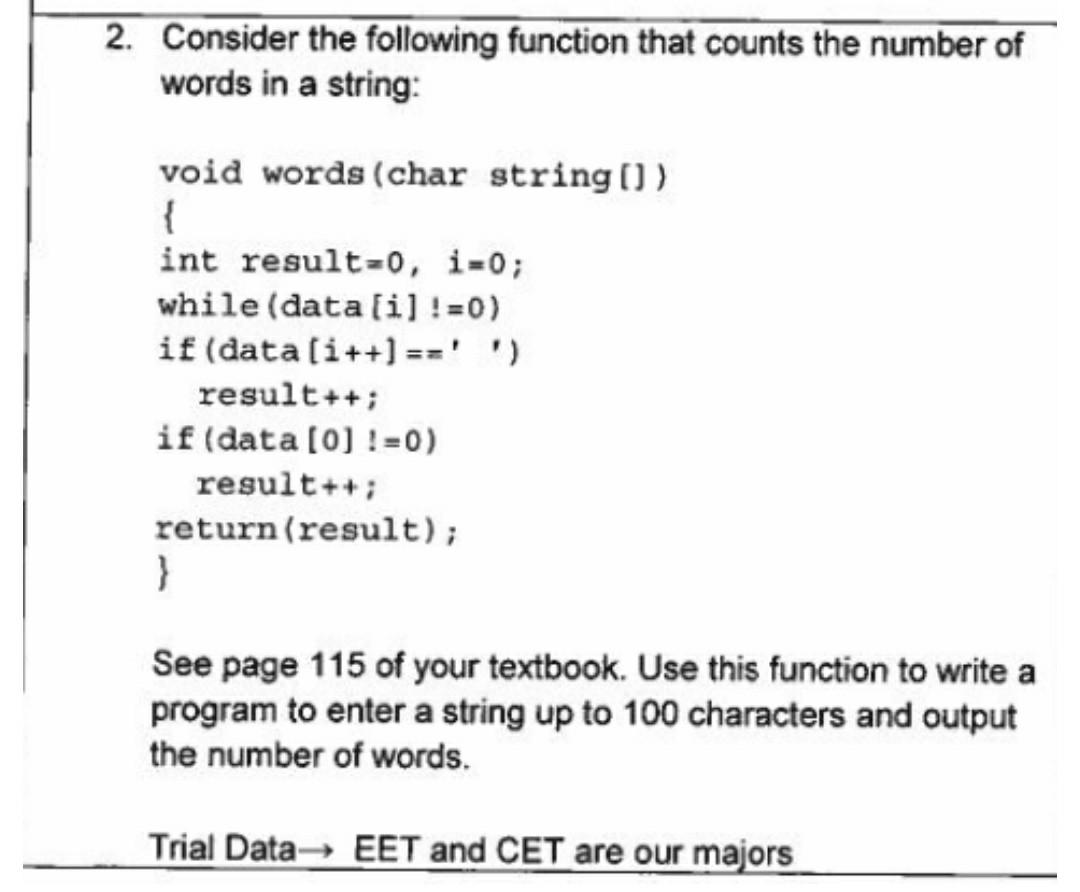
Question: pg115 in book 2. Consider the following function that counts the number of words in a string: void words (char string[]) { int result=0, i=0;
pg115 in book
![number of words in a string: void words (char string[]) \{ int](https://s3.amazonaws.com/si.experts.images/answers/2024/08/66cf265a1909e_80166cf265971df4.jpg)
![result=0, i=0; while (data[i] !=0 ) if (data [i++]==, ) result++; if](https://s3.amazonaws.com/si.experts.images/answers/2024/08/66cf2661ba9eb_80366cf265b799b8.jpg)
2. Consider the following function that counts the number of words in a string: void words (char string[]) \{ int result=0, i=0; while (data[i] !=0 ) if (data [i++]==, ) result++; if ( data [0]!=0) result++; return (result); \} See page 115 of your textbook. Use this function to write a program to enter a string up to 100 characters and output the number of words. Trial Data EET and CET are our majors Arrays 115 The above only works if the array element is a byte. A more general call that will work for any type looks like this: vectorAdd(A,B,sizeof(A)/sizeof(a[0])); In computer programs, it is a common practice to sum up a series of numbers to create a checksum. This checksum can then be kept with the list of numbers and later tested to ensure a number did not change. This might be used for a data transmission or if data is stored on some device. The following is an example function to calculate a checksum: int checksum( int data[], int count) int result=0; for ( int i=0;i
Step by Step Solution
There are 3 Steps involved in it

Get step-by-step solutions from verified subject matter experts
 Study Help