







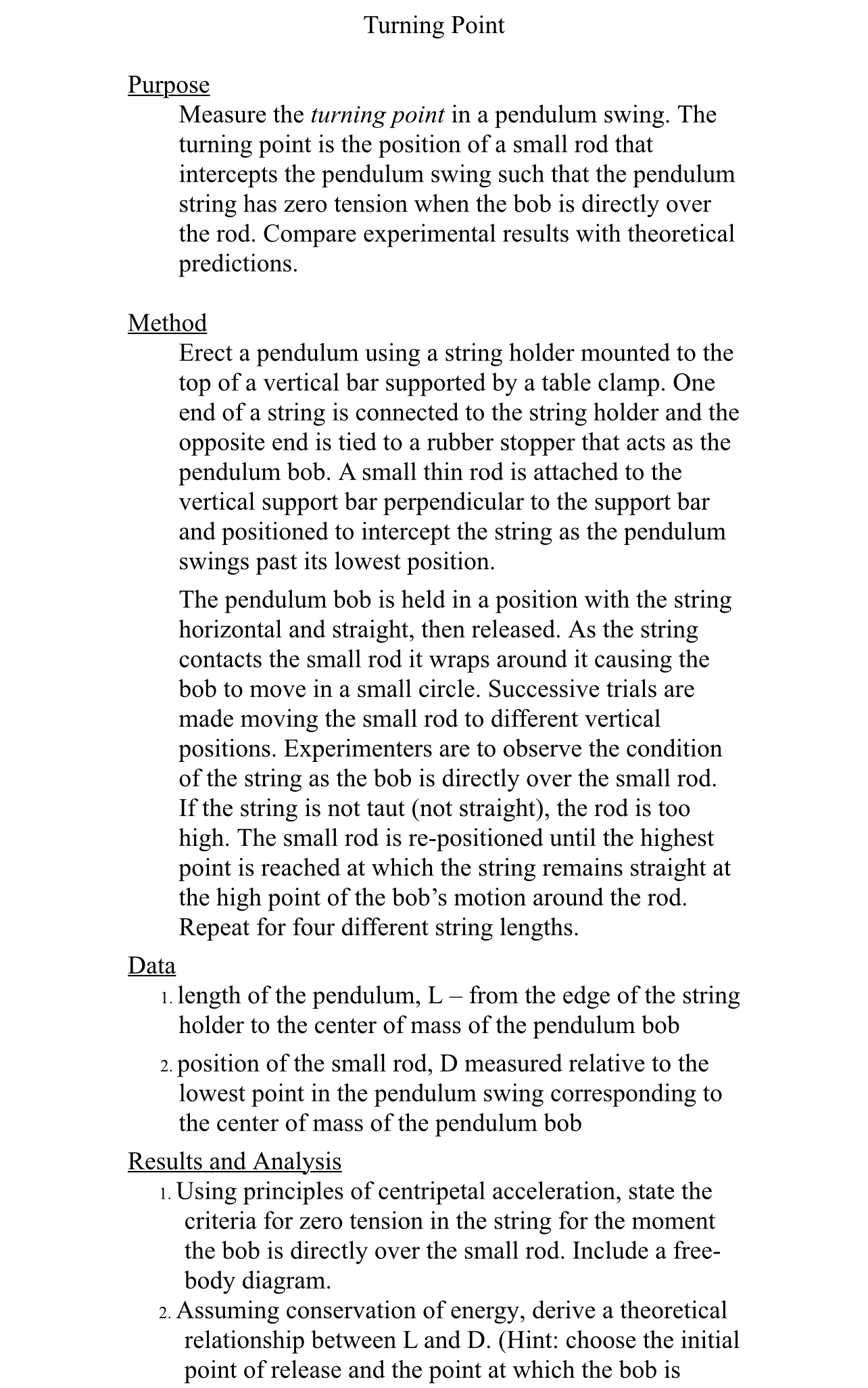
Question: Phy 2 0 4 8 L lab turning point Purpose Measure the turning point in a pendulum swing. The turning point is the position of
Phy L lab turning point
Purpose
Measure the turning point in a pendulum swing. The turning point is the position of a small rod that intercepts the pendulum swing such that the pendulum string has zero tension when the bob is directly over the rod. Compare experimental results with theoretical predictions.
Method
Erect a pendulum using a string holder mounted to the top of a vertical bar supported by a table clamp. One end of a string is connected to the string holder and the opposite end is tied to a rubber stopper that acts as the pendulum bob. A small thin rod is attached to the vertical support bar perpendicular to the support bar and positioned to intercept the string as the pendulum swings past its lowest position.
The pendulum bob is held in a position with the string horizontal and straight, then released. As the string contacts the small rod it wraps around it causing the bob to move in a small circle. Successive trials are made moving the small rod to different vertical positions. Experimenters are to observe the condition of the string as the bob is directly over the small rod. If the string is not taut not straight the rod is too high. The small rod is repositioned until the highest point is reached at which the string remains straight at the high point of the bob's motion around the rod. Repeat for four different string lengths.
Data
length of the pendulum, L from the edge of the string holder to the center of mass of the pendulum bob
position of the small rod, D measured relative to the lowest point in the pendulum swing corresponding to the center of mass of the pendulum bob.
Assuming conservation of energy, derive a theoretical relationship between L and DHint: choose the initial point of release and the point at which the bob is directly over the small rod
Step by Step Solution
There are 3 Steps involved in it
1 Expert Approved Answer
Step: 1 Unlock

Question Has Been Solved by an Expert!
Get step-by-step solutions from verified subject matter experts
Step: 2 Unlock
Step: 3 Unlock
 Study Help