







Question: PHY-22l: Physics ISpring 2023 Lab #SVector Addition Overview This lab is intended to introduce vector addition by the component method and uses an online simulation
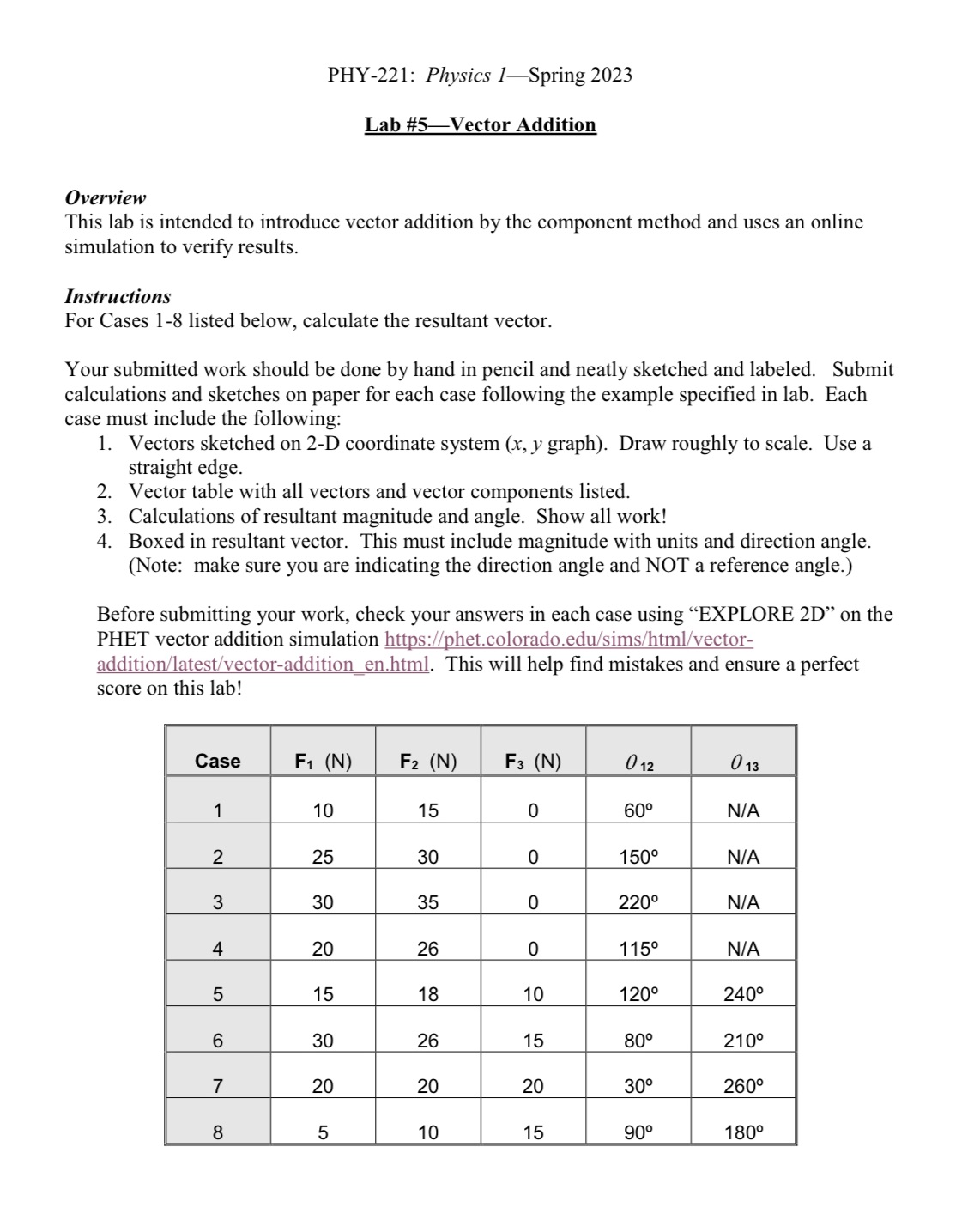
PHY-22l: Physics ISpring 2023 Lab #SVector Addition Overview This lab is intended to introduce vector addition by the component method and uses an online simulation to verify results. Instructions For Cases 1-8 listed below, calculate the resultant vector. Your submitted work should be done by hand in pencil and neatly sketched and labeled. Submit calculations and sketches on paper for each case following the example Specified in lab. Each case must include the following: 1. Vectors sketched on 2-D coordinate system (I, y graph). Draw roughly to scale. Use a straight edge. 2. Vector table with all vectors and vector components listed. 3. Calculations of resultant magnitude and angle. Show all work! 4. Boxed in resultant vector. This must include magnitude with units and direction angle. (Note: make sure you are indicating the direction angle and NOT a reference angle.) Before submitting your work, check your answers in each case using \"EXPLORE 2D\" on the PHET vector addition simulation https:..-'Ephet.colorado.edu.-"simsf'html.-"\\-'ector addition-"latest.="\\-'ectoraddition_en.html. This will help nd mistakes and ensure a Perfect score on this lab! Case F1 (N) F2 (N) Fa(N) _ 1 1o 15 0 60 NIA
Step by Step Solution
There are 3 Steps involved in it

Get step-by-step solutions from verified subject matter experts
 Study Help